
Process Intelligence and Workflow Orchestration for the Enterprise
Process intelligence combines process mining, workflow orchestration and a decision gate into one enterprise architecture that shows how work actually runs, coordinates what happens next, and keeps automation and AI agents inside auditable boundaries. This page collects my work on process intelligence and workflow orchestration: the independent landscape, the architecture guides, unified orchestration by industry, and how processes connect to data integration and trusted agentic AI.
From business process management to process intelligence
Business process management has existed as a discipline for decades, built on process models designed before the process ran. Process intelligence shifts the focus to runtime reality. The analyst market reflects the change. Gartner replaced its Magic Quadrant for Process Mining with a Magic Quadrant for Process Intelligence Platforms in May 2026, scoped to mining, task mining, modeling and monitoring. Forrester covers the orchestration side separately as adaptive process orchestration. I anchor both under process intelligence, because an enterprise needs all three jobs in one architecture.
- Process mining observes how processes actually run, based on event logs from ERP, CRM and other systems. It surfaces bottlenecks, rework loops and the variants that quietly bypass controls.
- Workflow orchestration coordinates what happens next across systems, people and AI agents, with state, retries, approvals and recovery.
- The decision gate enforces what each participant, human or AI, may do. What passes the rules proceeds, and what does not is escalated or rejected with a documented reason.
The three jobs feed each other. Mining finds the bottleneck, for example manual approvals that queue simple cases behind difficult ones. Orchestration routes each case to the right path, the gate decides which cases may run automatically, and every decision becomes a new event log that mining reads in the next cycle.
Unified orchestration across data, infrastructure, applications and business processes
Unified orchestration means one control plane for data pipelines, infrastructure automation, applications and business processes, with AI agents governed as steps across all four. Most enterprises run a separate orchestrator per team today, from job schedulers and data pipeline tools to BPM engines and infrastructure automation. Each one works inside its own silo, and the processes that cross silos run on scripts, tickets and manual handoffs. A shared control plane gives those cross-silo processes one place for dependencies, approvals, audit and recovery.
Workflow orchestration sits above data integration and complements it. Event streaming with Apache Kafka and APIs move data in milliseconds, and a Kafka event can trigger a workflow that runs for seconds, hours or days, waits for a human approval, and calls an AI agent as one governed step. Hard real-time control stays in PLCs and stream processing, while orchestration handles the long-running coordination around it. Together with data integration and trusted agentic AI, process intelligence forms what I call the Trinity of modern data architecture.
This is how the topics on this site fit together. The Process Intelligence Landscape covers mining and orchestration vendors. The data integration page covers the data underneath, the trusted agentic AI page covers the agents that act inside governed processes, and the industrial IoT page covers orchestration from the plant floor to the enterprise.
The Process Intelligence Landscape
The map below places process orchestration and process mining vendors in two bands, from platform-native to agnostic, with bubble size for market reach and darker fill for stronger agentic AI capability.
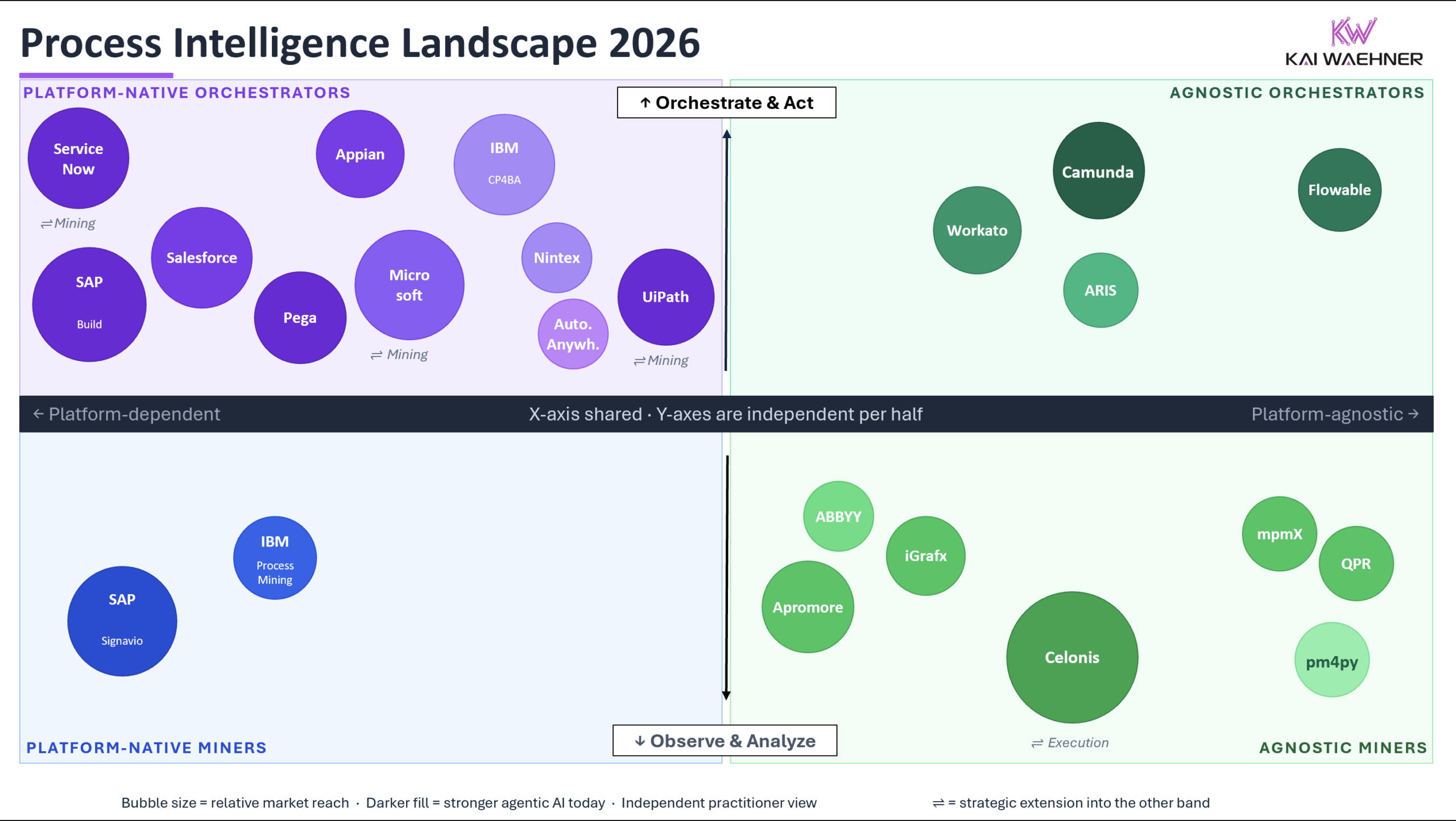
The Process Intelligence Landscape 2026 maps process orchestration and process mining vendors from BPM suites and enterprise application platforms to agnostic open source engines and independent miners. It covers the move from BPM to process intelligence, open standards on both sides, event-driven architecture, the orchestration stack, key trends, and a decision framework with six questions. It is an independent practitioner perspective. No vendor pays to appear. Download the PDF or read the announcement post.
Guides to start with process intelligence
- Process Intelligence Explained: Mining, Orchestration, and the Decision Gate. Defines the three jobs and walks through a credit application across all of them.
- The Trinity of Modern Data Architecture: Process Intelligence, Event-Driven Integration, and Trusted Agentic AI. Explains why the three layers only deliver value together.
- Agentic Technical Debt and Where Orchestration Belongs in AI Agent Architecture. Shows where coordination logic belongs once agents move into production.
- Jev by TypeSafe AI in Workflow Orchestration and Process Intelligence. Turns a calibrated probability into a confidence gate inside a workflow.
Workflow orchestration and event-driven processes
Workflow orchestration coordinates long-running processes on top of the data layer. These posts cover how orchestration relates to data streaming, BPM engines and durable execution, and how existing jobs move to an orchestration platform.
- Enterprise Workflow Orchestration for the Agentic AI Era. Explains why scheduling, data pipelines, business processes and infrastructure automation converge on one platform.
- Event-Driven Workflow Orchestration on Apache Kafka with Kestra. Shows how Kafka topics trigger governed workflows and where stream processing remains the better choice.
- The Rise of the Durable Execution Engine (Temporal, Restate) in an Event-Driven Architecture. Compares durable execution with BPM engines and stream processing.
- Apache Kafka as Workflow and Orchestration Engine. Explores where data streaming handles stateful workflows and where a dedicated engine fits better.
- From Cron Batch Jobs to Kestra: Migrating a Python Script Without a Rewrite. Walks through moving an existing batch job into orchestration without rewriting it.
Unified orchestration by industry
Every industry runs the same four silos with its own systems, regulations and failure costs. These posts map unified orchestration to specific industries.
- Unified Orchestration in Financial Services: One Control Plane Across the Bank
- Unified Orchestration in Manufacturing: From Shop Floor to Cloud
- Unified Orchestration in Telecom: One Control Plane Across OSS, BSS, and IT
- Why Physical AI Value Depends on Data Streaming and Workflow Orchestration
Looking for more? All posts tagged Process Intelligence list every article on the topic.
Work with me on process intelligence and workflow orchestration
I advise enterprises, system integrators and investors on process intelligence and workflow orchestration, including the combination of process mining, orchestration and decision gates, the consolidation of schedulers, data pipeline tools, BPM engines and infrastructure automation, event-driven orchestration on top of data streaming, and the governance of AI agents inside business processes. Alongside the advisory practice, I serve as Global Field CTO at Kestra. The advisory work stays vendor-neutral and is grounded in two decades of enterprise architecture across more than a dozen industries, starting with BPM and integration projects long before orchestration became its own category. Work with me describes the formats, from architecture reviews to workshops and keynotes.