
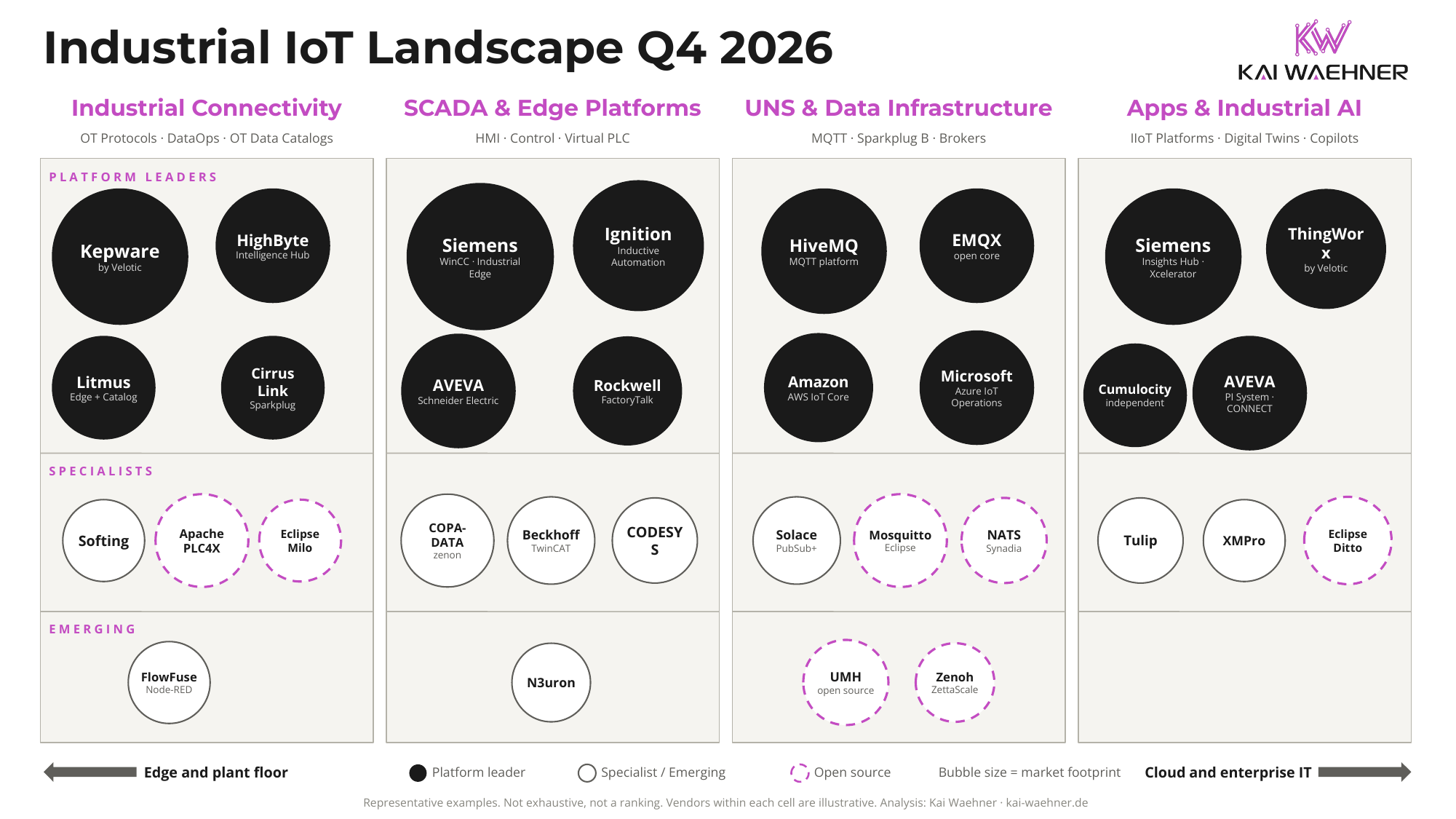
The Industrial IoT Landscape Q4 2026 maps the market in four categories from edge to cloud: industrial connectivity, SCADA and edge platforms, the Unified Namespace and data infrastructure, and applications and industrial AI. It covers the open standards that decide who stays replaceable, the IT/OT boundary, five trends from virtual PLCs to agentic AI on the plant floor, and a decision framework for choosing the stack. It is an independent practitioner perspective. No vendor pays to appear. Download the PDF or read the announcement post for a summary of the findings.

Industrial IoT case studies from Siemens and Volkswagen’s CARIAD
Public case studies from my time at Confluent show the architecture at work, on the plant floor and across a connected vehicle fleet.
Siemens connects intralogistics, machines and medical devices
At Siemens Digital Industries, the Modular Intralogistics Platform connects ERP, manufacturing operations, warehouse execution and AGV control through event streams and reusable data products. Siemens Healthineers streams telemetry from medical devices and connects machines, KUKA robots and SAP across manufacturing and logistics. Read the Siemens Digital Industries case study Read the Siemens Healthineers case study
CARIAD connects the Volkswagen Group’s vehicle fleet
The software company of the Volkswagen Group built one event-driven platform for vehicle data before and after production, across more than 45 million connected cars. Use cases include predictive maintenance, remote diagnosis, battery analytics and EU Data Act compliance. Read the Volkswagen CARIAD case studyGuides to start with industrial IoT architecture
- OPC UA, MQTT, and Apache Kafka: The Trinity of Data Streaming in Industrial IoT. Explains the three standards, what each is good at, and how they combine from the machine to the enterprise.
- Unified Namespace vs. Data Product in IT/OT for Industrial IoT. Shows how the UNS structures live plant data, how data products govern it on the IT side, and where the two meet.
- Edge to Cloud and Back: Four Data Movement Problems, and Why One Technology Never Solves All of Them. Separates northbound telemetry, southbound control, site-to-site traffic and outbound delivery, and names the technology that fits each of the four.
- When to Use AMQP, JMS, Kafka, or MQTT: Trade-offs, Not a Winner. Compares the four messaging protocols, with MQTT as the edge and device fan-in layer and Kafka or AMQP in the core.
- Modernizing OT Middleware: The Shift to Open Industrial IoT Architectures with Data Streaming. Describes why proprietary OT middleware gives way to open standards and streaming, and how to migrate.
More guides on MQTT, OT middleware, orchestration and physical AI
- Industrial IoT Middleware for Edge and Cloud OT/IT Bridge powered by Apache Kafka and Flink. Lays out the middleware layer that bridges OT and IT at the edge and in the cloud.
- MQTT Market Trends: Cloud, Unified Namespace, Sparkplug, Kafka Integration. Reviews where the MQTT market moved, from managed brokers and the UNS to Sparkplug and the Kafka integration.
- Condition Monitoring and Predictive Maintenance with Apache Kafka. Walks through the classic industrial IoT use case from sensor data to digital twin.
- Unified Orchestration in Manufacturing: From Shop Floor to Cloud. Shows how one control plane coordinates processes from plant events to ERP, suppliers and cloud.
- Why Physical AI Value Depends on Data Streaming and Workflow Orchestration. Argues that robots and autonomous machines need both a real-time data backbone and governed coordination to deliver value.
- Complex Event Processing (CEP) with Apache Flink: What It Is and When (Not) to Use It. Explains how to detect multi-sensor failure patterns over time, with a manufacturing predictive maintenance example.
Industrial IoT by industry
The architecture is the same across industries, but the data, the regulation and the business case differ. These posts show what industrial IoT looks like in practice.Manufacturing
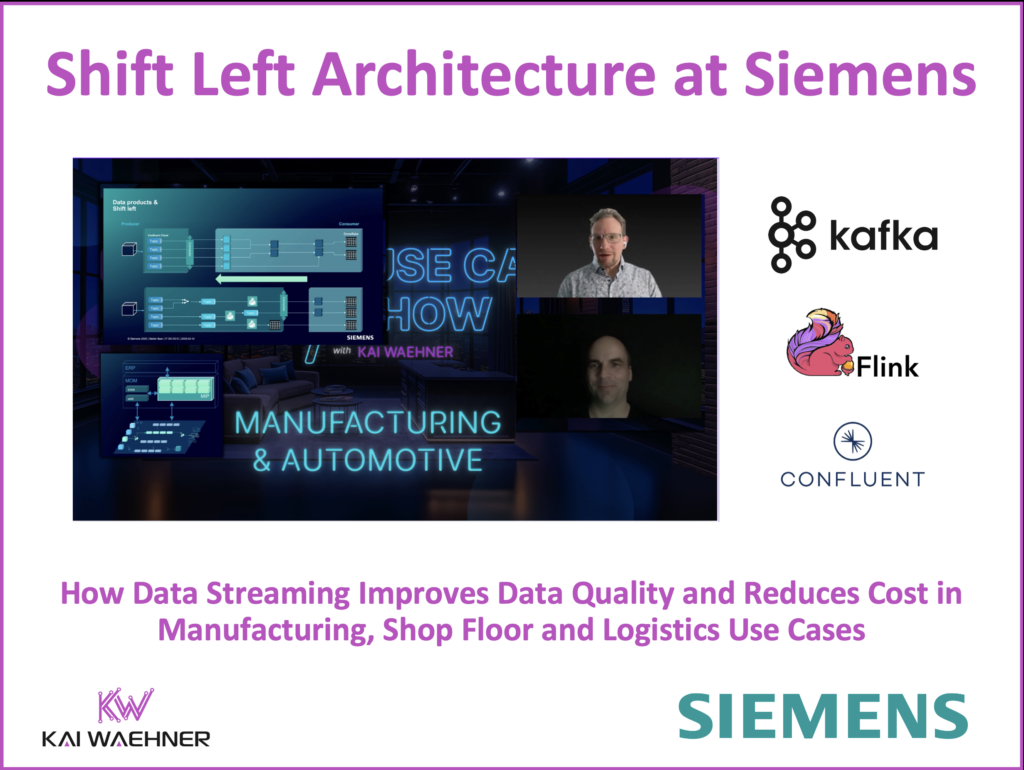
- Shift Left Architecture at Siemens: Real-Time Innovation in Manufacturing and Logistics with Data Streaming
- Apache Kafka Landscape for Automotive and Manufacturing
- Apache Kafka in Manufacturing at Automotive Supplier Brose for Industrial IoT Use Cases
- Choosing an ERP for Manufacturing: How AI Is Reshaping the Vendor Landscape
- ERP Migration to SAP S/4HANA and Beyond: Lessons Learned from German Manufacturing
Automotive and connected vehicles
- Real-World Deployments of Kafka in the Automotive Industry
- Streaming the Automotive Future: Real-Time Infrastructure for Vehicle Data
- Driving the Future: How Real-Time Data Streaming Is Powering Automotive Innovation
- CARIAD’s Unified Data Platform: A Data Streaming Automotive Success Story Behind Volkswagen’s Software-Defined Vehicles
Energy and utilities
- The State of Data Streaming for Energy & Utilities
- Tesla Energy Platform: The Power of Data Streaming with Apache Kafka
- Virta’s Electric Vehicle (EV) Charging Platform with Real-Time Data Streaming
- Energy Trading on Real-Time IoT Data from Smart Meters, Sensors and Solar Plants
Transportation, logistics and aviation
- IoT and Data Streaming with Kafka for a Tolling Traffic System with Dynamic Pricing
- The Digitalization of Airport and Airlines with IoT and Data Streaming using Kafka and Flink
- From Takeoff to Touchdown: Real-Time Aviation with Data Streaming at Qantas
- How Penske Logistics Transforms Fleet Intelligence with Data Streaming and AI
- Real-Time Logistics, Shipping, and Transportation with Apache Kafka
Looking for more? All posts tagged Industrial IoT lists every article on the topic.
Talks and videos on industrial IoT
I have spoken about industrial IoT at conferences for more than a decade, from MQTT Summit and ApacheCon to Kafka Summit. Selected talks are below, and the rest are listed on the activities page.- MQTT and Apache Kafka: A Match Made in Heaven (MQTT Summit, Munich, 2023)
- Use Cases and Architectures for Data Streaming in Manufacturing and Industry 4.0 (ApacheCon, New Orleans, 2022)
- IoT at Scale: Best Practices to Integrate Millions of Cars with MQTT and Kafka (Kafka Summit, London, 2020)
- Processing Industrial IoT (IIOT) Data from End to End with Apache Kafka (Codemotion, Amsterdam, 2020)
- Processing IoT Data from End to End with MQTT and Apache Kafka (Kafka Summit, San Francisco, 2018)