
Enterprise Architecture for Data, Processes and AI
Enterprise architecture decides how data, processes, applications and AI fit together across an organization, so that technology choices serve business goals and the architecture stays changeable as markets and vendors move. This page connects my work across all topics on this site: the Trinity of modern data architecture, the architecture patterns I recommend most often, and the independent landscapes that support vendor decisions in each layer.
The Trinity of modern data architecture
The Trinity of modern data architecture combines event-driven data integration, process intelligence and trusted agentic AI into three layers that only deliver value together. Data integration provides current, governed data. Process intelligence shows how the organization actually runs and coordinates what happens next through workflow orchestration. Trusted agentic AI acts on both, inside governed processes. Agentic AI without governed processes acts fast and without control. Data integration without process intelligence moves data and leaves decisions to chance. Process intelligence without live data automates outdated assumptions.
Each layer has its own page on this site. The data integration page covers event streaming, APIs, batch and legacy integration. The process intelligence page covers process mining, workflow orchestration and the decision gate, including unified orchestration across data, infrastructure, applications and business processes. The trusted agentic AI page covers AI vendor selection, sovereignty and lock-in, and the industrial IoT page applies all three layers from the plant floor to the enterprise.
Architecture patterns that keep the enterprise changeable
A few patterns come up in almost every architecture review I do, across industries and regardless of vendor.
- Kappa architecture treats event streams as the primary source of truth, so real-time, near-real-time and batch consumers read the same data instead of separate pipelines.
- Shift Left Architecture moves data processing and quality checks into the streaming layer, where data products are built once and served through operational, analytical and AI interfaces.
- Strangler Fig migration replaces legacy systems step by step while data streaming keeps old and new in sync, which avoids risky big-bang cutovers.
- Platform-independent governance keeps lineage, ownership and data quality in a catalog layer above all platforms, so a platform change never becomes a governance migration.
- Own the context, rent the model keeps conversation state, agent memory and business context in stores the enterprise controls, so AI models stay replaceable.
Independent landscapes as a decision tool
Read together, my landscapes follow the layers of an enterprise architecture. The Industrial IoT Landscape covers the edge and the plant floor. The Data Streaming Landscape covers data movement, and the Data Integration Landscape covers connection across all three integration paradigms. The Process Intelligence Landscape covers observation and coordination, and the Trusted Agentic AI Landscape covers action. No vendor pays to appear in them, and no vendor reviews them before publication.
The three layers of the Trinity
The figure below shows how process intelligence, data integration and trusted agentic AI depend on each other in one enterprise architecture.
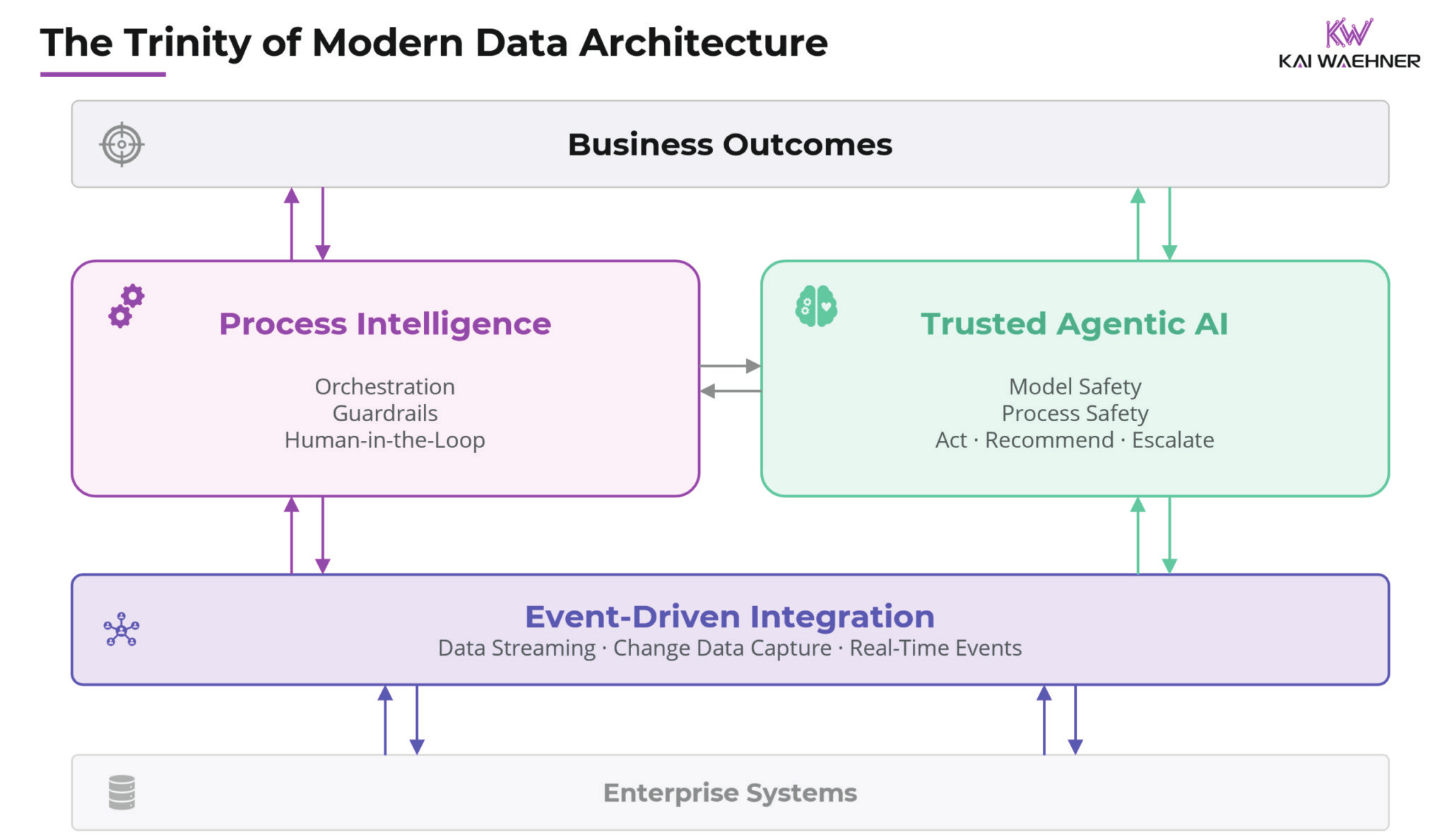
The Trinity post explains each layer, the failure mode when one layer is missing, and how the three combine in practice.
Guides to start with enterprise architecture
- The Shift Left Architecture 2.0: Operational, Analytical and AI Interfaces for Real-Time Data Products. Adds the AI interface and the real-time context engine to the original pattern.
- The Shift Left Architecture: From Batch and Lakehouse to Real-Time Data Products with Data Streaming. Introduces data products in the streaming layer as the answer to batch pipelines and Reverse ETL.
- Kappa Architecture Is Mainstream, Replacing Lambda. Shows how enterprises run real-time and batch workloads on one event-driven architecture.
- Replacing Legacy Systems One Step at a Time with Data Streaming: The Strangler Fig Approach. Explains gradual migration with old and new systems running in parallel.
- When to Use Reverse ETL and When It Is an Anti-Pattern. Explains why designing for data at rest and pushing it back out creates inconsistency and shadow IT.
- Beyond Enterprise Data Lineage: The Case for a Platform-Independent Data Catalog. Makes the case for governance above all platforms.
Architecture decisions for AI and agents
AI agents change what the architecture underneath has to deliver: current data, governed processes, standardized tool access and replaceable models.
- Agentic Technical Debt and Where Orchestration Belongs in AI Agent Architecture
- MCP vs. REST/HTTP API vs. Kafka: The Architect’s Guide to Agentic AI Integration
- How System One Models Like Jev Change Enterprise AI Architecture
- Data Ownership in the Age of Agentic AI: Why SAP’s API Policy Forces a Data Integration Reckoning
- Why Physical AI Value Depends on Data Streaming and Workflow Orchestration
Architecture decisions on platforms and categories
Many platform debates are category questions in disguise. These posts separate what each category is built for, before any vendor comparison starts.
- Why Databricks and Snowflake Speak the Kafka Protocol: Ingestion vs. Architecture
- Apache Kafka vs. Middleware (MQ, ETL, ESB): Friends, Enemies or Frenemies?
- Is Apache Kafka an iPaaS or Is Event Streaming Its Own Software Category?
- The Rise of the Durable Execution Engine (Temporal, Restate) in an Event-Driven Architecture
- Choosing an ERP for Manufacturing: How AI Is Reshaping the Vendor Landscape
Looking for more? All posts in the Enterprise Architecture category list every article on the topic.
Work with me on enterprise architecture
I advise CIOs, CTOs, enterprise architects and investors on architecture strategy across data integration, process intelligence and workflow orchestration, trusted agentic AI and industrial IoT, including architecture reviews, technology and vendor selection based on the landscapes, modernization roadmaps, and technical due diligence for private equity and venture capital. My career started in IT consulting with enterprise architecture management, integration and BPM, followed by roles at Talend, TIBCO and Confluent. Alongside the advisory practice, I serve as Global Field CTO at Kestra. The advisory work stays vendor-neutral and is grounded in two decades of enterprise architecture across more than a dozen industries. Work with me describes the formats, from architecture reviews to workshops and keynotes.