Process intelligence used to mean one thing to most people: a mining tool for process analysts. It is becoming the layer that decides how reliably an enterprise runs, governs, and automates its operations. The market is converging from both sides. Mining vendors are buying execution and orchestration, with Celonis launching its Context Model and acquiring Ikigai Labs. Orchestration vendors are adding analytics and agent control, and platform vendors are buying miners outright, with Salesforce folding Apromore into Agentforce. The two halves of the discipline, seeing what runs and governing what happens next, are collapsing toward each other.
What is process intelligence?
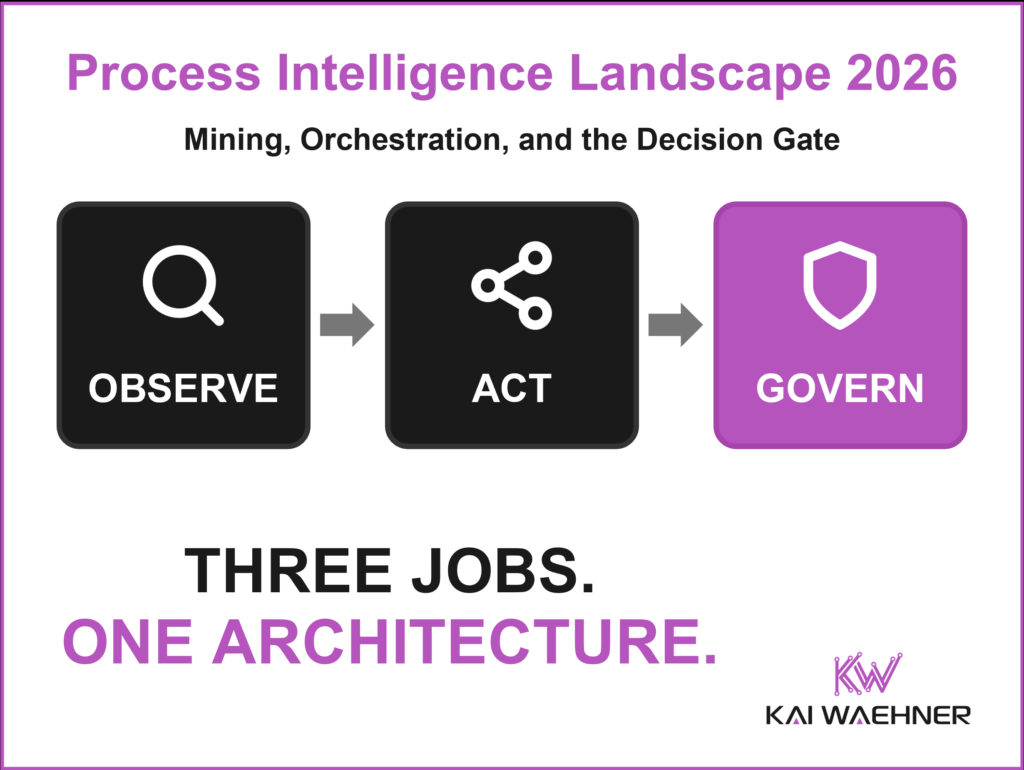
Process intelligence has three parts that work together:
- Mining reads the event logs that ERP, CRM, and ticketing systems already produce and reconstructs how work really runs, not how a diagram says it should.
- Orchestration governs what happens next, routing work across systems and people and enforcing the rules.
- The decision gate checks every automated action and AI recommendation against business rules, confidence thresholds, and constraints before it has consequences.
The discipline grew out of Business Process Management (BPM). BPM promised to fix processes and largely disappointed, modeling idealized diagrams that did not match reality on projects that took years. Process intelligence is what the discipline became once it started working from real execution data in near real time.
The most common mistake is treating process intelligence as one thing, usually a mining tool. It is three. Mining without orchestration sees problems but cannot fix them. Orchestration without mining automates a process nobody has verified. Neither one, without a decision gate, can tell an AI agent what it is allowed to do.
The payoff starts before AI
Most of the value lands before an agent enters the picture. Mining shows the gap between how a process was designed and how it actually runs, which is usually where the cost hides. It surfaces bottlenecks, rework loops, and the variants that quietly bypass controls. Orchestration then closes that gap, and the decision gate keeps it closed. The result is faster cycle times, lower operational cost, cleaner compliance evidence, and processes a team can actually trust. Every one of those holds whether or not an agent is involved.
Why does agentic AI raise the stakes?
Agentic AI does not change why process intelligence matters. It raises how much it matters, and how fast a mistake spreads. An agent takes actions and makes decisions with downstream consequences, which is what makes the process layer non-optional for any serious deployment.
AI agents need three things from it:
- Operational boundaries that define what an agent can decide on its own, what needs human approval, and what must always escalate.
- Live context, so the agent works on current operational reality rather than data that was already stale when it arrived.
- Audit trails that record every action, model decision, and human checkpoint in a way compliance can stand behind. The decision gate is where this is enforced. What passes the rules proceeds. What does not is escalated or rejected with a documented reason. Governance is the property you want. The decision gate is the mechanism that delivers it.
One step gets skipped often. Introducing agentic AI is not the same as embedding AI into an existing process. A process built for human execution is rarely the right foundation for an autonomous one. The step before automation is redesign, using mining evidence to understand what the process actually does, then rebuilding it for how agents work. Organizations that skip it automate their inefficiencies at machine speed.
Process intelligence splits into mining and orchestration
The landscape is easy to read as a four-quadrant chart where you pick one box. It is not. Process intelligence is at least two decisions, sometimes three. The bottom half of the chart is the mining decision. The top half is the orchestration decision. Most enterprises end up choosing at least one mining vendor and one or more orchestration vendors, because no single product covers both well across a multi-vendor environment.
Bubble size reflects relative market reach. Darker fill marks stronger agentic AI capability in production today, and the bridge marker (⇄) flags vendors extending into the other band as a strategic direction.
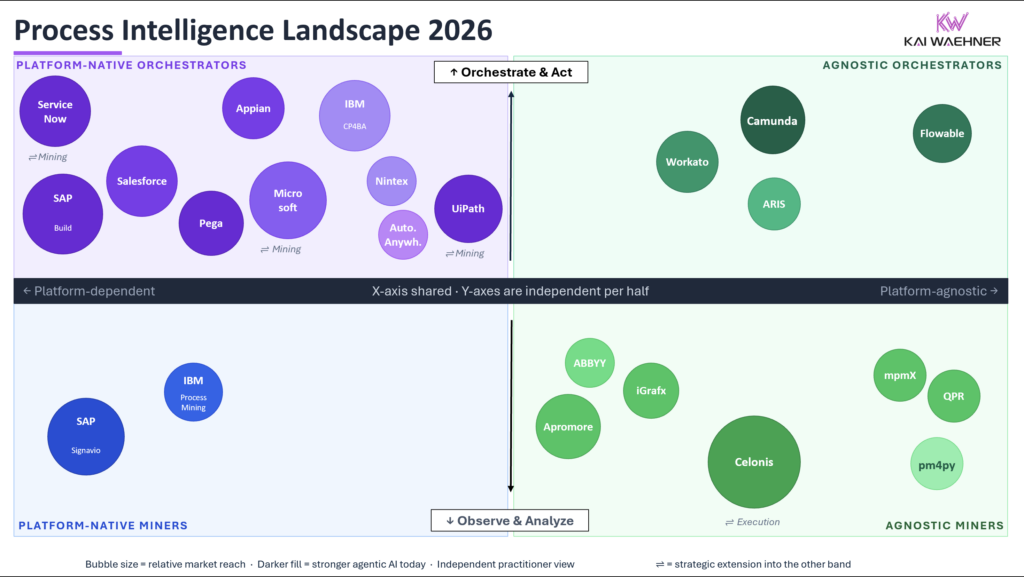
The word agnostic means something different in each half. In orchestration, it comes down to where the process logic lives, who owns it, and how open the engine is. BPMN makes the process model readable and auditable across tools, but engines are rarely drop-in compatible, so the model travels more easily than a running deployment. Real portability comes from owning your business logic in standard code, and from running an engine you can host and operate yourself, with an open or source-available core. Logic locked inside a vendor’s proprietary low-code environment offers none of that. In mining, agnostic is about data-source and commercial independence, whether a miner can connect to SAP, Salesforce, and ServiceNow at once while being licensed and governed independently from all of them.
There is a third choice too, and the landscape leaves it off the chart on purpose: the decision gate. It is a function, not a product category. It can live inside an orchestration engine as native DMN, run as a real-time context engine fed by event streaming, or sit in a third-party rules engine. The two bands map the decisions that line up with vendor categories, mining and orchestration, and the gate attaches to whichever route fits.
A split result is therefore normal and often correct. Many enterprises land on an agnostic miner and a platform-native orchestrator, or the reverse. It is not a contradiction. Buyers shop product by product. Architects design across the boundary.
The full landscape works through the market vendor by vendor: Process Intelligence Landscape.
Four choices that keep your options open
Four decisions matter more than the logo on the contract, because they decide how reversible your choice is later.
Open standards come first. They keep definitions portable and tools interchangeable: BPMN and DMN for orchestration, OCEL 2.0 and XES for mining, MCP and A2A for agent connectivity. Each solves a different problem. OCEL 2.0 is the portability standard for object-centric mining (OCPM), BPMN keeps a process model readable across tools, MCP standardizes how agents reach data. Watch one gap on the mining side. Object-centric process mining is a capability many vendors deliver on their own internal model. OCEL 2.0 is the standard that actually makes the data portable. So OCEL export is the lock-in check, not the OCPM label. A vendor that builds proprietary equivalents of these standards recreates the lock-in closed BPM platforms created a decade ago, one layer up.
Open source is the second, and it is not the same thing. A vendor can support every open standard and still be closed underneath. An open core, the engine or the library itself, is what makes leaving practical rather than theoretical, because you can host it, inspect it, and migrate or fork it if you have to. Open standards keep your data portable. Open source keeps the software itself within reach.
Data sovereignty is the third. Some platforms are SaaS-only and require operational data to leave your environment. Others run on-premises, or analyze data where it already lives inside your own data platform. Regulated industries have always weighed this. The trade and digital-sovereignty tensions between the US, China, and Europe have turned it into a board-level question for everyone else, because where operational data sits, and who can reach it, is no longer only a technical choice.
Consolidation is the fourth. Smaller specialists change hands, and an acquisition can bring price increases, roadmap shifts, forced migrations, and a loss of cross-vendor neutrality. Bigger is not automatically safer. A large suite vendor removes the acquisition risk and hands you its own lock-in instead. Apromore’s move into Salesforce shows how quickly an independent specialist can change hands.
The Trinity: where the three layers fit
Process intelligence does not stand alone. It is one of three layers that only work together. Event-driven data integration provides the current, governed data, mapped vendor by vendor in the Data Integration Landscape 2026. Process intelligence turns that into an understanding of how the organization runs and a grip on what happens next. Trusted agentic AI acts on both. None of the three delivers much without the other two. I call them together the Trinity of modern data architecture.
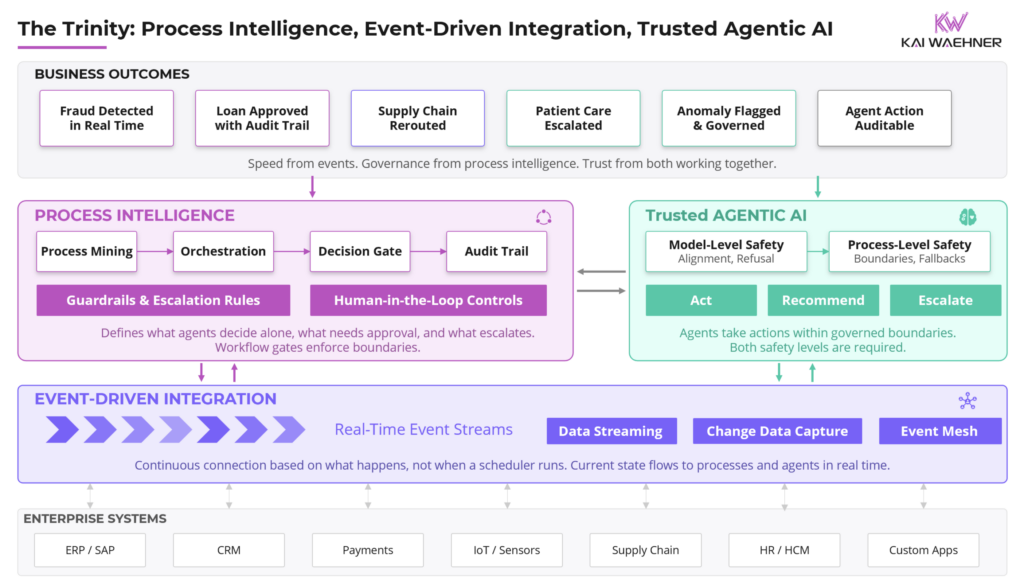
No single vendor leads all three layers, and that is less of a problem than it sounds. The convergence that matters is architectural, not commercial. The three layers have to work as one system. They do not have to carry one logo. Most enterprises are better served by a strong miner, a strong orchestrator, and a strong integration and agent layer than by buying all three from one suite. Best-of-breed keeps capability, pricing leverage, and exit options on your side, and open standards keep the seams between them manageable. Buying the whole stack from a single mega-vendor removes some integration work up front and replaces it with lock-in across all three layers at once.
For enterprises, the takeaway is that process intelligence selection, data integration, and agentic AI strategy are not three separate decisions. Each constrains the others, and the cost of treating them apart shows up in the first production incident.
The full vendor-by-vendor analysis is available as a free PDF with no registration. It works through the platform-native and agnostic options on both the mining and orchestration sides, shows where open standards and deployment model draw the real lines, and ends with six questions for narrowing the field to your own situation. Read the full the Process Intelligence Landscape.
If you are making a process intelligence decision, start with the enterprise architecture, not the vendor list. Decide what you need at the mining layer and the orchestration layer, confirm where the decision gate lives, and the shortlist gets much shorter.
About this landscape
This is an independent analyst perspective. No vendor paid for inclusion or placement. No vendor reviewed its section before publication. I run an advisory practice through Kai Waehner GmbH and have held roles at Talend, TIBCO, and Confluent. I also serve as Global Field CTO at Kestra, a workflow orchestration vendor. Kestra is referenced in the full report where pipeline orchestration meets the process intelligence stack, but it is not part of the landscape and was not evaluated or placed in any zone. The complete methodology note is in the full landscape.