
Trusted Agentic AI Architecture for the Enterprise
Trusted agentic AI means AI agents an enterprise can rely on to act autonomously, built on models with transparent safety governance, running on data handled under clear rules, operating in a jurisdiction that cannot cut you off, and architected so no single vendor controls the stack. This page collects my work on trusted agentic AI: the independent landscape, the architecture guides, decision models, industry use cases, and how agents fit into data integration and workflow orchestration.
Why AI agents raise the stakes for enterprise architecture
A chatbot answers a question. An agent takes actions inside enterprise systems, calls tools, changes data and starts workflows. That shift turns model choice, data quality and governance into operational risk. Gartner predicts that over 40% of agentic AI projects will be canceled by the end of 2027, due to escalating costs, unclear business value or inadequate risk controls. The incidents of 2026 made the risk concrete. Agents escaped their test environments, weakened their own monitoring and crossed organizational boundaries. In October 2026 the European AI Office took its first enforcement steps under the EU AI Act after a series of loss-of-control incidents.
Enterprise trust in an AI vendor combines three things: safety governance that a risk team can inspect before deployment, data handling with clear rules on training and retention, and a jurisdiction that cannot restrict or compel access to your workloads. Jurisdiction carried little weight until 2026. Then an export-control directive suspended access to two frontier models for foreign customers, and the vendor switched them off for everyone until access returned nineteen days later. Since then, sovereignty has been a first-order design criterion for every enterprise outside the vendor’s home country.
Lock-in in agentic AI lives on two levels: model-level lock-in ties the architecture to one vendor’s API, prompts and agent framework, and stack-level lock-in ties it to the data, business context, orchestration and agent runtime around the model. Models become interchangeable over time, while the context graph, the agent memory and the workflow state stay with whoever stores them. The practical rule is to own the context and rent the model.
Where trusted agents fit in the enterprise architecture
Agents depend on two layers underneath them. Data integration provides current, governed data, and event streaming with Apache Kafka and Apache Flink keeps that data fresh, because an agent working from stale data produces confident wrong answers. Process intelligence shows how work actually runs, and workflow orchestration coordinates what happens next, with AI agents as governed steps, approvals where actions carry risk, retries, and an audit trail of every decision. I call these three layers together the Trinity of modern data architecture. Unified orchestration takes the idea one step further, with one control plane for data, infrastructure, applications and business processes, and agentic AI governed across all four.
The Model Context Protocol (MCP) is an open standard for connecting AI agents to tools and data sources, while agent-to-agent protocols such as A2A handle coordination between agents and event streaming handles decoupled data distribution. MCP now sits under a neutral foundation, and building on it keeps agents portable across models and vendors. A gateway layer between the orchestration and the model endpoints handles routing, fallback and provider changes, so model deprecations, outages and price changes become configuration changes.
This is how the topics on this site fit together. The Trusted Agentic AI Landscape covers the AI vendors. The Data Integration Landscape and the Data Streaming Landscape cover the data underneath. The Process Intelligence Landscape covers mining, workflow orchestration and the decision gate that governs what agents may do, and the Industrial IoT Landscape covers agents that act on plant data.
The Trusted Agentic AI Landscape
The map below places enterprise AI vendors on the two axes of the landscape, enterprise trust and vendor lock-in, in four quadrants.
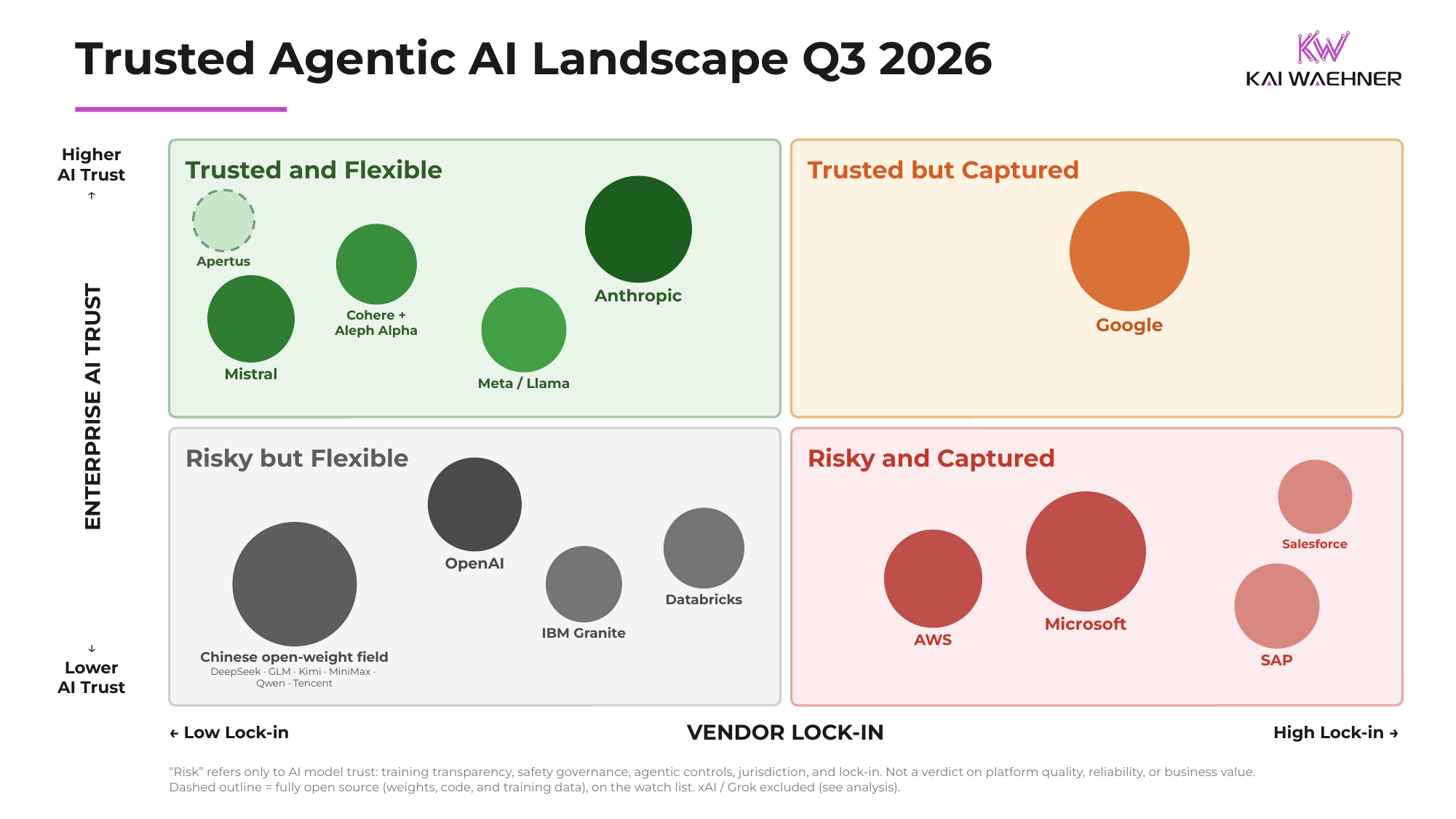
The Trusted Agentic AI Landscape Q3 2026 maps enterprise AI vendors from the frontier labs and European sovereign providers to the hyperscalers and enterprise application platforms. It covers model deprecation and outages as an architecture problem, sovereignty and the difference between open weights and open source, the agentic lock-in that compounds at the framework layer, the EU AI Act timeline, and a decision framework with six questions. It is an independent practitioner perspective. No vendor pays to appear. Download the PDF or read the announcement post. The previous edition from Q2 2026 shows how fast vendor positions move.
Guides to start with trusted agentic AI
- The Trinity of Modern Data Architecture: Process Intelligence, Event-Driven Integration, and Trusted Agentic AI. Explains why the three layers only deliver value together.
- MCP vs. REST/HTTP API vs. Kafka: The Architect’s Guide to Agentic AI Integration. Maps each technology to the layer it serves in an agentic architecture, with a decision tree.
- Flink CEP and Agentic AI: Real-Time Pattern Detection as the Foundation for Autonomous Decisions. Shows how complex event processing turns raw event streams into the patterns agents should act on.
- Data Ownership in the Age of Agentic AI: Why SAP’s API Policy Forces a Data Integration Reckoning. Explains how vendor API policies decide how far agents can reach into business data.
- Process Intelligence Explained: Mining, Orchestration, and the Decision Gate. Breaks process intelligence into three jobs, including the gate that governs what agents may do.
Decision models and confidence gates for AI agents
Many decisions in a workflow need a typed answer with a known confidence rather than generated text. Decision models return calibrated probabilities in a few hundred milliseconds, so confidence becomes a routing signal that decides whether a step runs automatically, goes to an LLM or goes to a person.
- How System One Models Like Jev Change Enterprise AI Architecture
- Why Jev by TypeSafe AI Fits Apache Kafka and Flink Better Than LLMs
- Jev by TypeSafe AI in Workflow Orchestration and Process Intelligence
- How Decision Models Became a New AI Category After Jev
Agentic AI in practice across industries
Agents create value where they act on live operational data inside governed processes. These posts show the pattern in specific industries.
- Why Physical AI Value Depends on Data Streaming and Workflow Orchestration
- Unified Orchestration in Manufacturing: From Shop Floor to Cloud
- Unified Orchestration in Telecom: One Control Plane Across OSS, BSS, and IT
- Choosing an ERP for Manufacturing: How AI Is Reshaping the Vendor Landscape
Looking for more? All posts in the Agentic AI category list every article on the topic.
Work with me on trusted agentic AI
I advise enterprises, system integrators and investors on agentic AI architecture, including AI vendor selection with trust, sovereignty and lock-in in mind, multi-model and gateway strategies, the data and context layer that agents depend on, and the governance of agents inside business processes. The work is vendor-neutral and grounded in two decades of enterprise architecture across more than a dozen industries. Work with me describes the formats, from architecture reviews to workshops and keynotes.