The default assumption in manufacturing ERP conversations is that bigger means better. SAP at the top. Microsoft and Oracle close behind. Everyone else has a fallback if the budget will not stretch. The assumption is wrong often enough that it deserves to be examined directly, because the manufacturing ERP landscape is far broader than that short list suggests.
Consider three German manufacturers. A valve maker left a legacy ERP and chose a focused product for project manufacturing. The fit was specific: lot sizes between one and seven, deep product data management (PDM) integration, project costing as a core process. SAP would have been wrong for this profile. An office furniture producer chose a variant-management ERP for its high variant complexity, mixed metal and wood manufacturing, and lot-size-1 economics. SAP would have been wrong here too. A foundry group made the opposite choice and went with SAP S/4HANA. Foundry process complexity, multiple sites, and value from the broader SAP suite all justified it. The focused mid-market products would have been wrong here.
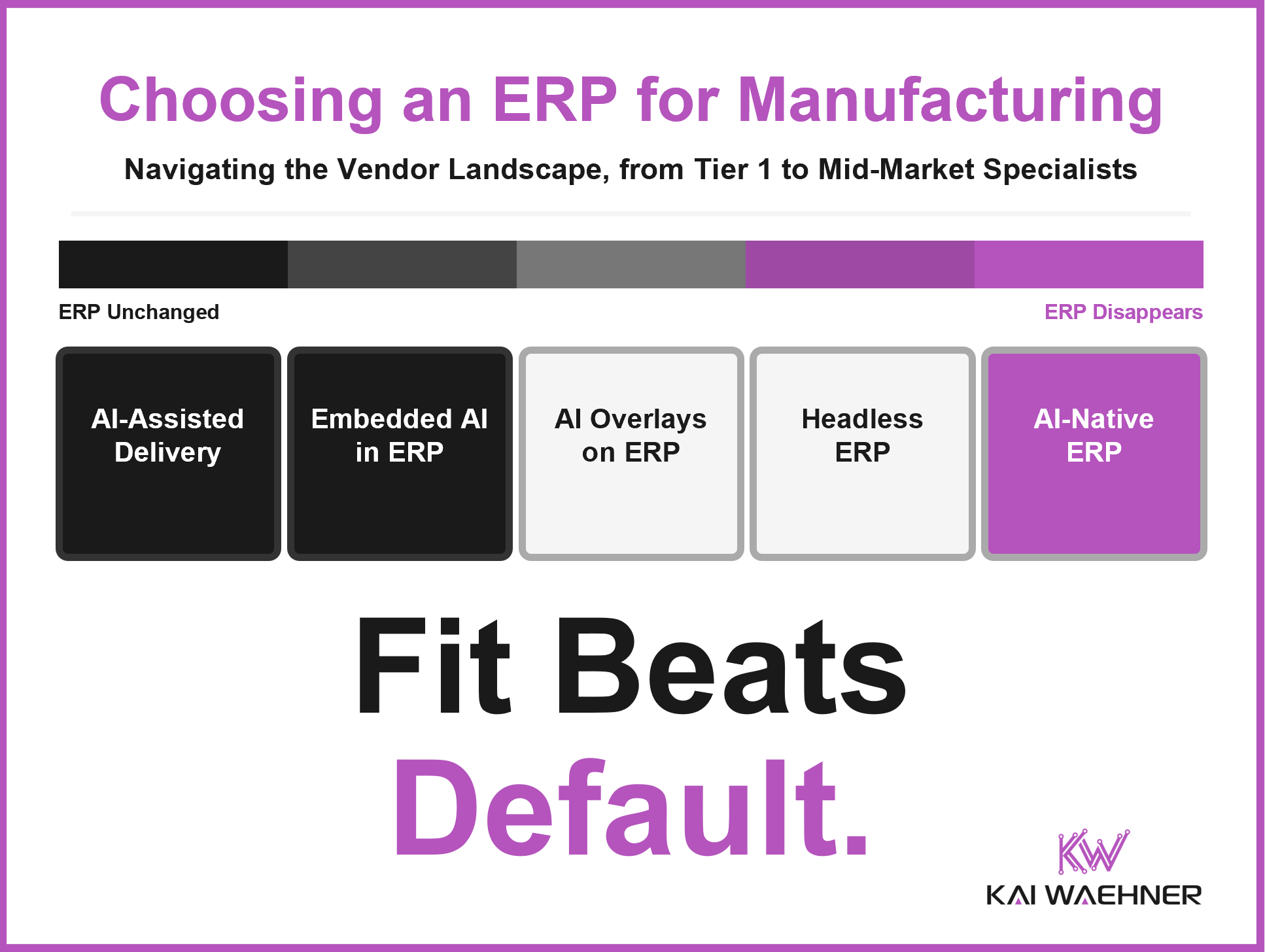
Three German manufacturers. Three different ERPs. Three correct choices. The lesson is not that one product wins. The lesson is that across the full vendor landscape, fit beats default.
The customer stories of Adams Armaturen, Reiss Büromöbel, and Fritz Winter Eisengießerei come from the German Digital Manufacturing 2/2026 issue from WIN-Verlag. This is one of my favorite magazines to learn about the tech evolution, market reality, and mapping to business value in the industrial space. The vendor discussion below is based on my own personal view, with public analyst references where they exist.
The Four Segments of the Manufacturing ERP Landscape
The manufacturing ERP market is broader than the Tier 1 vendor list suggests.
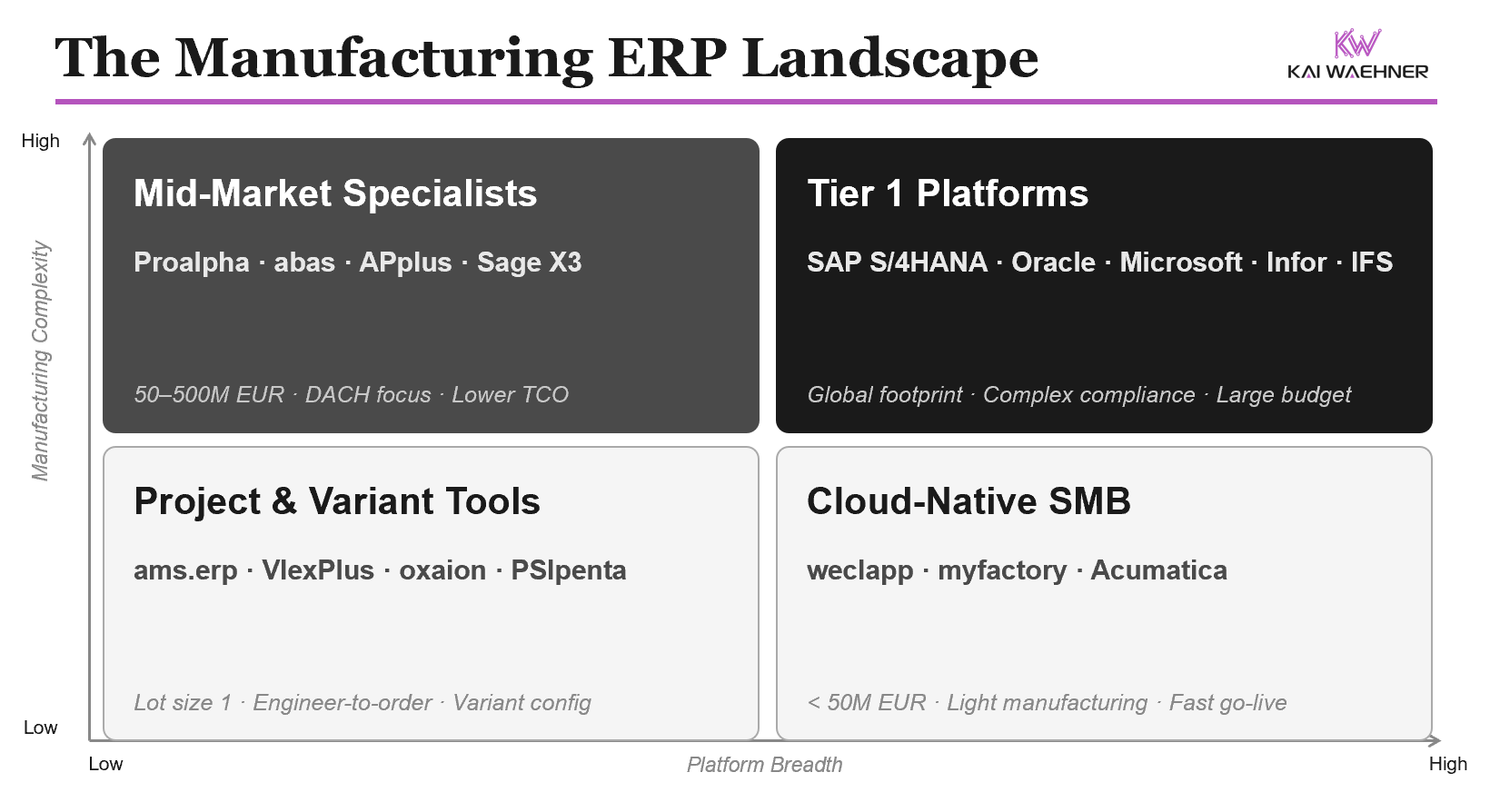
Four segments cover the full range from narrow specialist tools to broad global platforms. At the top, Tier 1 platforms like SAP S/4HANA and Microsoft Dynamics offer the widest functional coverage for large enterprises, while mid-market specialists like Proalpha and abas deliver strong manufacturing depth with lower total cost for the Mittelstand. At the bottom, focused tools like ams.erp and VlexPlus go deep on specific manufacturing profiles such as lot-size-1 and engineer-to-order, while cloud-native SMB products like weclapp keep things simple and fast to deploy for smaller operations with lighter manufacturing needs. The above landscape is far from complete. It shows a handful of vendors I have seen most often in the field, not a ranking or a market census.
A practical segmentation that matches what shows up in real selection projects:
Heavyweight Tier 1 Platforms
SAP S/4HANA, Oracle Fusion Cloud ERP, Microsoft Dynamics 365 Finance and Operations, Infor CloudSuite, IFS Cloud, and Epicor Kinetic sit in this segment. The shared characteristics are broad functional coverage, deep industry templates, global multi-entity capability, and the largest partner ecosystems in the market. The fit is strong for large enterprises and upper mid-market manufacturers with international footprint, complex compliance, and the budget for the implementation effort. The Fritz Winter S/4HANA project is an example: multi-site German foundry, complex casting specifications, and a long-term roadmap that benefits from the broader SAP suite.
Public analyst reports position these vendors consistently as leaders. The 2025 Gartner Magic Quadrant for Cloud ERP for Product-Centric Enterprises names Microsoft, Oracle, SAP, Infor, IFS, and Epicor in the Leaders quadrant. IDC’s MarketScape for SaaS and Cloud-Enabled Manufacturing ERP Applications places SAP, Microsoft, IFS, and Infor in similar positions. Forrester Wave reports show comparable patterns. These reports are useful as a starting filter for buyers building a shortlist.
Mid-Market Specialists with Manufacturing Depth
Proalpha, abas, Sage X3, Asseco APplus, Step Ahead, and ams.Solution at the upper edge of this segment share European mid-market roots, manufacturing as a core focus, faster implementation cycles, and lower total cost than the Tier 1 platforms. The fit is strong for German Mittelstand manufacturers in the 50 million to 500 million euro revenue range.
Proalpha is an excellent example, with about 17,500 customers globally, 2,500 employees, deep DACH presence, and recent acquisitions of Mapex for MES and Insiders Technologies for AI document automation. The vendor expanded its scope through M&A while keeping the mid-market manufacturing focus. APplus from Asseco Solutions is another DACH-rooted player with a process-oriented Flow Mode user interface and integrated AI dashboards.
Project and Variant Manufacturing Focused Tools
ams.erp, VlexPlus from VLEXsoftware, oxaion, PSIpenta, Industrie Informatik, and Baumann Software are built for lot-size-1 and engineer-to-order. The Adams and Reiss cases are the obvious examples. These products solve specific problems that the Tier 1 platforms address only with heavy customization: project costing, variant configuration, change management across long product lifecycles.
For the right operating profile, these tools beat SAP on time-to-value and fit. They are not trying to be everything for everyone. They are trying to be the right thing for one type of manufacturer.
SMB and Cloud-Native Players
weclapp, myfactory, Acumatica, and Priority Software offer lower entry cost, faster implementation, and weaker depth in complex manufacturing. Typically the right answer below 50 million euros in revenue, or for distribution-heavy companies with light manufacturing.
Trade-offs That Decide Selection
The variables that actually matter in a real ERP selection break down into five dimensions.
Functional Fit vs Platform Breadth
SAP wins on breadth. The S/4HANA suite plus SAP MII, SAP DMS, SAP IBP, SAP Ariba, SAP SuccessFactors, and SAP BTP cover almost every business process under one vendor. The price is implementation complexity and customizing depth. Fritz Winter is a strong example: foundry-specific casting specifications meet SAP standard, and the project absorbed the customizing effort because the breadth justified it.
ams.erp wins on fit for project manufacturing. The product does fewer things, but it does them well for the operating profile it targets. Adams Armaturen is the corresponding example: lot size 1 to 7, deep PDM integration, project-centric scheduling. The price is integration work for everything outside the core scope, which Adams accepted because the alternative was customizing SAP into the same shape.
Most selection projects hit a point where the breadth and fit axes pull in different directions. The real question to ask is how much of the platform breadth will actually get used, and at what cost.
Total Cost of Ownership
Tier 1 platforms carry higher license, implementation, and operational cost. The break-even comes from process standardization at scale, global rollout, and the value of the broader suite. A two-plant German manufacturer with a stable domestic operation rarely hits that break-even.
Mid-market specialists undercut Tier 1 on cost in three ways: lower license, shorter implementation, and less consulting overhead. The trade-off shows up later if the company grows internationally or moves into highly regulated segments where the deeper platform depth would have helped.
Region, Compliance, and Data Sovereignty
This dimension matters more in 2026 than it did even a few years ago. Three forces are pushing it up the priority list.
The first is regulatory. The EU Data Act introduced obligations around customer access to data generated in vendor systems. NIS2 expanded cybersecurity obligations across critical sectors. The Corporate Sustainability Reporting Directive added ESG data requirements that flow through ERP. GDPR continues to drive operational design.
The second is data sovereignty. German mid-market manufacturers care about data center location, not as a marketing checkbox but as a contractual and operational requirement. Proalpha, APplus, abas, and the DACH-rooted players have strong positioning here. They run from German data centers, support German labor law in HR modules, and integrate with DATEV for accounting. The big international platforms can offer the same, but the certifications and local depth take more vendor-side work.
The third is language and support depth. German-language documentation, German-speaking consultants who understand German manufacturing culture, partner ecosystems that work in DACH time zones. This is not nice-to-have for a German Mittelstand manufacturer. It is the difference between a smooth rollout and an exhausting one.
AI Roadmap Maturity
Every ERP vendor has an AI story now. The substance varies.
Microsoft is furthest along on shipped capability. Copilot in Dynamics 365 is in production. The Dynamics 365 Supplier Communications Agent reads incoming supplier emails, updates orders, and triggers replanning. Microsoft has been positioned as a Leader in the 2025 IDC MarketScape for AI-Enabled Large Enterprise ERP Applications.
SAP is moving fast with Joule and the Agent Gateway, with strong roadmap commitments around agentic AI. The actual shipped capability is narrower than the marketing implies, with Joule in production at only a small share of customers. The trajectory is real, and as of June 2026 SAP is mandating Joule as the path for agentic access to SAP data, which matters as much as the feature set itself. More on that below.
Mid-market players are catching up. Sage Copilot Insights warns proactively in process context, for example in purchasing or production order management. Proalpha has its Nemo AI technology for disposition parameters and demand forecasts. ams.Solution is building a sovereign on-premises AI platform rather than relying on public LLMs. PSI Software has integrated RAG-based dialog assistance into PSIpenta/ERP.
The realistic read across vendors is that the AI gap between Tier 1 and mid-market is real, but it is narrowing. The Tier 1 vendors are investing far more in AI engineering and acquiring their way to capability, building broad agentic platforms across the entire suite. The mid-market specialists cannot match that spend, so they focus on the AI features that matter most for their specific manufacturing profile rather than trying to cover everything. For 2026 buying decisions, the marketing slides are running ahead of shipped capability everywhere.
Vendor Stability and Consolidation Risk
The ERP market is consolidating. Forterro continues to roll up European ERP brands. Proalpha acquired the Spanish MES vendor Mapex and the document automation company Insiders Technologies in 2025. SAP announced the delisting of Business ByDesign for new customers in 2026. Acquisition risk should be part of the conversation, especially in long-cycle selection projects where the vendor lifecycle matters as much as the product lifecycle.
Non-Fit Factors That Often Decide Anyway
Fit is the analytically correct lens. The reality of vendor selection in mid-market and large enterprises includes factors that have nothing to do with fit. Partner ecosystem availability in the buyer’s region. Board comfort with brand-name risk. M&A scenarios where the parent group standardizes on a Tier 1 vendor. Financing covenants that prefer audited large vendors. Existing relationships with a system integrator who works primarily with one platform.
These factors regularly push selections toward Tier 1 even when fit would favor a specialist. A selection process that ignores them produces a recommendation the organization will not actually implement. A selection process that surfaces them directly produces a decision that survives contact with the board.
Five Ways AI Is Disrupting ERP (and Why It Matters for Selection)
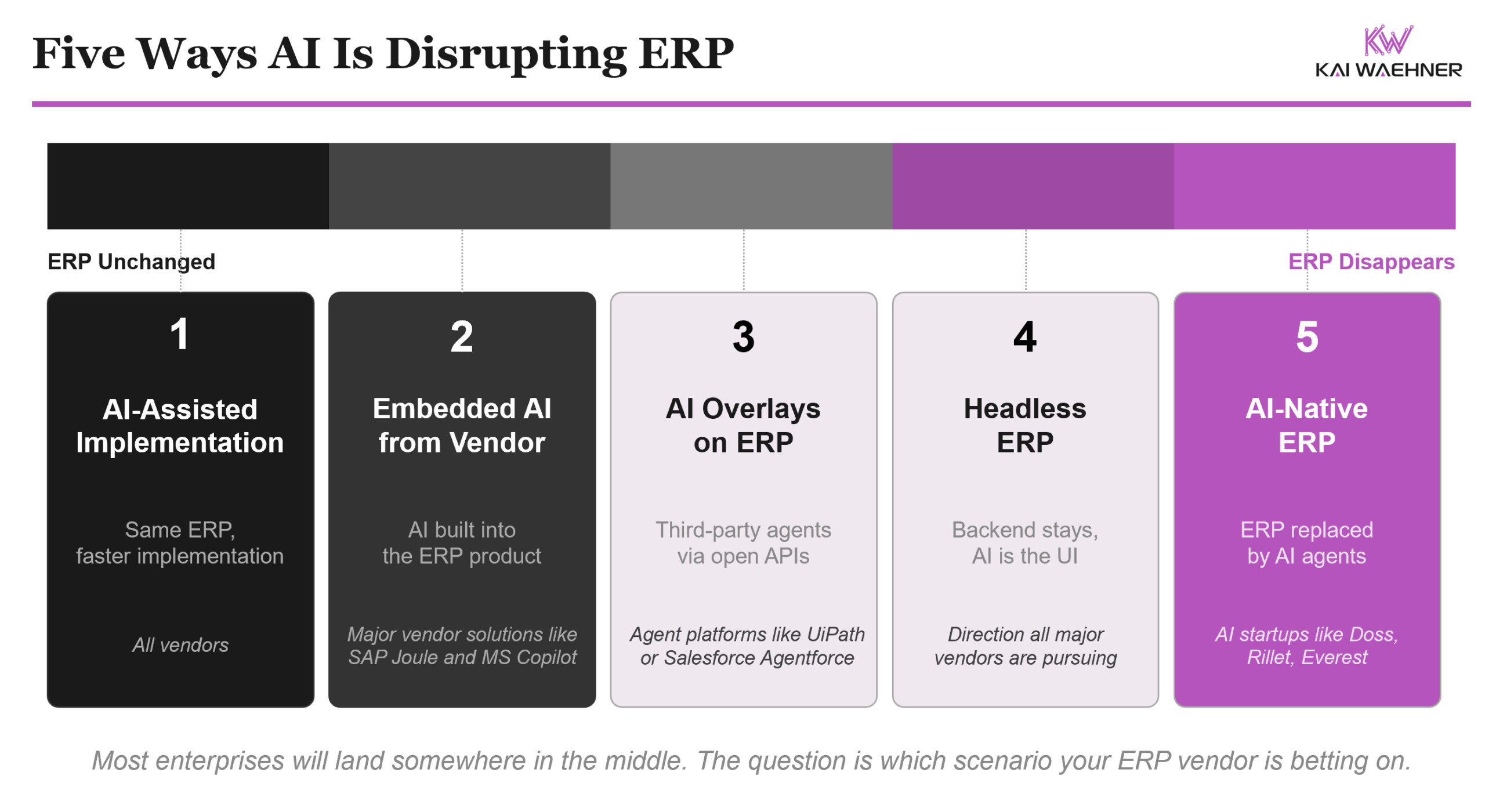
The vendor selection conversation in 2026 is not just about modules, deployment models, and total cost. It is also an enterprise architecture decision that will shape your AI strategy for years. McKinsey’s recent analysis covers five dimensions of AI disruption in ERP. Drawing on that research, a useful way to frame the selection implications is as five scenarios on a spectrum.
- AI-accelerated ERP delivery. The ERP itself does not radically change. The implementation effort and program duration compress because AI tooling helps with configuration, data migration, testing, and documentation. McKinsey argues the compression can reach 50 percent of effort and program duration, though most implementation work still sits in process redesign, change management, and integration, which AI tooling does not eliminate.
- Embedded AI from the ERP vendor. SAP Joule, Microsoft Copilot in Dynamics 365, Oracle NetSuite Next, Sage Copilot Insights. The vendor builds AI into the product. The customer gets AI capabilities that are tightly integrated with the ERP but tied to the vendor’s stack.
- AI overlays on existing ERP. Independent AI platforms read from and act on ERP data through APIs, vendor-neutral. The view pushed by service providers like Rimini Street is that it does not matter what is at the backend; the agent layer sits above and runs the workflows.
- Headless ERP. The backend stays: data, application logic, audit, system of record. Users no longer touch the front-end directly. AI agents become the primary interface. Screens get replaced by intent-driven agent interaction.
- AI-native ERP (the radical view). ERP as we know it ceases to exist. AI agents replicate ERP capabilities, creating and optimizing processes on the fly. Data lives in microservices rather than large tables. Application logic becomes a commodity. McKinsey calls this the “SaaSpocalypse” scenario.
Which Scenario Is Your Vendor Betting On?
The five scenarios are not mutually exclusive. Most enterprises will end up with a mix. But different vendors are betting on different scenarios, and that bet shapes their product strategy, their pricing, and their API policies.
SAP, Microsoft, and Oracle are betting hardest on Embedded AI from the Vendor. Their portfolio strategies, their AI assistants, and their integration policies all push in that direction. The vertical stacks they offer reflect this bet: S/4HANA plus SAP Datasphere plus SAP Signavio plus Joule, Dynamics 365 plus Fabric plus Copilot, Fusion Cloud plus Oracle Analytics plus AI Agent Studio. Infor is close behind with similar logic. The mid-market specialists like Proalpha, Sage, ams.Solution, and PSI Software pursue a mix of Embedded AI from the Vendor (their own AI features) and AI Overlays on ERP (openness to third-party AI through MCP, RAG, and open APIs). Service providers like Rimini Street and a long tail of agentic AI startups are explicitly pushing AI Overlays as the future. No vendor publicly bets on AI-Native ERP, but the AI-native startup wave is starting to test it.
For ERP selection in 2026, the question to ask each shortlisted vendor is which scenario their product strategy assumes, and whether that scenario aligns with the buyer’s view of where the enterprise will be in five years.
A Critical Note on Agentic AI as a Vendor Lock-In Mechanism
The AI angle deserves a sharper look than vendor briefings usually offer. The vendor that helps build a clean, integrated, observable data foundation matters more than the vendor with the flashiest AI demo. The selection question is which vendor will help and which will get in the way.
In late April 2026, SAP published an updated API policy. Section 2.2.2 of API Policy v4/2026 prohibits the use of SAP APIs for interaction or integration with semi-autonomous or generative AI systems that plan, select, or execute sequences of API calls. In plain language: no third-party AI agents on SAP data unless SAP says so. This is no longer just a stated intention. Enforcement began on June 9, 2026, with a security patch that blocks noncompliant calls. Third-party agents like Microsoft Copilot and Salesforce Einstein must now route through an SAP-mediated layer that is itself a metered SAP product. Twelve months ago that layer did not exist.
There are two reasonable readings of this move. The first is the infrastructure argument SAP itself offers. ERP systems were built for mission-critical transactions, not for arbitrary AI agent consumption. Indirect access licensing has been a long-standing SAP concern, covering how third parties access data that originates in SAP systems. From this angle, the policy protects platform integrity and the commercial terms that fund development. CEO Christian Klein reinforced this reading on the Q1 investor call, saying the intent is to protect domain know-how and prevent performance degradation rather than block customers from their own data, though the policy text remained unchanged after those assurances.
The second reading is strategic. The vendor that owns the data platform also decides which AI runs on top of it. SAP is positioning for Embedded AI from the Vendor, and the policy constrains customers who want to pursue AI Overlays on ERP. The adoption numbers make the stakes clear. Joule sits in production at roughly 3 percent of SAP customers, while Forrester puts Microsoft Copilot adoption among AI-active SAP customers at 77 percent. SAP has restricted the AI tool the majority actually use, in favor of its own tool that few have adopted. Gartner calls the resulting licensing dynamic Indirect Access 2.0, where AI agents generate unexpected licensing exposure at scale. Both readings have merit and both probably apply. The point for ERP selection is that the choice of platform now carries consequences for AI strategy that did not exist a year ago.
Salesforce and ServiceNow are taking a different path. Both have built their own agent layers, but neither blocks direct third-party API access the way SAP now does. The tightening is industry-wide, but the hard gate is so far specific to SAP. I covered the architectural implications in a separate post on data ownership in the age of agentic AI.
For a broader view of how the major AI vendors compare on trust, flexibility, and lock-in, see my Enterprise Agentic AI Landscape 2026.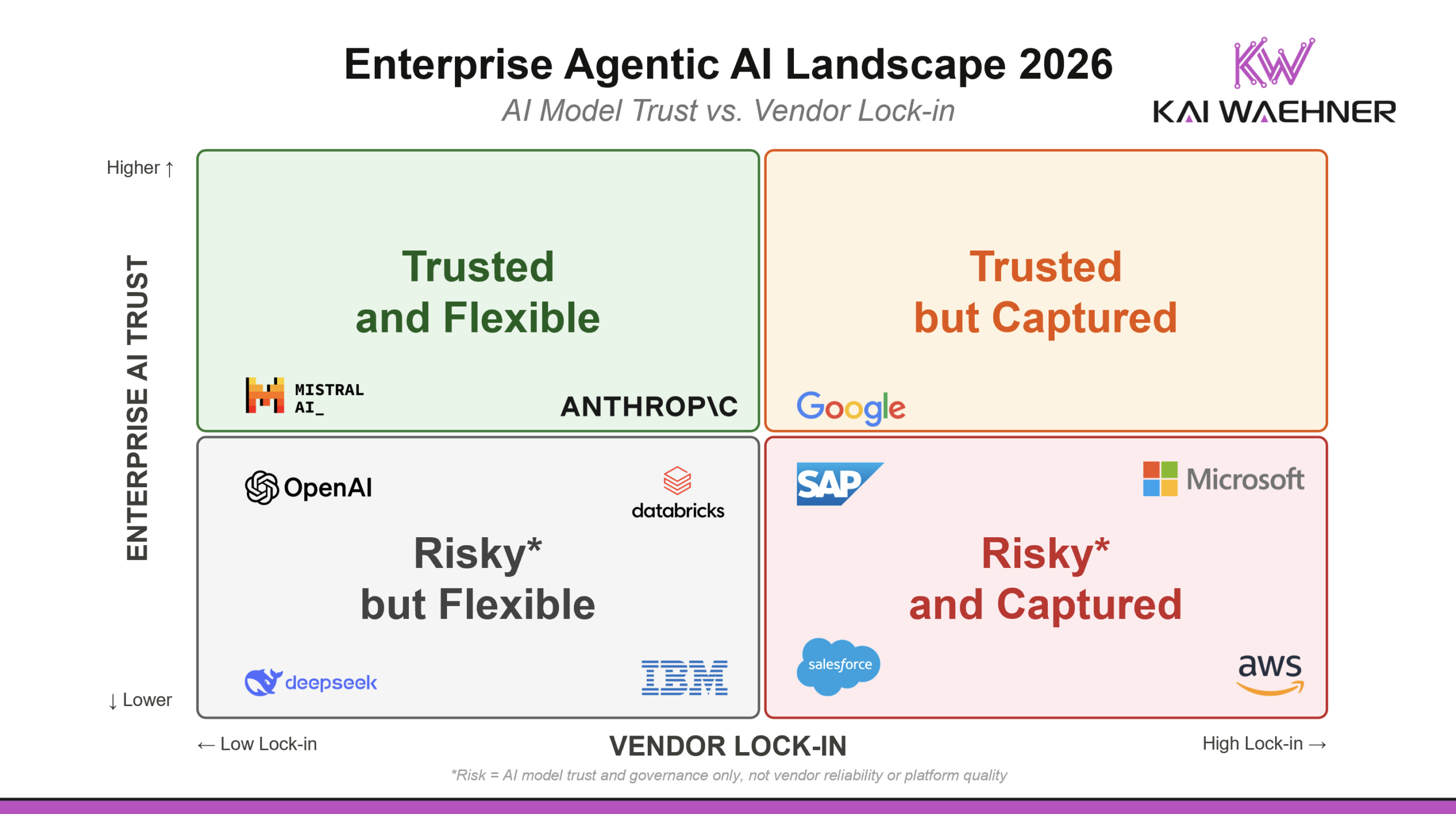
What the API Lockdown Means for Your ERP Selection
For ERP selection, this changes the conversation in two ways. First, the AI capabilities embedded in the ERP are not interchangeable with the AI capabilities the buyer can run on top of it. SAP customers building agentic workflows on third-party tools now face a compliance question they did not have a year ago. Second, the integration architecture matters more than ever. Enterprises that extract ERP data into a downstream layer they control, through CDC, streaming, or iPaaS, are largely insulated from this debate. Their agents consume from the downstream layer, not from the ERP directly. The Adams and Reiss projects made good integration choices for operational reasons. Those same choices look even smarter under an agentic AI lens.
The takeaway for vendor conversations is to treat AI roadmap claims with skepticism. Ask which agents are permitted, which are restricted, and what the API terms say about third-party access. The answer reveals more about the vendor’s strategy than the marketing slides will.
The Real Answer to “Which ERP Should We Choose for Manufacturing”
The default position in many manufacturing ERP selections is to start with the Tier 1 vendor that the board has heard of, run a tender to confirm the choice, and call it due diligence. The default produces correct decisions often enough that it survives. It also produces a meaningful number of wrong decisions, where a mid-market specialist would have delivered better fit, faster time-to-value, and lower total cost. The Adams and Reiss cases are not edge cases. They are common patterns dressed up as exceptions.
A Tier 1 platform like SAP is the right choice for companies that match its operating profile: multi-site, multi-country, complex industry processes, willingness to standardize on the vendor’s process model, budget for the implementation. Fritz Winter is one example. SAP, Microsoft, Oracle, Infor, IFS, and Epicor compete for these cases on merit. For everyone else, the right vendor is in a different segment. Microsoft Dynamics 365 where the Microsoft 365 and Azure footprint is already deep. Infor and IFS in vertical-deep scenarios like process manufacturing and asset-heavy operations. Proalpha, APplus, abas, and Sage X3 in German Mittelstand manufacturing where DACH localization and total cost of ownership outweigh global reach. ams.erp, VlexPlus, oxaion, and PSIpenta in project manufacturing, variant configuration, and lot-size-1 niches. SMB players below 50 million euros in revenue and in distribution-heavy companies with light manufacturing.
The work of selection is matching the operating profile to the vendor segment with discipline, then accounting for the non-fit factors that will push the decision one way or the other. The Tier 1 default survives because it is right often enough. It should still be examined every time, because the cost of getting it wrong is real and the alternatives are credible. The vendor that wins the demo is rarely the vendor that wins the next decade. The vendor that fits the profile usually is.
For the migration patterns and lessons learned from manufacturers who already went through this decision, see the previous post in this series on ERP migration lessons from German manufacturing.
Stay informed about the latest thinking on enterprise architecture, data integration, process intelligence, and trusted agentic AI by subscribing to my newsletter and following me on LinkedIn or X.