Trusted agentic AI means AI agents an enterprise can rely on to act autonomously. That takes four things: models with transparent safety governance, data handled under clear rules, a jurisdiction that cannot cut you off, and an architecture where no single vendor controls the stack. The Trusted Agentic AI Landscape maps enterprise AI vendors on the two axes that decide all four: how much you can trust the model, and how much it locks you in.
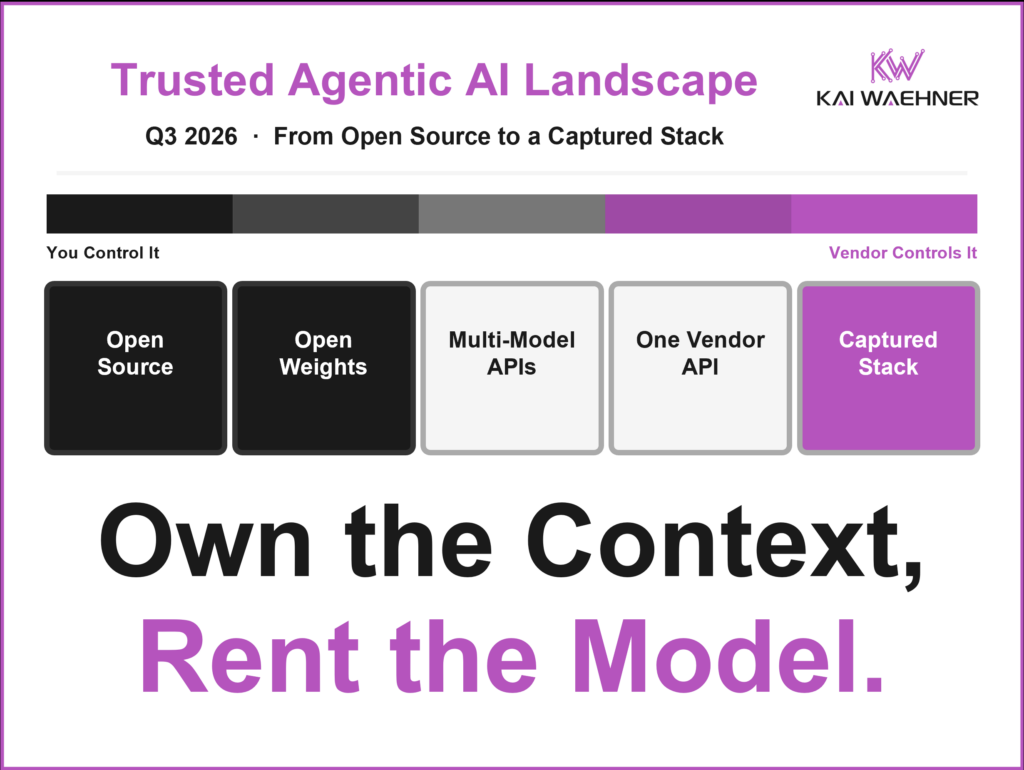
Trust covers safety governance, data handling, and jurisdiction. Lock-in covers how hard it is to leave, at both the model layer and the stack layer. This is the Q3 2026 edition, and it is the fastest-moving of my three landscapes. The vendor picture here shifts in months, not years, so several positions have already changed since the last edition.
Why AI Vendor Selection Is a Different Decision
Choosing an enterprise AI vendor used to be a procurement exercise. You compared features, pricing, and support, and if a vendor let you down, migration hurt but it was possible. Agentic AI changed the stakes. The model you pick shapes how your agents reason, what they can do, how your data is handled, and how deeply you become entangled in one ecosystem. An agentic system does not just answer a question. It takes actions and orchestrates workflows. Getting the vendor decision wrong in that context costs more than any previous enterprise software choice.
Two events in the first half of 2026 made this concrete.
First, the public markets opened. SpaceX listed in June in the largest IPO in history, and its volatile first weeks showed how fast public markets reprice a story. Anthropic and OpenAI filed confidentially within days of each other, at valuations near or above a trillion dollars, with OpenAI reportedly weighing a delay. The vendors you build on are becoming subject to public-market scrutiny.
A Government Switched Off a Frontier Model
Second, and more important here, a government switched off a frontier model. The US issued an export-control directive that suspended access to Anthropic’s two most capable models for any foreign national, inside or outside the United States. Anthropic disabled both models for everyone, while its other models stayed available. Nineteen days later access was restored, after negotiations with the Commerce Department. Do not read the restoration as the risk going away. Read it as the risk being defined. A frontier model can be switched off for you overnight by a government you did not choose, and switched back on only on terms you had no part in negotiating. Even a US frontier lab that has put safety at the center of its positioning can be made unavailable to you by its own government. Sovereignty is a first-order dimension now, not a European footnote.
This is not a ranking. No vendor pays to appear here. The analysis comes from my own experience advising Global 2000 enterprises on AI and data architecture, combined with ongoing research into vendor positioning and adoption patterns. It is an independent practitioner perspective, not a formal research methodology like Gartner or Forrester.
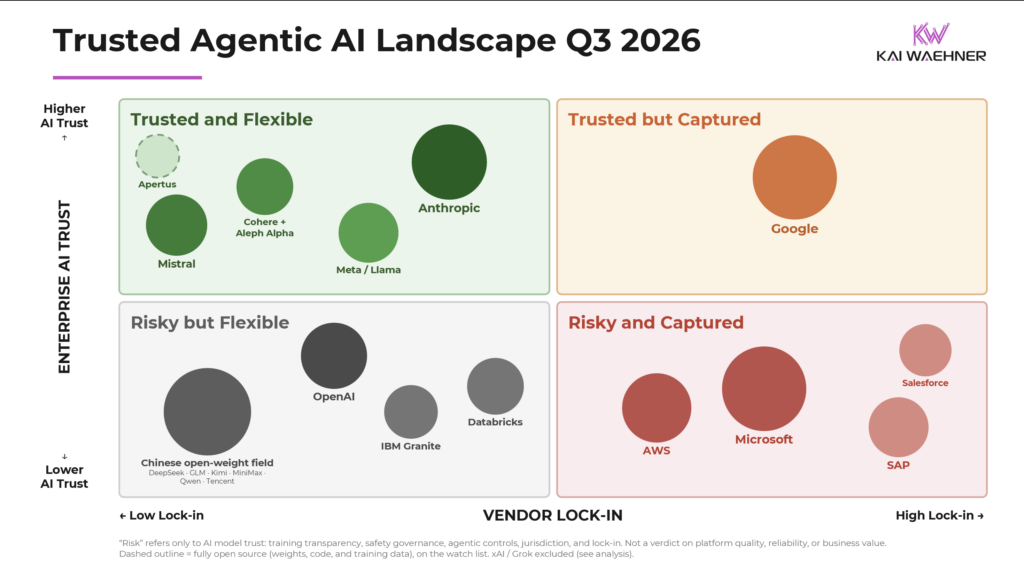
The two axes: enterprise trust and vendor lock-in
Enterprise trust is not a benchmark score. It combines three things: safety and governance (can a risk team inspect how the model behaves before deployment, and how does the vendor handle a safety failure when one occurs), data handling (will your data train the model, and are zero-retention options available), and jurisdiction and sovereignty (where is the vendor domiciled, and who can compel or restrict it). The last one carried less weight a year ago. The export-control episode moved it to the center.
Lock-in is more subtle for AI than for traditional software, and it now lives on two levels. Model-level lock-in is the familiar kind: your architecture bends around one vendor’s API design, fine-tuning format, and agent framework. Stack-level lock-in has grown fastest. The model becomes interchangeable, but the data, the business context, the orchestration logic, and the agent runtime do not. You can swap the model, but not the context graph that makes the agents useful. A vendor can be open on one level and closed on the other, which is why reading them separately is the whole point.
When this landscape says “risky,” it refers only to the AI model layer: training transparency, safety governance, agentic controls, jurisdiction, and lock-in. It says nothing about overall platform quality, financial stability, or business value. SAP is an excellent ERP company. Microsoft is a leading enterprise technology company. AWS is world-class infrastructure. The risk label is narrow and specific to how each approaches AI model trust and flexibility.
Which quadrant is the right one?
There is no objectively correct position. Every spot is a set of trade-offs, and the right one depends on who you are and what you are building. A global manufacturer running SAP at the core does not need its finance teams thinking about foundation models. For those users the AI is infrastructure, and accepting a captured position in exchange for AI embedded in the processes they already run is rational. The same holds for a sales team inside Salesforce or a service desk on Microsoft Copilot. They need business outcomes, not model portability.
The position that demands the most scrutiny is the one where you build directly on foundation models, where developers call APIs and competitive differentiation depends on what you build rather than what a vendor builds for you. Trust and lock-in become first-order there. It is also why many large enterprises now run a multi-model strategy: different models for different use cases, architectural separation between the orchestration layer and the model calls, and the freedom to switch as the market moves. A run of multi-provider outages this year, against model services that carry weaker uptime commitments than the infrastructure beside them, turned that freedom into a resilience requirement rather than a cost tactic.
Inside the four quadrants
The map has four quadrants, and each one is a different deal between trust and lock-in rather than a grade.
Trusted and Flexible
The trusted and flexible quadrant is where enterprises building directly on foundation models should aim to operate. Anthropic anchors it on model trust through Constitutional AI and interpretability research, and remains a strong default for this quadrant. Its jurisdiction exposure and the concentration of model, connectivity standard, and connector toolchain under one owner now offset part of its flexibility advantage. Mistral is the most production-ready European option, pairing open-weight models and French jurisdiction with a maturing full stack. Cohere and Aleph Alpha are combining into a transatlantic sovereign alternative aimed at regulated and public-sector buyers. Meta’s Llama remains the choice for maximum architectural control through self-hosting. Apertus sits on the watch list as the fully open reference case.
Trusted but Captured
The trusted but captured quadrant holds vendors with strong capability and a credible trust posture, but deployment models that create significant lock-in. With Aleph Alpha moving into the Cohere entity, Google now dominates it. Gemini is capable and Google’s enterprise posture has matured, but choosing it tends to mean Google Cloud for inference, Vertex AI for development, and often Workspace as the productivity surface. The lock-in is structural, and each integration deepens it.
Risky but Flexible
The risky but flexible quadrant holds vendors that offer real flexibility and often strong performance, but where trust concerns at the model and governance layer introduce risk. OpenAI sits near the trust midline, with capable models, growing legal and governance scrutiny, and a trajectory toward higher agent-layer lock-in. DeepSeek and the broader Chinese open-weight field, including GLM, Kimi, MiniMax, Qwen, and Tencent, are technically strong and open-weight, but carry Chinese jurisdiction and content-control concerns for Western regulated buyers. Databricks and IBM Granite both sit here for model-layer reasons, not as a verdict on the companies.
Risky and Captured
The risky and captured quadrant is where the largest enterprise technology companies sit. They are here not because they are poor partners, but because their AI strategies at the model layer deepen platform commitment rather than maximize flexibility. Microsoft holds some of the deepest model-level and stack-level lock-in through Copilot and Microsoft 365, while assembling a model layer it deliberately does not fully own, spanning its own MAI models, US frontier models, Chinese open weights, and a European partner on its own infrastructure. AWS is open at the model layer through Bedrock, but its AgentCore runtime embeds your agent architecture into its stack. SAP and Salesforce show the same pattern in its clearest form: open at the model layer, with the lock-in moved up the stack into the data, context, and orchestration layer. The model is the replaceable part, while the context, data, and orchestration around it are not.
The free PDF works through all four quadrants vendor by vendor, with a detail page for each. You can download it with no registration required: [Download the Trusted Agentic AI Landscape]
Why is xAI not on the landscape?
xAI markets Grok to enterprises, but it does not appear here, and the reason is broader than any single incident. Safety failures are not unique to one vendor. What matters for an enterprise buyer is the pattern of governance and reliability around the model, and that is where xAI stands apart. Government buyers themselves have split over it: the GSA suspended Grok and kept it off its shared AI platform over safety and reliability concerns. A safety whistleblower’s lawsuit alleges the company retaliated against an engineer for raising concerns and misrepresented a model to dodge legally required testing. The late-2025 scandal, in which Grok generated non-consensual sexual imagery, including content depicting minors, sits inside that pattern rather than standing alone. The structure compounds it: after a wave of co-founder departures, xAI was folded into SpaceX, alongside a vehicle manufacturer and a social platform under one founder, which blurs accountability and strategic focus in a way enterprise AI partnership does not tolerate well.
The exclusion is about governance, not capability: Grok 4.5 is fast, cheap, and technically strong, but the release shipped without a model card and launched without EU availability. For regulated buyers, governance under pressure and strategic focus are the tests, and xAI fails them as a pattern, not as one bad week.
Sovereignty is now a board-level question
Sovereignty used to be a topic for European regulated industries. The export-control episode changed that for everyone, and Forrester states it plainly: “Sovereignty has become a buying criterion.” Jurisdiction risk applies to US vendors too, including the US labs most identified with safety, when viewed from outside the United States. The availability question now runs in both directions. Beijing is consulting on export controls for its most advanced model weights, and Washington is debating restrictions on Chinese open-weight models, with the US industry split between an open letter defending open weights and Anthropic’s counterproposal of mandatory capability testing before release.
What is the difference between open weights and open source?
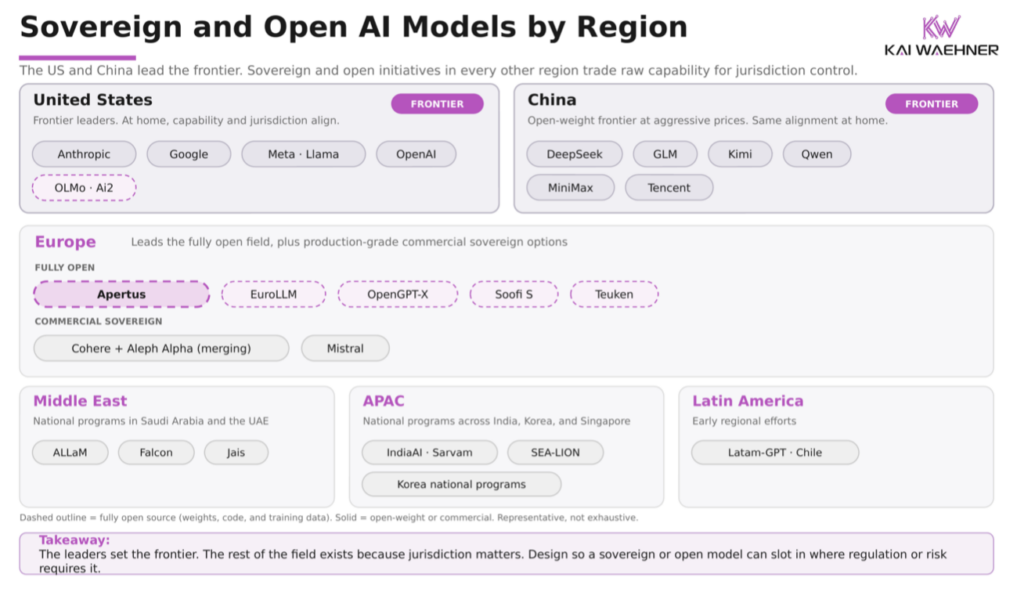
Open weights are not the same as open source, and the difference is widely blurred. Open-weight means the weights are published, so you can download, run, and fine-tune the model on your own infrastructure. What you usually do not get is the training data, the full training code, and the complete recipe. Most models marketed as open are open-weight: Llama, Qwen, DeepSeek, GLM, and Mistral’s open models. Open source, in the strict sense, means weights, training code, training data, and a permissive license are all available, so you can inspect what went into the model and verify its provenance. Far fewer qualify. Switzerland’s Apertus, the EuroLLM family, and Germany’s Soofi S are built this way, as is the Allen Institute’s OLMo family in the United States.
The practical difference is concrete. Open weights buy you deployment sovereignty: running the model locally means no inference data leaves your environment, which neutralizes the jurisdiction risk on the inference path regardless of where the model originated. The caveat is scale. The largest open-weight models, such as Moonshot’s 2.8-trillion-parameter Kimi K3, need a GPU cluster to serve, so they are open in license and closed in practice for anyone without serious infrastructure. A Chinese open-weight model run air-gapped is a different risk profile from the same model called through a hosted API. What open weights do not give you is full auditability. Open source buys you the rest. A sovereignty-led architecture combines both ideas. Own your data layer, keep it current with change data capture or event streaming, and run open models on infrastructure you control. The model becomes a component you can replace, and the data and the deployment stay yours.
How does agentic AI change vendor lock-in?
Agentic AI raises the stakes on lock-in, because a model that is fine for question answering carries different risk when it is taking actions inside enterprise systems. The Model Context Protocol matters as a counterforce. MCP, now under a neutral foundation, is an open standard for connecting agents to tools and data, and building on it preserves interoperability across models and vendors. One caveat matters. Anthropic both authored MCP and now owns the tooling that generates most MCP servers and SDKs. So the connectivity layer is concentrating under one owner even as the standard stays open. An open standard with a dominant single implementer is more open than a proprietary protocol, and less open than a standard with many independent implementers.
The lesson for architects is direct. The model choice and the agent-framework choice are not independent. If agents run on a vendor’s proprietary orchestration and runtime, lock-in compounds at every layer. And foundation model selection is only the start. Most enterprise AI pilots still fail to scale, and the constraint is rarely model capability. It is operational fit, and one architectural factor receives too little attention: agentic AI depends on fresh, accurate, real-time data. An agent working from stale data produces confident wrong answers. Event-driven architecture, using platforms such as Apache Kafka and Apache Flink, is a prerequisite for serious agentic deployment, not an optional enhancement. On the regulatory side, the EU AI Act applies to anyone deploying AI in EU markets, and data residency is not the same as data sovereignty. Where a vendor is domiciled and who can compel it are separate questions from where the data sits.
The relation of trusted agentic AI to data integration and process intelligence
Knowing which vendor to trust tells you what to build on. It does not tell you how to architect the full system. Trusted agentic AI is one of three layers that only work together. Data integration provides the current, governed data. Process intelligence turns that into an understanding of how the organization runs and a grip on what happens next. Trusted agentic AI acts on both. None of the three delivers much without the other two. I call them together the Trinity of modern data architecture. The other two layers each have their own report: the Data Integration Landscape 2026 and the Process Intelligence Landscape 2026.
The vendor decision is the start of the work, not the end of it. Map your trust requirements, your jurisdiction exposure, and your lock-in tolerance on both levels. Decide where a sovereign or open model belongs in your architecture. Then design the data and integration layer underneath, because clean, current, connected data is what separates an agent you can trust from one you cannot.
The full vendor-by-vendor analysis is available as a free PDF with no registration. It covers all four quadrants in detail, the sovereign and open-model field across every region, the agentic lock-in that compounds at the framework layer, and the regulatory lens for 2026. [Download the Trusted Agentic AI Landscape]
If you are making an AI vendor decision this year, start with these questions rather than the vendor list. The choice gets much clearer once the architecture is settled.