I started at Confluent in May 2017 to work as Technology Evangelist focusing on topics around the open source framework Apache Kafka. I think Machine Learning is one of the hottest buzzwords these days as it can add huge business value in any industry. Therefore, you will see various other posts from me around Apache Kafka (messaging), Kafka Connect (integration), Kafka Streams (stream processing), Confluent’s additional open source add-ons on top of Kafka (Schema Registry, Replicator, Auto Balancer, etc.). I will explain how to leverage all this for machine learning and other big data technologies in real world production scenarios.
Read this, if you wonder why am so excited about moving (back) to open source for messaging, integration and stream processing in the big data world.
In the following blog post, I want to share my first slide deck from a conference talk representing Confluent: A software architecture user group in Leipzig, Germany organized a 2-day event to discuss big data in practice.
This is the abstract of the slide deck:
Big Data and Machine Learning are key for innovation in many industries today. Large amounts of historical data are stored and analyzed in Hadoop, Spark or other clusters to find patterns and insights, e.g. for predictive maintenance, fraud detection or cross-selling.
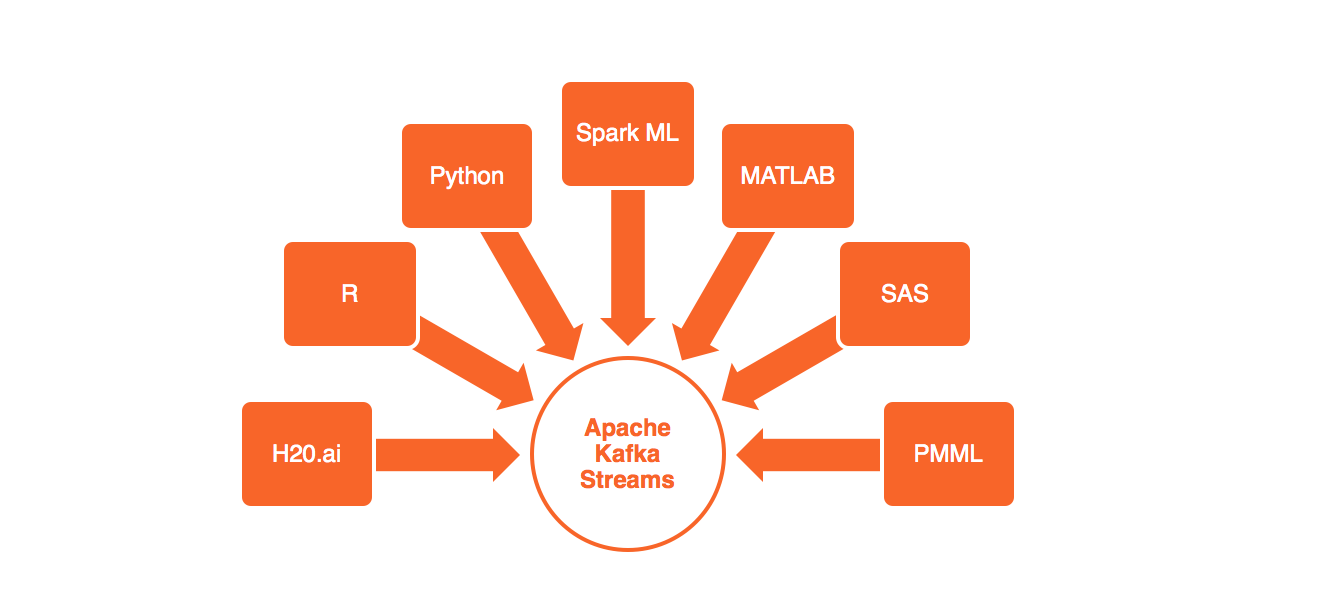
This first part of the session explains how to build analytic models with R, Python and Scala leveraging open source machine learning / deep learning frameworks like Apache Spark, TensorFlow or H2O.ai.
The second part discusses how to leverage these built analytic models in your own real time streaming applications or microservices. It explains how to leverage the Apache Kafka cluster and Kafka Streams instead of building an own stream processing cluster. The session focuses on live demos and teaches lessons learned for executing analytic models in a highly scalable and performant way.
The last part explains how Apache Kafka can help to move from a manual build and deployment of analytic models to continuous online model improvement in real time.
Here is the slide deck:
https://www.slideshare.net/KaiWaehner/apache-kafka-streams-machine-learning-deep-learning
More blog posts with more details and specific code examples will follow in the next weeks. I will also do a web recording for this slide deck and post it on Youtube.
The Industrial IoT Landscape Q4 2026 maps vendors and open source from edge to cloud…
Telecom has more orchestration standards than any other industry, and the maturity stops at the…
Jev by TypeSafe AI returns a calibrated probability instead of text. In a workflow that…
Jev by TypeSafe AI returns typed decisions with calibrated probabilities in a few hundred milliseconds.…
System One models such as Jev by TypeSafe AI answer typed questions with calibrated probabilities…
A working Python cron job moved to Kestra, the open source workflow orchestration platform, without…