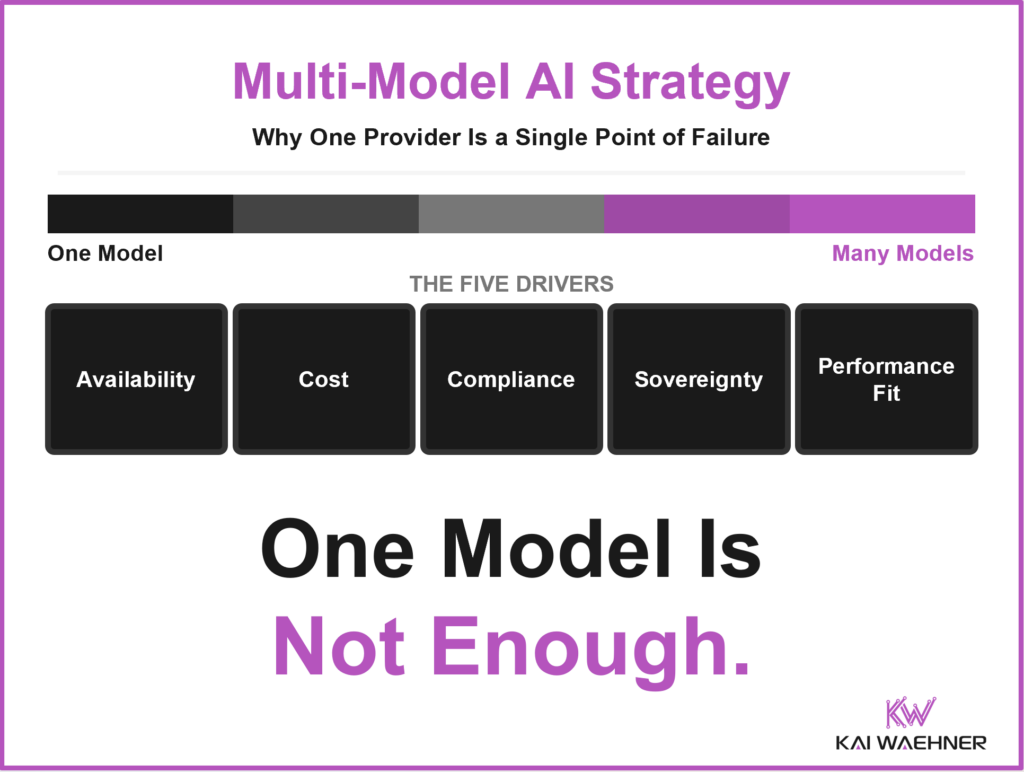
Single-vendor AI has become a single point of failure. A multi-model AI strategy means running more than one model behind an orchestration layer, mixing hosted frontier APIs with open models you run yourself. You route each workload to the model that fits, fail over when a provider goes dark, and switch when cost, compliance, or availability changes. The argument holds for US and Chinese providers alike. It is now about resilience as much as price.
Three events in the first half of 2026 made the same point from three directions. A government switched off a frontier model. A wave of provider outages took down production workloads across the industry. A US software company began evaluating a Chinese model inside its own cloud to keep its flagship agent affordable. Read together, they say something an enterprise architect cannot ignore. Building your most critical processes on a single AI model provider is a concentration risk, and in 2026 that risk stopped being theoretical.
In my Trusted Agentic AI Landscape Q3 2026, I mapped where the major vendors sit on two axes: enterprise trust and vendor lock-in. Each axis is evaluated at two levels, the model and the stack. The landscape tells you where each option stands. This article is about what to do with that map. The short version: do not bet the whole architecture on one position, no matter how good it looks today. Multi-model started as a cost-optimization tactic. It is resilience engineering now.
Why This Is Not a US Versus China Story
Two readings of this article would both be wrong: that concentration risk is a European problem, or that the answer is to avoid Chinese vendors. A US enterprise operating globally meets different and sometimes conflicting rules in every market it serves. US vendors are working the same problem in the open. Every risk in this article has a version on the US side and a version on the Chinese side.
Most of the examples that follow are US-origin. That is where the disruptions of 2026 actually landed, not a verdict on who runs better infrastructure. The mitigation does not change with the flag. Whichever provenance worries you, the answer is the same: do not let one jurisdiction, one balance sheet, or one bad week own a capability your business depends on.
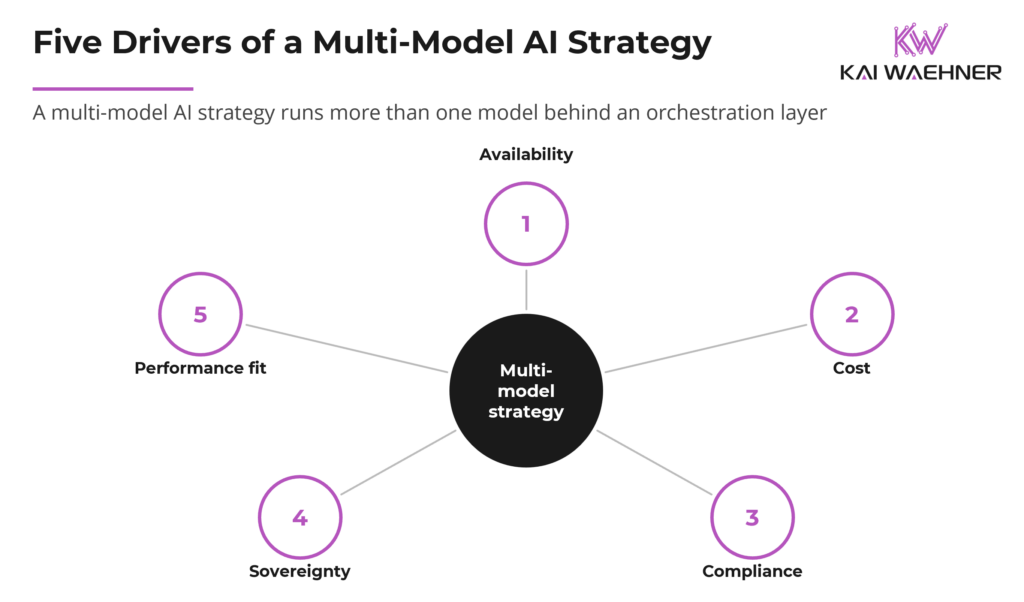
Five Drivers of a Multi-Model AI Strategy
For most of 2024 and 2025, “use more than one model” meant routing cheap tasks to a cheap model. The logic still holds, and it still saves money. But the case for multi-model has widened. It now covers risks that have nothing to do with the per-token price. Five drivers now make the case for multi-model, and 2026 gave each of them a concrete example. They are availability and model churn, the cost of running agents, regulation and compliance, sovereignty and jurisdiction, and picking the right model for the task. Availability and sovereignty are the two that changed most this year. Cost is the one that got attention first, and it is no longer the strongest argument.
Driver 1: Availability and Model Churn
AI has become production infrastructure. It is being treated with less resilience discipline than a database or a cloud region. The data caught up with that gap this year. Ookla analyzed 471 days of US Downdetector reports across ChatGPT, Claude, Gemini, and Copilot, and counted high-signal disruption days rising from six in Q1 2025 to 51 in Q1 2026. Anthropic’s Claude accounted for 39 of those 51, against seven for Gemini, three for Copilot, and two for ChatGPT. That concentration is not evidence that one vendor is careless. Claude went from near-zero report volume in early 2025 to carrying agentic coding workloads at scale, and its disruptions cluster around demand surges and release windows. ChatGPT moved the other way, with median daily reports falling even as usage grew. Scale-up volatility lands on whichever provider is growing fastest. Next year it will be someone else, which is the reason to architect for it rather than to pick a better vendor.
SLAs Do Not Cover Model Deprecation
Published uptime has been sitting below the levels most enterprise contracts assume. The uptime commitments that do exist come mostly from the hyperscaler-hosted model services, and they sit below what enterprises expect from a managed database or cloud region. The frontier labs’ own direct APIs largely publish none at all. A service credit for a downed endpoint is also not the same as business continuity. Deprecation is the quieter half of the same risk, since providers retire model versions within weeks while a regulated enterprise needs months to revalidate one. InformationWeek’s coverage of AI model churn quoted me on where that lands: a model going missing does not break one application, it stops the whole workflow and every business process attached to it.
Failover, and the Case for No AI at All
The architectural lesson from the outage data is consistent. Hardcoding one provider’s endpoint was an acceptable availability strategy in the early boom. In 2026 it is a single point of failure. It puts business continuity at the mercy of one company’s worst day. A second model behind a failover path turns an outage into a degraded mode instead of a stoppage.
For the most critical processes the fallback may need to be AI-free entirely, a rule-based path or a human in the loop. The real question is not which model you fail over to. It is what happens to the business when every model is unavailable. Multi-model is the first answer. Designing for graceful degradation, and accepting that not every process should depend on an LLM in the first place, is the second. Treat both as disaster-recovery work. Budget them the way you budget a failover region.
Slack’s own infrastructure history shows this playing out in practice. After three years on AWS alone, moving through SageMaker and then Bedrock, the team concluded that even a single hyperscaler’s regional and provider-level reliability was not enough, and added Google Vertex AI as a second full provider with automatic failover between them (source: Slack Engineering, May 2026). A company with no compliance or sovereignty pressure forcing the move still treated single-provider dependency as an unacceptable availability risk on its own.
Driver 2: The Cost of Running Agents
Agents broke the economics that chatbots lived inside. A chatbot answers one prompt and stops. An agent plans, reads, calls tools, retries, and keeps consuming tokens while the user moves on. A joint study from Microsoft Research and the Stanford Digital Economy Lab measured agentic coding tasks on SWE-bench Verified at roughly a thousand times the token consumption of code chat or code reasoning, with input tokens rather than output tokens driving the bill. The same study found runs on an identical task varying by up to 30 times. That variance is what breaks budgeting, more than the absolute number. The bills followed. Uber’s CTO disclosed in April that the company had burned its entire 2026 AI budget in four months after rolling Claude Code and Cursor out to roughly 5,000 engineers. Uber has since capped spending at $1,500 per engineer per month, per tool. Flat per-seat pricing cannot survive that load. The industry is shifting to usage-based billing for agents.
This is the pressure behind the Microsoft news. The company moved its enterprise agent to general availability and to usage-based pricing. On the same day, it disclosed that it is evaluating a lower-cost model option to sit alongside its existing premium providers. Read that as an architecture signal rather than a political one. A high-volume agent runs on a mix of models chosen by cost and task, with routine work on a cheap engine and high-value reasoning reserved for a frontier one. Microsoft could have stayed single-source. Cost pressure pushed it into multi-model routing anyway.
Driver 3: Regulation and the EU AI Act
A global enterprise does not face one rulebook. It faces many, and they do not always agree. The EU AI Act applies to anyone deploying AI in EU markets regardless of headquarters. The logic is extraterritorial, the same as GDPR. Its timeline firmed up this June. The European Parliament endorsed the Digital Omnibus on June 16 and the Council gave final approval on June 29. The package defers the heaviest high-risk obligations to December 2027 and August 2028. Transparency duties, content labelling, and a new prohibition on AI-generated abuse imagery stay on near-term dates. Add sector rules in finance, healthcare, and the public sector. Add data-residency requirements that differ by country, and emerging state-level AI laws in the US. No single model provider satisfies every regime your business touches at once.
A multi-model posture is how you meet that reality without re-platforming for each market. Sensitive workloads in a regulated jurisdiction can run on a model and a deployment that satisfy local rules. Less constrained workloads use whatever fits best. The alternative is forcing every market through one provider’s compliance envelope. It means accepting the lowest common denominator everywhere, or breaking a rule somewhere.
Driver 4: Sovereignty and Jurisdiction
A vendor’s home government can reach into your access. This is the driver that changed most this year. In June, the US government used national-security export controls to bar Anthropic from serving Fable 5 and Mythos 5, its two most capable models, to any foreign national. The order forced the company to disable those models for everyone, while its other models stayed live. Access came back 19 days later, after the Commerce Department lifted the controls, and the redeployment carried new restrictions. That is the part that matters for architecture. The outage ended on terms set between two parties you were not one of, and a capability you depend on was gone and then returned by government decision, not by anything you controlled.
A model that was available on Friday was gone on Saturday, by government order. Data residency would not have changed the outcome by a minute.
Brussels answered institutionally in July. The European Commission published an AI security action plan drawn up in direct response to the suspensions, including emergency measures by the end of 2026 for the case that a third state cuts off access to critical AI capabilities. When a regulator starts writing contingency plans for a foreign government switching models off, the risk has moved from conference talks into official policy.
Chinese-origin models carry the same category of risk from the other direction, and I work through both sides in detail in the sovereignty section below. Any model whose continuity depends on a single state’s legal reach is a concentration risk, whatever the flag. The mitigation is the one that answers the other drivers too. Do not let one jurisdiction own your only path to a capability. Keep a sovereign or open option ready that can run on infrastructure you control.
Driver 5: The Right Model for the Task
No single model leads on everything at once. One is stronger at long-context document work. Another is better at low-latency interaction, another at structured reasoning, another at code. Latency-sensitive and privacy-sensitive steps often belong on a small model running on-device or on-premises. Escalation goes to a frontier model only when the task demands it. This routing can sharply cut calls to large models without degrading quality.
The pattern now has numbers behind it. Cursor’s July agent-swarm research had four model configurations rebuild SQLite in Rust from the 835-page manual alone, with no source code, no tests, and no internet access. Every configuration eventually passed the full held-out test suite. The cost ran from $1,339 for a frontier planner driving a low-cost worker model, to $10,565 for a single frontier model doing both jobs. Same verified outcome, roughly eightfold spread, decided entirely by which model was assigned where.
Slack reported the same effect from the quality side after matching models to individual features, with roughly 10 percent better results on complex reasoning tasks and roughly 67 percent lower latency on short-prompt workloads (Slack Engineering, May 2026). The question is no longer which model is best. It is which model is best for this task, at this cost, at this latency, inside this compliance envelope.
AI Sovereignty Cuts Both Ways
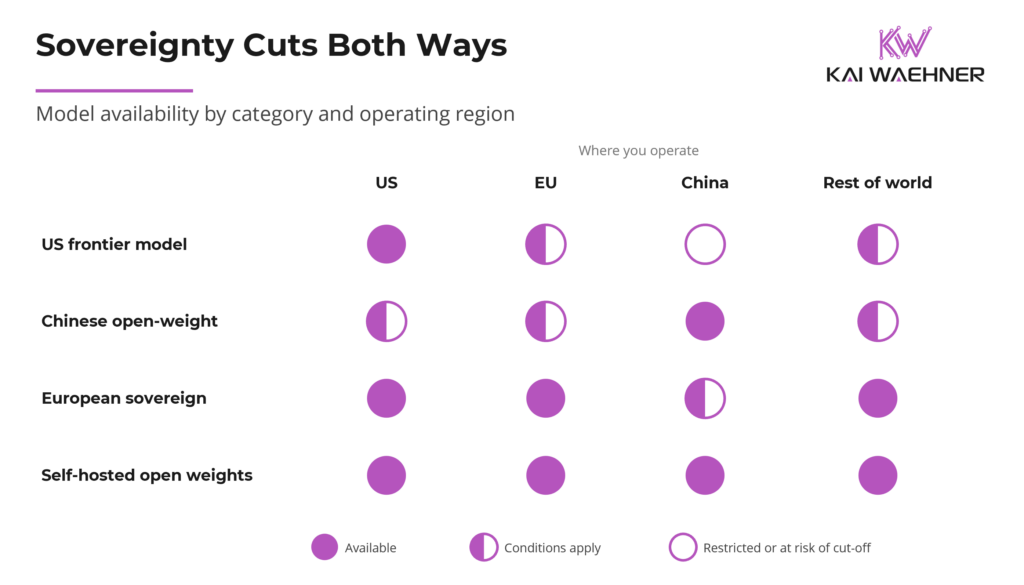
Europe has been having this conversation for a decade. Data protection and sovereignty have been live topics since GDPR. For most of that time, the alignment pressure fell on US providers. The conflict between the US Cloud Act and European data-protection law is one example. The legal challenges that twice struck down the frameworks for transatlantic data transfer are another. Chinese providers are the newer entry to the debate. What 2026 made clear is that the US is now as much a continuity concern as China. US, Chinese, and other foreign vendors alike have to be aligned to local rules before they touch regulated workloads. The structural question was never about one country. It is whose law governs the model and the data you depend on, and that applies to every foreign vendor.
US Models Carry US Jurisdiction
On the US side, the export-control episode showed that US origin is no guarantee of continuity. The same political volatility had surfaced earlier in the year, when the Pentagon designated Anthropic a supply-chain risk and barred military and contractor use after contract renegotiations broke down over restrictions on mass surveillance and autonomous weapons. In March a federal judge barred the administration from enforcing the ban on using Claude, while Anthropic’s challenge to the designation itself remains unresolved on appeal. Note the asymmetry for a buyer. The designation took days to impose and has taken months of litigation to unwind, and the enterprise depending on the model had no seat at either table.
US data-access law gives American authorities reach over data held by US companies regardless of where it physically sits. For a European or other non-US enterprise, a US frontier model is a foreign model with foreign jurisdiction attached, exactly the way a Chinese one is.
Chinese Models Carry Chinese Jurisdiction
On the Chinese side, open-weight models such as DeepSeek are technically strong and often dramatically cheaper. They are spreading fast, and now rank at the top of some public model marketplaces. They also carry national-security and data laws that create access obligations, plus content controls baked into the weights on politically sensitive topics. Running open weights locally removes the data-egress problem, since nothing leaves your environment. Deployment sovereignty is only real when you can actually run the weights yourself, though; the largest open-weight models now exceed what most buyers can serve. And local deployment does not remove the content-control or supply-chain considerations. Hosting a Chinese model inside a Western cloud, the path Microsoft is evaluating for its agent, addresses data routing without changing the model’s country of legal origin.
Availability risk is turning symmetrical as well. Beijing is preparing curbs on overseas access to China’s most capable models, a mirror image of the US episode. Regulators have met with the leading labs about limiting foreign access to frontier models, and the commerce ministry is consulting on export controls that could reach as far as whether foreign users may download the weights at all. A hosted API from a Chinese lab therefore carries the same continuity risk as a hosted API from a US lab. Published weights are different, because a released model cannot be recalled. A buyer who picks a Chinese model should hold the weights rather than rent the endpoint, while they are still small enough to serve and still being published.
What Redomiciling to Singapore Changes
Redomiciling changes some things and not others, and the difference matters for procurement. Chinese-founded AI companies have been relocating to Singapore, thinning their mainland operations, and presenting themselves as neutral global firms to reach Western capital and customers.
The move can be substantive. A company that shifts its legal entity, its data processing, its infrastructure, and its key engineering staff out of the mainland is a different counterparty from one that added a holding company. That version clears European procurement on the same terms any foreign vendor does: a European contracting entity, inference running where you need it to run, and a data processing agreement that survives review. Founder nationality is not a compliance category.
Where redomiciling does less is at the level of the technology itself. Manus, an autonomous-agent startup, moved its headquarters to Singapore and agreed to sell itself to Meta for around $2 billion. Beijing blocked and unwound the deal on national-security grounds, looking straight through the Singapore holding structure to the technology’s Chinese origin. Export control follows the technology and the people who built it, not the address on the letterhead.
Treat the move as evidence to verify rather than a label to accept or reject. Ask which entity signs, where inference runs, where the weights live, and what happens to your access if the origin state asserts a claim. A vendor that answers all four clears the bar, which is the same test you should be putting to a US vendor.
Two Meanings of Sovereign
There is a constructive side to this. Two different things travel under the word “sovereign,” and it helps to keep them apart. One is jurisdiction: a model whose home legal system you trust. The other is deployment: open weights you run on infrastructure you control, regardless of where the model came from. The strongest position combines both.
Sovereign and open options now exist across regions, not only Europe. Switzerland’s Apertus is a fully open reference, with weights, training data, and methods published. Mistral is a commercial European option with support and accountability. National efforts are under way in the Middle East and Asia too. Adopting one tomorrow is not the point. Design the architecture so a sovereign or open model can slot in when regulation or risk tolerance requires it. My landscape maps this field by region.
The takeaway is not “avoid Chinese models” or “trust US models.” It is that model provenance is now a procurement field you fill in deliberately for every vendor. Provenance means where a model and its data legally originate, and whose laws shaped them. For a European enterprise, and increasingly for any enterprise operating across borders, the work is aligning all foreign providers to local rules, not singling out one flag.
When Domain-Specific Models Beat Frontier Models
The “right model for the task” logic has a sharper version. A general frontier model is built for broad reasoning. It is not built for the vocabulary, telemetry, and protocols of one industry. For specialized work, a smaller model fine-tuned on domain data often beats a much larger general one on accuracy, and at a fraction of the cost.
Telecom is a current example. The GSMA’s Open Telco AI platform produced a family of open telco models, post-trained by AT&T on open foundations such as Google’s Gemma and on datasets curated with operators and equipment vendors. The tailored, smaller models outperform far larger frontier models on telecom tasks. They were also built for a regulated setting, using retrieval and abstention to reduce hallucinations. The result is better accuracy, lower cost, and a tighter compliance story at the same time.
This opens two paths, and most large enterprises will use both. Fine-tune your own model on proprietary data, or adopt a purpose-built industry model that someone else has trained. Either way the production model portfolio ends up mixed: general frontier models for open-ended reasoning, specialized models for the domain work that runs the business. Multi-model shows up here for a different reason. Fit and total cost of ownership drive it, and failover never enters the calculation.
The Trade-Offs of a Multi-Model AI Strategy
The strategy this article recommends is not a free lunch. Pretending otherwise is how multi-model programs fail. The trade-offs are real.
Operational complexity multiplies. Every additional provider is another API, another billing model, another set of failure modes, another governance surface. Evaluation becomes harder, because models behave differently. A prompt tuned for one is rarely optimal for another. In an agentic chain, routing a step to a weaker model can compound errors silently, since the system keeps going. Auditability and data handling now span multiple providers, and possibly multiple jurisdictions. This is exactly where your compliance team needs to be tightest. The abstraction layer you build to manage all of this becomes a dependency in its own right, with its own lock-in and its own capacity to fail in exactly the way you built it to prevent.
None of this argues for staying single-source. It argues for treating multi-model as an engineering discipline with its own architecture and its own operating model. A procurement checkbox will not carry it.
Model Orchestration Is the Next Decision
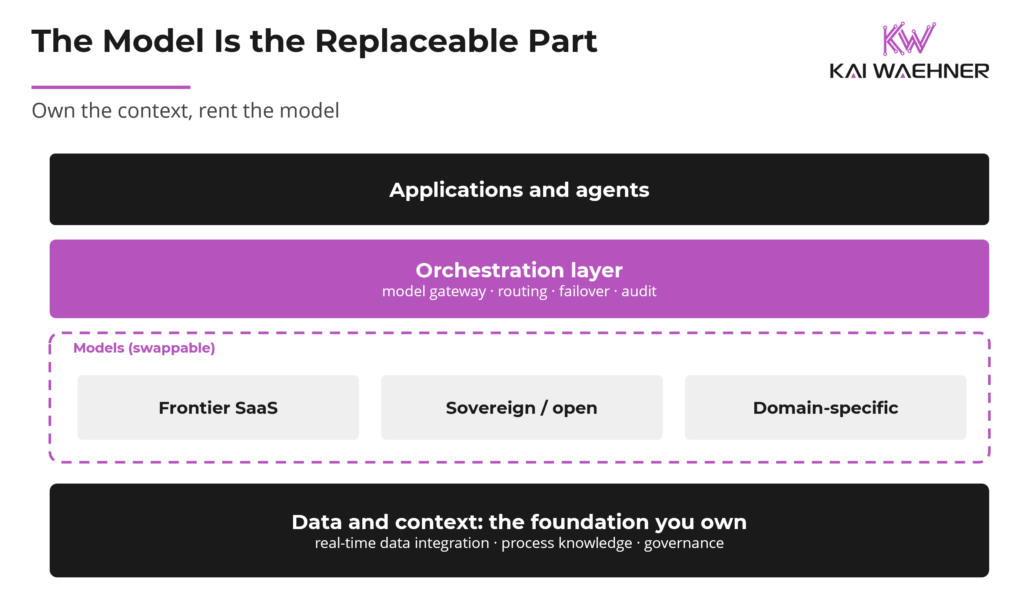
A multi-model strategy only works if an orchestration layer sits between your applications and the providers and runs the traffic. That layer routes each request to the right model by cost, sensitivity, latency, and availability, fails over when a provider goes dark, and produces a single audit trail across every provider you use. Often paired with a model gateway underneath, this is where reliability and governance get enforced for mission-critical workloads, rather than bolted onto each application after the fact. Choose the layer deliberately, because it comes with lock-in of its own.
Routing Became a Product Category
The market caught up with this in a single week of July. Cursor launched a router that scores each coding request and picks the model by measured quality against cost, claiming savings of 30 to 50 percent versus sending everything to a frontier model. Ramp opened up the router it built to manage its own AI bills, and Meta is reportedly building one internally. Microsoft stood up an entire services unit to help enterprises build with a mix of models. OpenRouter has offered general-purpose routing since 2023, so the category is older than the July news cycle suggests. Routing is now a product category, and it comes with a caveat: several of these routers come from companies with model ambitions of their own. The layer that decides where your requests go is not always a neutral referee, so choosing the router is a vendor decision like any other.
This layer is involved enough to deserve its own treatment. The end-to-end governance and mission-critical requirements run deep. How to orchestrate across models, clouds, and jurisdictions with governance from end to end is the subject of a follow-up to this article. For now the point is narrower. Holding accounts with several providers gets you nothing on its own. A multi-model strategy commits you to building or adopting the orchestration layer that makes those accounts usable.
The Model Is the Replaceable Part
Knowing which vendor to trust tells you what to build on. It does not tell you how to architect the system. A multi-model AI strategy is, underneath, a data and architecture problem rather than a model problem. The models are the components you swap. What you actually own is the layer beneath them. It holds the current, governed data that feeds the models, the process knowledge that tells them how the organization runs, and the orchestration that lets you route, fail over, and switch as the market moves. The landscape calls this stack-level lock-in, seen from the buyer’s side: the model commoditizes while the context does not, so the context layer is the position an enterprise should claim for itself.
I have called these three layers the Trinity of modern data architecture: data integration, process intelligence, and trusted agentic AI. The other two layers each have their own report, the Data Integration Landscape 2026 and the Process Intelligence Landscape 2026.
None of the three delivers much without the other two. Agents acting on stale or inconsistent data produce confident wrong answers, then compound them across automated workflows. Real-time, governed data integration is a prerequisite for serious agentic deployment.
How to Build a Replaceable Model Layer
The practical conclusion is to design the model layer to be replaceable from day one. Pick a strong default. Put an orchestration layer in front of it. Route specialized work to specialized models. Keep a sovereign or open option ready for the workloads that need it, and a non-AI fallback for the processes that cannot stop. Own the data and integration underneath. Own the context, rent the model. The vendor decision is the start of the work, not the end of it. The providers will keep changing, in capability, in price, in availability, and in jurisdiction. An architecture that assumes this, instead of resisting it, is the one still standing after the next switch gets thrown.
For more on the trust and lock-in dimensions behind this strategy, see the Trusted Agentic AI Landscape Q3 2026. A follow-up article goes deep on orchestrating multiple models across providers and jurisdictions with end-to-end governance. To follow the data integration, process intelligence, and trusted agentic AI work that underpins it, subscribe to the newsletter and connect on LinkedIn.