The Industrial IoT Landscape Q4 2026 is live. It is the fifth landscape in the series, after data streaming, data integration, process intelligence, and trusted agentic AI, and the first one that starts at the machine instead of in the data center. It maps the industrial IoT market across four categories from edge to cloud, covers the open standards that decide whether today’s vendor decision is still reversible in five years, and explains why the Unified Namespace has become the dominant integration pattern inside the plant.
Industrial IoT (IIoT) connects machines, sensors, controllers, and plants to software, so that production data becomes accessible, contextualized, and actionable from the edge to the cloud. The center of gravity in this market has moved back to the plant. The hyperscalers retreated from the IoT application layer, private equity is reassembling orphaned industrial software into new platforms, and AI has reached the plant floor. The architecture that works under those conditions looks different from the one most plants built five years ago.
This landscape is not a ranking. No vendor pays to appear in it, and no vendor reviewed its section before publication. It is an independent practitioner perspective from advisory work with Global 2000 enterprises, combined with ongoing research into product developments and adoption patterns. The complete analysis is on the landscape page: Industrial IoT Landscape Q4 2026.
What the Industrial IoT Landscape Covers, and What It Leaves Out
Most maps of the industrial IoT market come from vendors drawing themselves in the center, or from analyst firms behind a paywall. Architects evaluating a plant stack have had no neutral overview of who does what between the PLC and the lakehouse, which is where most of the expensive mistakes happen: a connectivity product chosen for driver count that turns out to be a platform play, a broker installed as a namespace without the contextualization that makes it one, a cloud IoT service retired two years into the rollout. This landscape exists to make those decisions visible before they are made. It is also the natural next step for the series. Enterprise integration platforms carry and connect, but they do not speak PLC protocols and they do not run on a factory floor with intermittent connectivity; the Data Integration Landscape draws that boundary from the IT side, and this landscape describes everything on the other side of it.
The scope is deliberately narrow. Consumer IoT is a different market. OT cybersecurity, with vendors such as Claroty, Nozomi Networks, and Dragos, is a discipline of its own under NIS2 and the Cyber Resilience Act and deserves its own analysis rather than a token column. Network connectivity, from 5G to TSN, is the transport beneath this landscape, not part of it. And data streaming of IoT sensor and log events with Apache Kafka and Apache Flink appears as the adjacent technology at the IT boundary, not as a landscape entry, because the Data Streaming Landscape already covers it.
The Industrial IoT Market Moved Back to the Plant
Industry 4.0 was announced as a revolution more than a decade ago. The vision held up better than the first decade of execution. Lighthouse factories produced demos while most plants stayed in pilot purgatory: point-to-point integrations, proprietary protocols, and cloud platforms that treated the factory as just another data source.
The strongest signal is what the cloud providers stopped doing. Between 2023 and 2027, Google, AWS, and Microsoft retired or are retiring eight IoT application services, from Cloud IoT Core to IoT Analytics to Azure IoT Central. What survives is the infrastructure underneath: device ingestion, storage, compute, and in Microsoft’s case a new Kubernetes-based edge data plane. The cloud providers decided that the industrial application layer is not their business, and the vendors who understand plants took it back.
The second signal is ownership. Three of the best-known names on the map changed hands within eighteen months. Kepware, ThingWorx, and Proficy now form Velotic, a TPG-backed company with more than 300 million dollars in revenue that exists only to sell industrial software. Cumulocity left Software AG through a management buyout. And Schneider Electric agreed in October 2026 to buy PTC for 22.6 billion dollars, months after PTC’s own IIoT assets had gone to Velotic, which puts design, operations, and industrial data under one roof next to AVEVA and Cognite. Private equity is building focused independents while the automation giants buy context, and both bets assume the plant is where the value sits.
Industrial IoT Vendors in Four Categories from Edge to Cloud
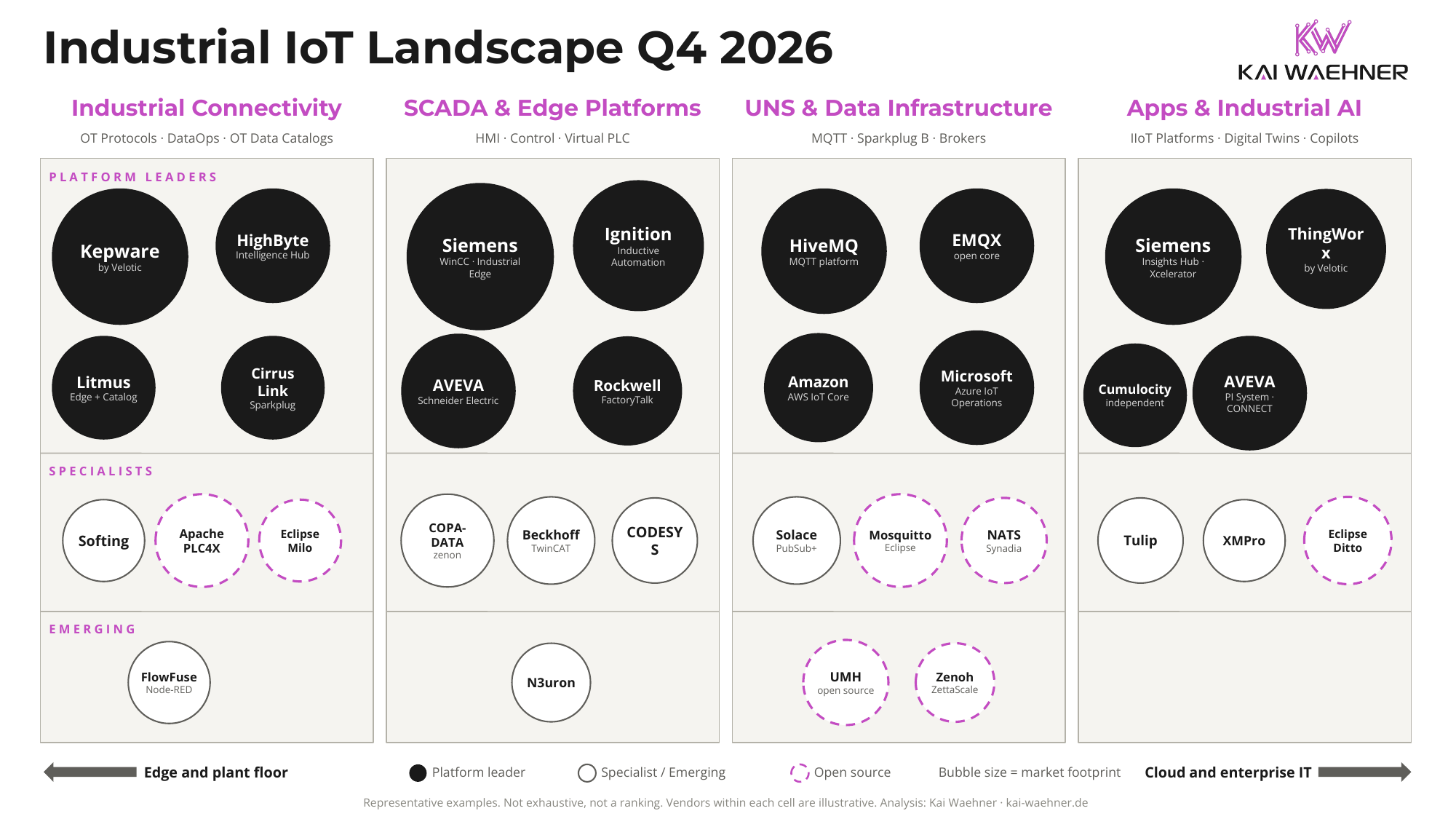
The landscape organizes the market into four columns that read from edge to cloud, with platform leaders, specialists, and emerging players in each.
Industrial connectivity is the first mile: protocol servers like Kepware, industrial DataOps platforms like HighByte and Litmus, Sparkplug expertise from Cirrus Link, and the open source projects that changed the economics of connectivity, Apache PLC4X and Eclipse Milo among them. Buyers here solve the problem of getting clean, modeled data out of heterogeneous equipment.
SCADA and edge platforms operate the plant. Siemens, Ignition, AVEVA, and Rockwell lead; COPA-DATA, Beckhoff, and CODESYS specialize. The column is covered compactly in this edition, because supervisory control is a deep market of its own.
Unified Namespace and data infrastructure is the backbone between plant and enterprise: HiveMQ and EMQX as the MQTT brokers most often named in UNS architectures, AWS IoT Core and Azure IoT Operations as what the hyperscalers kept, and Solace, Eclipse Mosquitto, NATS, and United Manufacturing Hub as the specialists and newcomers.
Applications and industrial AI turn data into decisions: Siemens with Insights Hub and the digital twin business, ThingWorx under its new Velotic ownership, AVEVA’s PI System, Cumulocity, and frontline and twin specialists such as Tulip, XMPro, and Eclipse Ditto.
Vendors are placed by the center of gravity of each product, and some appear in more than one column. Several of this year’s most interesting product moves are vendors growing into the neighboring column, which the landscape covers as its own trend.
The Unified Namespace as the Integration Pattern of the Plant
A Unified Namespace is a single, hierarchically organized source of current plant data, usually an MQTT broker structured along ISA-95, that every producer publishes into once and every consumer reads from, so that no application needs a direct connection to any other.
Point-to-point OT integration couples every application to every source. Each new consumer multiplies connections, each change breaks something downstream, and every system holds a different version of the plant’s state. The UNS inverts this. Producers publish once. Consumers subscribe independently. Adding the tenth application costs the same as adding the second.
One clarification matters, because it separates working UNS deployments from broker installations with a new name. Raw sensor values dumped onto a broker are not a UNS. Without contextualization in the DataOps layer, a broker is a message bus, not a namespace. The namespace earns the name when data arrives modeled, named, and self-describing, and the maturity step behind that is data contracts: machine-readable schemas that let the namespace validate payloads and evolve safely across sites, teams, and vendors.
Event streaming brought the same shift to enterprise IT a decade ago, which is why the two worlds connect so cleanly at the boundary.
OPC UA, MQTT, and the Standards That Keep Vendors Replaceable
OPC UA describes what a machine is and what its data means; MQTT moves that data to everyone who needs it. One is the semantic standard at the equipment, the other the distribution standard across the plant, and the question of which one to pick is usually the wrong question. The practical pattern of 2026 is OPC UA at the equipment interface, contextualization in the DataOps layer, and MQTT with Sparkplug B as the distribution fabric. Any vendor forcing a choice between the two is describing its product boundary, not the architecture. Many plants still deliberately run only one of them, and combining both pays off when contextualized distribution at scale is the goal.
Two findings in this chapter surprise most architects. First, the portability check for OPC UA is not whether a vendor supports it, nearly everyone does, but whether the server exposes real companion specification models or a flattened proprietary view with its own variables. An OPC UA server with custom variables is connected, not interoperable. Second, standards carry a bill. On some controllers OPC UA is a per-CPU runtime license, and a standards-based read can cost up to two orders of magnitude more in latency and controller load than the native protocol on the same wire. How a client asks often matters more than which protocol it speaks. Standards buy portability, semantics, and auditable security. They do not buy performance, and they should be budgeted and measured like any other architecture component.
The chapter also covers what regulation now forces, from the EU Data Act’s access-by-design obligation to digital product passports, and why Zenoh and NATS are worth watching as robots and software-defined vehicles bring their own protocols into the plant.
Where Industrial IoT Meets Enterprise IT
Industrial IoT does not end at the plant gate, and it does not extend into the enterprise data stack either. The two architectures meet at a boundary, and each OT layer has a natural counterpart on the IT side: intelligence to the lakehouse, applications to the business systems, the Unified Namespace to data streaming, and connectivity to the data catalogs.
The main highway is the exchange between the Unified Namespace and data streaming, where Apache Kafka and Apache Flink carry plant events into the enterprise. The boundary is turning into product on both sides: Ignition 8.3 publishes and consumes Kafka topics natively, and the analytical platforms accept the Kafka protocol for ingestion. OPC UA, MQTT, and Kafka as the trinity of industrial data streaming was the argument in 2022, and it is the default pattern of 2026.
Two connections are missing from that mapping by design. Physical operations has no direct path to enterprise IT, because PLCs reach it only through the layers above them. And there is no direct OT-to-lakehouse path, because that route recreates reverse ETL at plant scale. What decides and coordinates above the data movement is workflow orchestration, a layer deliberately outside this landscape and covered in Unified Orchestration in Manufacturing.
Five Industrial IoT Trends and Six Questions Before a Shortlist
The landscape closes with five trends and a decision framework. The trends:
- Virtual PLCs move control to software. Audi’s EC4P program replaced thousands of controllers with virtual counterparts on rack servers, and certified virtual safety controllers now exist. Control becomes deployable, versionable, and orchestrable.
- Digital twins close the loop. The what-if layer is becoming an expectation, and the Asset Administration Shell keeps twins exchangeable across vendors.
- Generative and agentic AI reach the plant. MCP servers are spreading across industrial vendors, and deterministic decision models complement LLM-based agents where latency and non-determinism are disqualifying. Both need a contextualized namespace to read from and governed pathways to act through.
- OT metadata joins enterprise governance. OT data catalogs are the newest category on the map, connecting plant assets, tags, and lineage to Collibra, Purview, and Unity Catalog.
- The categories are converging. HiveMQ moved a broker into contextualization, Litmus moved DataOps into governance, and Ignition moved SCADA into native Kafka event distribution. Expect overlap in every shortlist.
The six questions to answer before any vendor shortlist: where your data needs to be actionable first, one vendor stack or best-of-breed through a UNS, which standards are non-negotiable for your fleet, what your deployment constraints are, whether the licensing model survives scaling, and whether closed-loop automation or agentic AI is a near-term priority. Each one eliminates more vendors than a feature comparison does.
Read the Industrial IoT Landscape Q4 2026
The full landscape works through the market vendor by vendor, with all six figures and the complete chapters on standards, regulation, and the IT/OT boundary: Industrial IoT Landscape Q4 2026. The PDF is available on that page.
The plant floor is becoming software. Data must flow from edge to cloud in real time. Everything else follows from that.
To follow this work across data integration, workflow orchestration, process intelligence, and trusted agentic AI, subscribe to the newsletter and connect on LinkedIn.