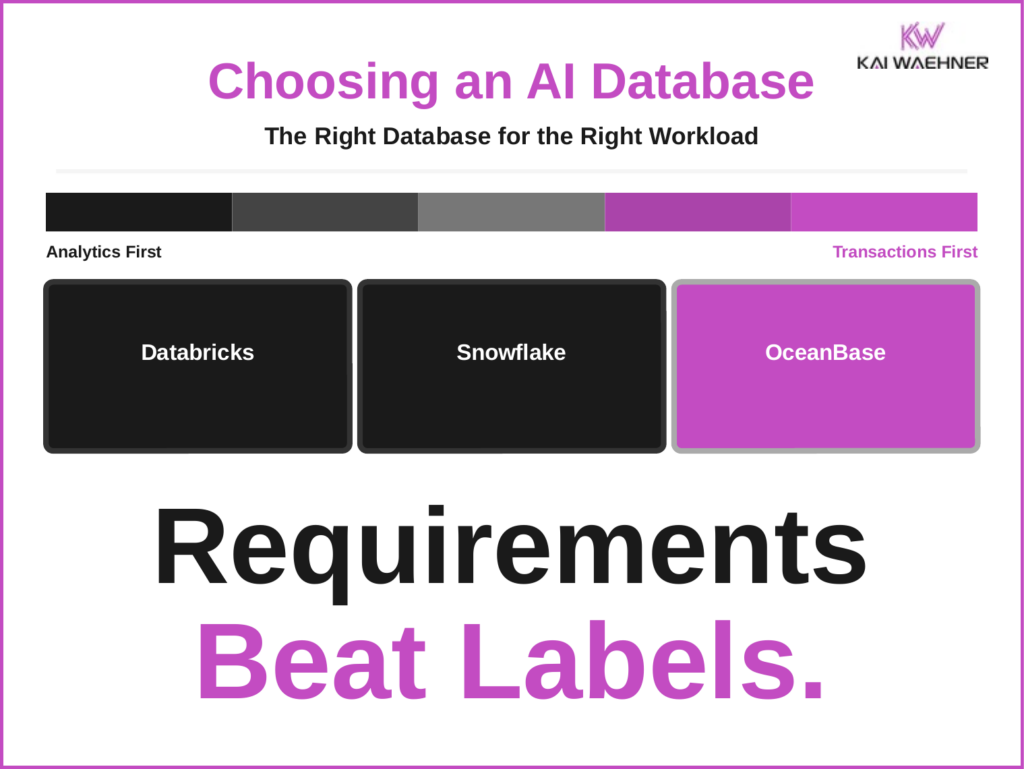
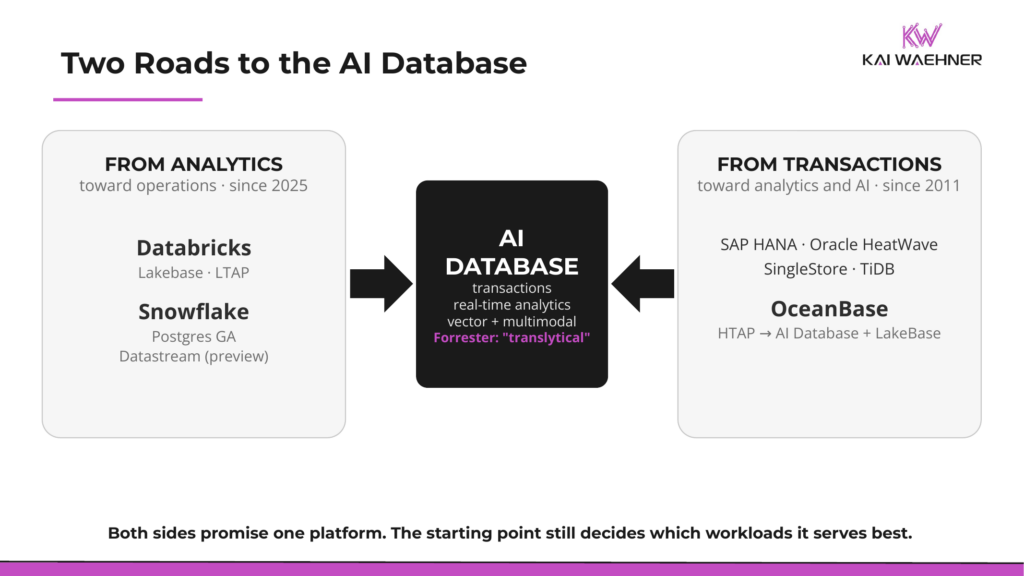
At its OceanBase Hours event in Singapore in August 2026, OceanBase presented the next step of a fifteen-year evolution: from the distributed database behind Alipay to an AI Database portfolio for agents working on live operational data. The ambition is not unique. Databricks and Snowflake are moving toward the same goal from the opposite direction, extending their analytics platforms into transactional workloads. The marketing sounds identical from both sides: one platform for all data and AI workloads. The architecture underneath is not identical, and neither are the trade-offs. This article examines OceanBase’s positioning in depth and compares it with Databricks and Snowflake where the roads cross. It also states clearly where OceanBase is the best fit and where it is not.
What Is an AI Database?
An AI database is a data platform that combines transactional or analytical data management with the capabilities AI applications need. These capabilities include vector search, hybrid retrieval across structured and unstructured data, and low-latency access to fresh state for agents.
The term needs one disambiguation up front. It describes a market category, and since June 2026 it is also a product name: OceanBase launched a portfolio called OceanBase AI Database. In this article, “AI database” means the category unless a vendor product is named explicitly. A second naming overlap tells you how convergent this market has become: both Databricks and OceanBase now ship a product called Lakebase, announced a year apart. This article distinguishes them as Databricks Lakebase and OceanBase LakeBase throughout.
As a category, the term currently describes at least three different products. The first is an analytics platform with a new operational tier, such as Databricks Lakebase or Snowflake Postgres. The second is an operational database that added analytical processing and vector search to its transactional engine, such as OceanBase, SingleStore, or TiDB. The third is a lightweight engine built for retrieval and agent state, such as OceanBase seekdb, Pinecone, or PostgreSQL with pgvector.
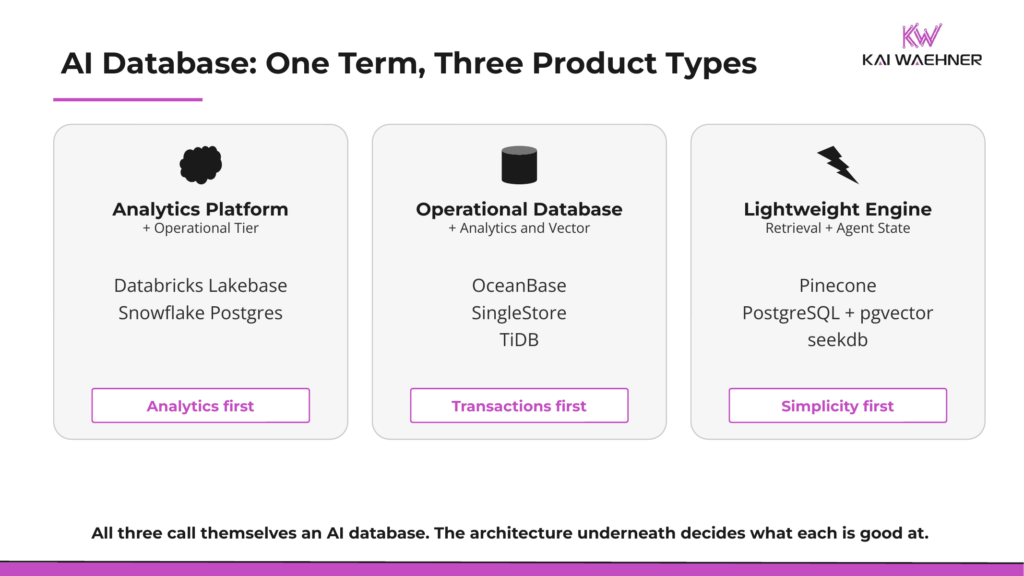
All three answer the phrase “AI database” in a vendor deck. They do not answer the same requirements. The rest of this article looks at where OceanBase sits among them, and why.
Why AI Agents Change Database Requirements
Agentic applications produce a workload shape that classic categories do not cover cleanly. An agent holds state that must survive restarts and stay consistent across steps. It takes actions with real consequences, such as placing an order or moving money. These actions demand transactional guarantees. It retrieves context across documents, embeddings, and structured records in a single request. And it needs data fresh enough to act on, not yesterday’s batch load.
Forrester analyst Indranil Bandyopadhyay made a sharper version of this point at OceanBase’s Singapore event in August 2026: most data platforms were designed with a human at the other end. Humans query occasionally, tolerate latency, and read reports on a schedule. Agents query continuously, at machine speed, around the clock. The consumer of the data platform has changed, and the platform requirements change with it. Governance changes too. Permission checks and audit models designed for occasional human access become a bottleneck when agents act continuously. This pushes policy enforcement down into the engine, evaluated at the moment data is read or written.
Consistency and durability point to OLTP. Large-scale retrieval and aggregation point to OLAP and search. Semantic retrieval points to vector engines. No single classic category covers the combination, which is why every vendor now claims the middle ground. OceanBase’s answer to that combination is best understood through the path the product took.
Inside OceanBase: Three Stages from Mission-Critical Transactions to Multimodal AI
OceanBase’s evolution runs in three stages, and each stage builds on the guarantees of the previous one. Mission-critical transactions came first. Real-time analytics on that live transactional data followed. Multimodal AI on the same foundation is the third step. The most reliable way to evaluate the AI claims of stage three is to understand what stages one and two demanded.
Stage One: What a Payment Ledger Demands from a Database
A payment ledger is one of the least forgiving workloads in enterprise IT. The database underneath must guarantee strict consistency across geo-distributed replicas, because an account balance cannot fork. Write throughput has to hold up under contention, because payment spikes are not schedulable. Failover happens in seconds without data loss, and the regulator expects a complete audit trail.
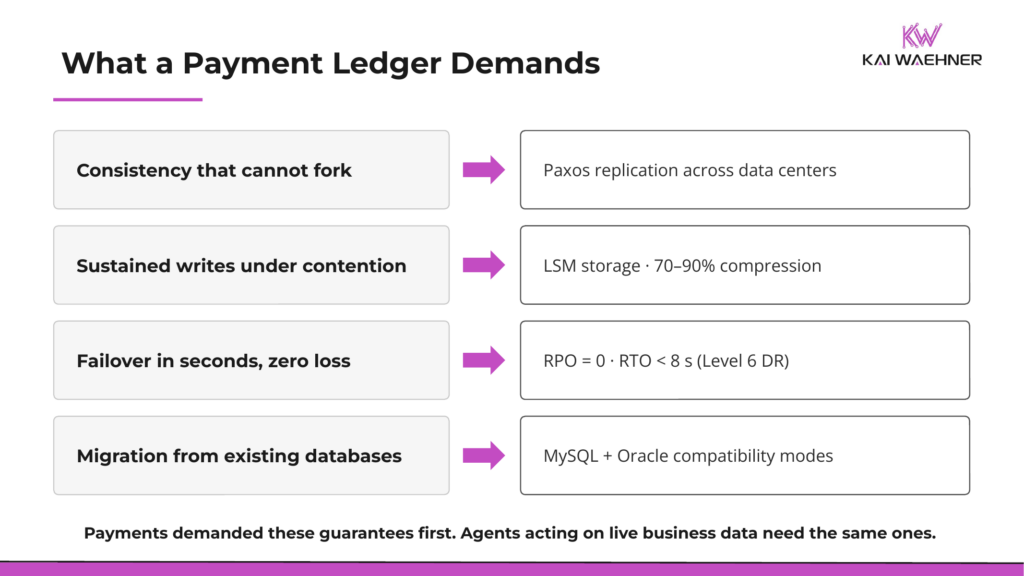
OceanBase was developed from 2010 onward because existing options could not meet those demands at Alipay’s scale. The architecture reflects the requirements. Paxos-based replication provides strict consistency across data centers. The “five data centers across three regions” deployment pattern covers regional disaster recovery. An LSM-tree storage engine materially reduces storage footprints through compression. The published recovery targets are zero data loss and failover in under eight seconds, RPO = 0 and RTO < 8s, which maps to the highest level of the financial industry’s disaster recovery standard. MySQL compatibility, plus Oracle compatibility in the enterprise edition, made it a migration path for banks moving off their existing databases. The system has carried Double 11 for eleven consecutive years, with a recorded peak of 459,000 transactions per second. Double 11 is China’s largest online shopping festival and one of the biggest transaction peaks anywhere in the world. It also holds a published result of 707 million transactions per minute in TPC-C, the standard industry benchmark for transactional database performance. Read that benchmark with context: it dates from 2020, and no major vendor has contested TPC-C at that scale since. The production numbers are the more meaningful proof.
Customer Proof Points Beyond Ant Group: GCash, DANA, and TNG Digital
The fair question for any vendor with a famous in-house workload is what runs outside the family. The reference base has internationalized. OceanBase powers GCash in the Philippines, DANA in Indonesia, the African e-wallet PalmPay, and the Iraqi national credit card Qi Card. TNG Digital in Malaysia and easypaisa in Pakistan run on it as well. The GCash numbers are concrete: roughly 70 percent lower storage requirements and more than 40 percent lower resource costs. The wallet is used by roughly one in two people in the Philippines. Overall, OceanBase reports more than 4,000 customers. Over 100 are fintech companies, including more than 20 e-wallets serving over 1.3 billion end users. More than 400 banking and financial institutions run it, over 60 percent for core systems.
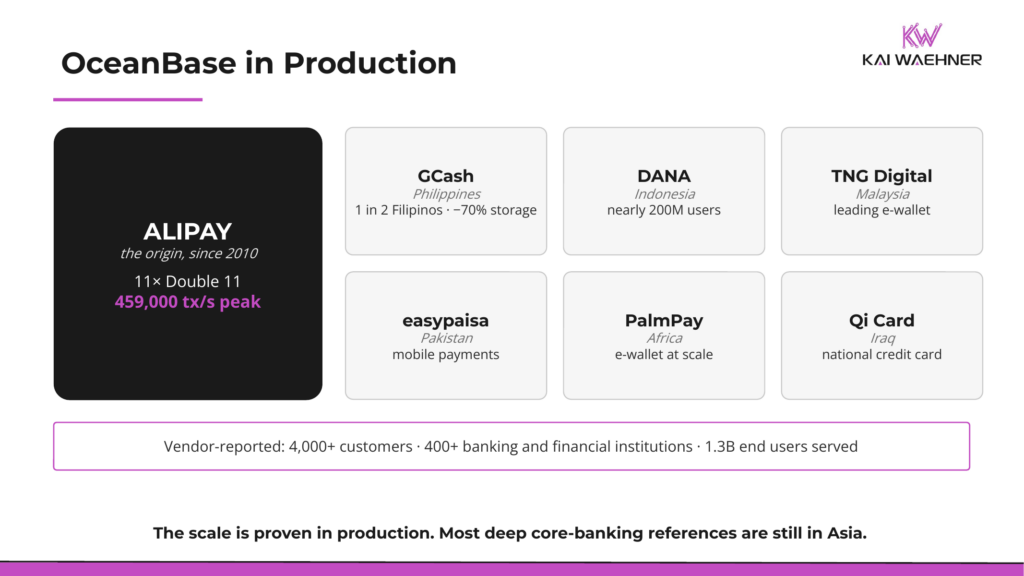
State the limitation as plainly as the strength: the deepest core-banking deployments remain concentrated in Asia, where the product originated and where digital payments run at the highest volumes in the world. A European or American buyer gets strong evidence at extreme scale and a smaller local reference pool than the incumbents offer.
Stage Two: Real-Time Analytics on Live Transactional Data
The second stage added analytical processing to the same live business data, so that continuously changing orders, accounts, and inventory can be analyzed without first copying them into a separate system. Forrester calls this category translytical. These platforms support transactional, operational, and analytical workloads on a single engine without sacrificing integrity or real-time analytics. OceanBase was named a Challenger in The Forrester Wave: Translytical Data Platforms, Q4 2024. Forrester’s Noel Yuhanna argues on the firm’s blog that translytical platforms have become critical for AI applications, because consistent, real-time data improves accuracy and reduces problems such as hallucinations. The direction itself has history: SAP HANA, Oracle HeatWave, SingleStore, and TiDB all combine transactional and analytical processing in their own ways. OceanBase extends the lineage furthest toward AI: version 4.4 integrates transactional, analytical, and AI capabilities in a single kernel.
One caveat applies to every system in this category, OceanBase’s included. Combining workloads in one engine still means more than one internal representation of the data. Typically there is a row-oriented path for transactions and a columnar path for analytics. Nobody found a way around physics. The difference between vendors is which workload the architecture treats as its center of gravity, and which one it added later.
Stage Three: OceanBase AI Database, LakeBase, and seekdb
In June 2026, OceanBase packaged its AI direction as the OceanBase AI Database portfolio, built around its LakeBase architecture. The LakeBase engine combines data lake openness with database-grade transactions and real-time serving. DataStudio covers data production, governance, and semantic modeling. DataPilot translates natural-language questions into governed queries.
Two concepts define the ambition, and the distinction between them is worth spelling out because production AI needs both. Multimodel means supporting multiple data models: relational, document, key-value, and vector. Multimodal means managing different forms of content: text, images, audio, and video. OceanBase’s multimodal tables address both at once: structured fields, documents, images, vectors, and model outputs managed under the semantics of one table, inheriting the same transactions, consistency, and access controls. An order status, a customer profile, a business document, and a vector index become different representations of the same business entity rather than separately maintained copies. The design goal is not one engine for every workload. The native SQL engine handles transactions, real-time analytics, and hybrid search. Engines such as Spark and Ray work against shared data and metadata.
Alongside the platform sits seekdb, released in late 2025: a lightweight, MySQL-compatible engine unifying vector, full-text, JSON, and relational data for hybrid search and agent state, in embedded or single-node form. It is built on the same OceanBase SQL engine that runs the distributed cluster, so the newest product inherits fifteen years of production hardening. Unlike the distributed OceanBase database, seekdb is fully open source under the Apache 2.0 license. The split is sensible: an open source, lightweight engine for the agent tier, the distributed database where the transactions live, and one MySQL-compatible surface across both.
The Same AI Database Goal from the Other Direction: How Databricks and Snowflake Converge
OceanBase is not alone in seeing the destination. Databricks acquired Neon for a reported one billion dollars and shipped Databricks Lakebase, then announced its LTAP architecture in June 2026. The acronym stands for Lakehouse Transactional-Analytical Processing, a term Databricks introduced as a deliberate variation of HTAP, the established category for hybrid transactional and analytical processing in one system. Snowflake Postgres reached general availability on February 24, 2026, built on the Crunchy Data acquisition. Both target application state, session data, chat history, and feature serving beside the lakehouse, without a pipeline in between.
Event streaming already showed how this kind of race tends to end: platforms absorb the convenience workloads next to data they already govern, while the specialized engine keeps the critical, high-scale workloads. Why Databricks and Snowflake both speak the Kafka protocol today, and why ingestion is not the same as architecture, is a story of its own. The open question for databases is the same one: who runs the engine underneath the most critical workloads.
Databricks markets LTAP as “one data, zero compromises, zero copies.” Engineers pushed back on that claim quickly. Pressed on the wording, a Databricks engineer acknowledged that two physical representations exist, since pageservers act as a caching and materialization layer in the Neon-derived architecture. The company argues the claim holds because only one authoritative copy needs synchronization. SingleStore’s CTO, a competitor with its own combined-processing history, countered that renaming HTAP to LTAP changes the marketing rather than the physics. Database researcher Andy Pavlo assessed the underlying engine work as far from trivial. Both positions can be right at once: the engineering is real, and the zero-copies framing oversimplifies it. Maturity matters as much as architecture: Databricks Lakebase and Snowflake Postgres are generally available, while parts of the synchronization tooling are newer. When evaluating, separate what is shipped from what was announced.
Shift Left, One Layer Down: Guarantees at Write Time
The clearest way to separate OceanBase’s road from the lakehouse road is to ask where the guarantees live. Databricks unifies at the storage layer: PostgreSQL handles transactions, lakehouse engines handle analytics, and both operate on one durable copy of open columnar data. OceanBase unified transactions and real-time analytics inside the database engine first, and then used its LakeBase architecture to connect object storage and open compute such as Spark and Ray. Put simply, Databricks brings transactions to the lake, while OceanBase brings the lake to live operational data.
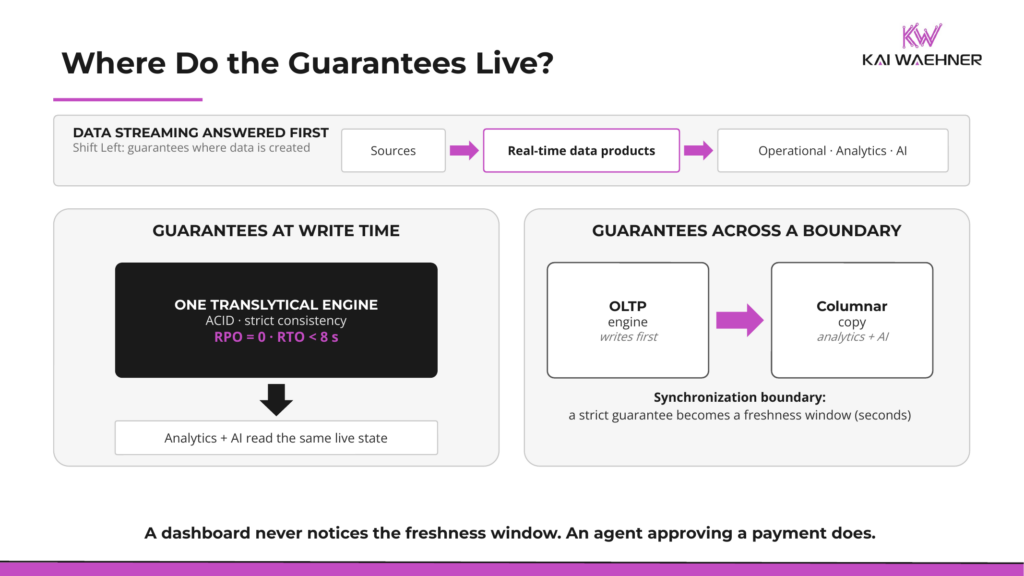
Readers from the data streaming community will recognize this argument. The Shift Left Architecture makes the case that quality, governance, and freshness should be built where data is created. Real-time data products then serve operational, analytical, and AI consumers alike. The alternative lands raw data in a lakehouse and reconstructs trust downstream, layer by layer. The same logic now applies one layer down, in the database itself. In a translytical system, the guarantees exist at write time: ACID transactions, strict consistency across replicas, and recovery targets attached to the system where the data is born. Analytics and AI read the same live state those guarantees protect. In a lakehouse-first architecture, the operational tier writes with real transactional guarantees too. But the analytical and AI representations sit on the other side of a synchronization boundary. Every boundary crossed turns a strict guarantee into a freshness window. For a dashboard, that window is invisible. For an agent approving a payment against an account balance, it is the difference between acting on the truth and acting on a copy.
Stated fairly, this is a difference in center of gravity and maturity, not a missing feature. Databricks Lakebase writes to a real OLTP engine, and its synchronization to the lakehouse is fast. But mission-critical operational capability arrived on that platform within the last two years, while it was the founding requirement of OceanBase’s road. When the hardest requirement is the ledger, that history is not a footnote.
Deployment Control: Where OceanBase Differs Most from Databricks and Snowflake
Workload fit and architecture are two axes of this decision. The third is deployment control: where the software is allowed to run, and who controls that decision. The Trusted Agentic AI Landscape and the Data Streaming Landscape both treat deployment control as a first-order selection criterion, and the same applies to AI databases.
The contrast is sharp. The operational tiers from Databricks and Snowflake exist only as managed cloud services. OceanBase runs on bare metal, on-premises, and across the major clouds. The company reports operating across more than 170 availability zones in over 50 regions. seekdb even runs embedded inside an application. For a system of record under residency mandates or strict regulatory requirements, the ability to run the database in your own environment and leave with your data often decides the evaluation before performance enters it.
When to Choose OceanBase as Your AI Database
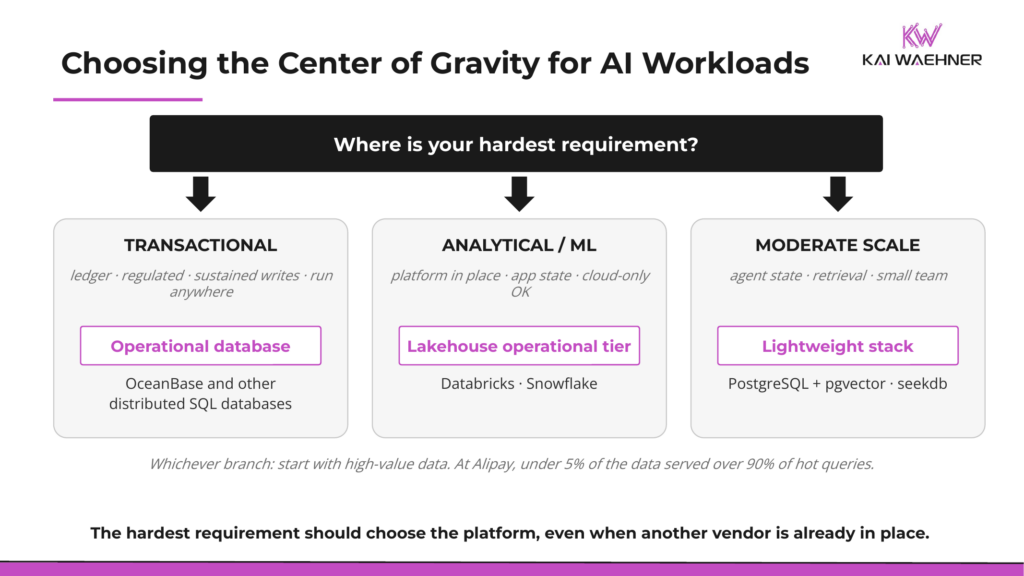
The three axes come together in one practical question: which system becomes the center of gravity, with everything else attached to it.
The Best Fit: Transactional Systems of Record with AI Capabilities
OceanBase belongs on the shortlist when the hardest requirement is transactional:
- Money or inventory moves through the system, and an account balance cannot fork.
- Consistency violations carry regulatory consequences, and the audit trail must be complete.
- Write throughput is sustained rather than bursty, and failover targets are measured in seconds.
- The system must run in your own environment, from bare metal to multi-cloud.
Within that shortlist, OceanBase’s differentiation is the combination of proven extreme scale, the integrated analytics and AI capabilities of the 4.4 kernel, and deployment freedom. AI capabilities then attach to the system of record: vector search near the ledger, agent actions with real transactional guarantees.
When Databricks, Snowflake, or a Lightweight Stack Is the Better Choice
Choose the Databricks or Snowflake operational tier when the hardest requirement is analytical or ML-driven and the operational need sits next to it. The signals: the team already operates the platform, and the transactional workload is application state rather than a ledger. Cloud-only deployment is acceptable, and reducing vendor count outweighs deployment control. And many agentic applications need neither enterprise platform: PostgreSQL with pgvector, or an embedded engine such as seekdb, covers retrieval, hybrid search, and agent state at a fraction of the operational weight. Start there when data volumes are moderate and no regulator audits the workload; migrate upward when the transactional signals appear, not before.
The limit of both alternatives is the ledger. Do not put a booking system or any workload with hard consistency and failover requirements on an operational tier that reached general availability within the last year, however strong the platform around it. And do not let platform convenience decide a system-of-record question. A wrong analytics choice costs a migration project. A wrong ledger choice costs an incident report with your name on it.
When Not to Use OceanBase
A distributed database built for payment-grade workloads is the wrong choice without payment-grade problems, the same way Apache Kafka cannot replace a database for every workload. Skip OceanBase when:
- The workload is analytics-first or ML training. The lakehouse platforms are simply better there.
- A small team would carry the operational weight of a distributed system for traffic a single Postgres instance handles.
- The architecture is already standardized on Databricks or Snowflake and the transactional need is modest application state. The platform’s operational tier next to existing governance will cost less than a new vendor.
Start with High-Value Data
Whichever center of gravity you choose, migration scope decides whether the first project succeeds. OceanBase’s CTO shared a useful number from Alipay’s own adoption at the OceanBase Hours event in Singapore in August 2026: less than 5 percent of the data moved onto the new AI platform, and that 5 percent served more than 90 percent of the hot queries. The remaining cold data stayed in systems that were never designed for AI, and that was fine. The lesson generalizes to every platform in this article: a small scope with a real business owner beats a full migration that delivers value only after everything has moved.
Data Integration Remains: Why Pipelines Survive the Convergence
Both camps promise the end of pipelines. Real enterprises run many systems of record, not one. The ERP, the core banking system, the CRM, and dozens of SaaS applications do not migrate into anyone’s unified platform, whichever side wins the next architecture decision. Integration, change data capture, and event streaming remain the connective tissue between the system of record and every other consumer of its data. What convergence changes is the number of pipelines, not their existence: one hop removed between app backend and analytics, or between transactions and reporting, while the hops between the fifty other systems remain. The same holds one level up. Business processes such as order-to-cash or claims handling cross the ERP, the core system, and a dozen applications end to end, no matter how converged the database underneath becomes. Process intelligence and workflow orchestration therefore sit alongside data integration in the permanent layer: processes need to be coordinated and observed across system boundaries, not only their data moved. Plan that layer as permanent, because it is.
Every Architecture Has a Center of Gravity
OceanBase’s road to the AI database runs through fifteen years of mission-critical transactions. Exactly this history makes its AI positioning credible. Agents acting on live business data inherit the guarantees the payment ledger demanded first. Databricks and Snowflake ship real engineering toward the same goal from the analytics side, and for many workloads their operational tiers are the right choice. At OceanBase’s Singapore event, Indranil Bandyopadhyay closed with a line that captures the decision better than any vendor slide: converge where the seams cost you, and specialize where scale demands it. Match the center of gravity to your hardest requirement. Keep the interfaces open, because MySQL, Oracle, Postgres, and Kafka compatibility preserve your exit options. And treat deployment control as a design input of the same rank as throughput and latency.
Supported by OceanBase (Ant Group). Kai Waehner is the author and retains full editorial control. OceanBase reviewed this article for factual accuracy only.