An AI agent harness is everything between the model API and the business outcome: the tool connections, the context and memory, the agent loop, the guardrails, and the runtime that executes it all. The term has been in specialist use since late 2024, and the vocabulary went mainstream in February 2026 when Mitchell Hashimoto named the practice of “harness engineering” and LangChain popularized the formula behind it: Agent = Model + Harness. The model reasons. The harness makes the reasoning useful.
Almost everything written about harnesses so far is engineering content that explains how to build one, how to keep agents reliable over hundreds of tool calls, and how to structure context. The work is valuable, but it is aimed at builders. Multi-model orchestration answered which layer picks the model. This post takes the other seat at the table and answers where the switching cost actually sits.
If you are an enterprise buyer or architect, the harness is not an engineering detail. It is where vendor lock-in moved after the model became swappable, and it deserves more scrutiny than the model choice that gets all the attention.
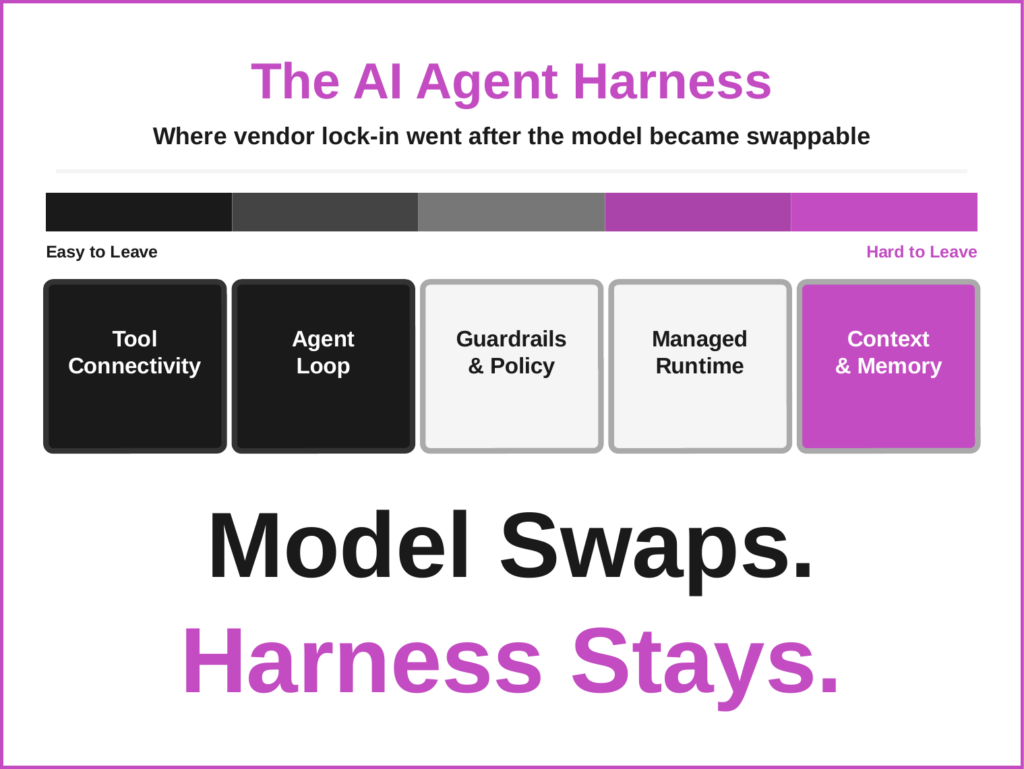
Why the AI Agent Harness Is Now the Real Decision
The Trusted Agentic AI Landscape Q3 2026 documented a shift across the enterprise AI market: lock-in moved up the stack. Model-layer lock-in is dead as a vendor strategy. Models commoditize in months, customers demand portability, and every serious platform now advertises model choice. The vendors did not become generous. They moved the lock-in one level higher, into the layer that does not commoditize.
That layer is the harness. Your models change with every release cycle, while your harness accumulates. It collects agent definitions, tool integrations, context about how your business runs, and operational knowledge about what fails and why. After eighteen months, the model is a config setting and the harness is your architecture. The switching cost inverted, and most procurement processes have not noticed yet.
What Does an AI Agent Harness Include?
Five layers wrap a bare model, and each one locks you in differently.
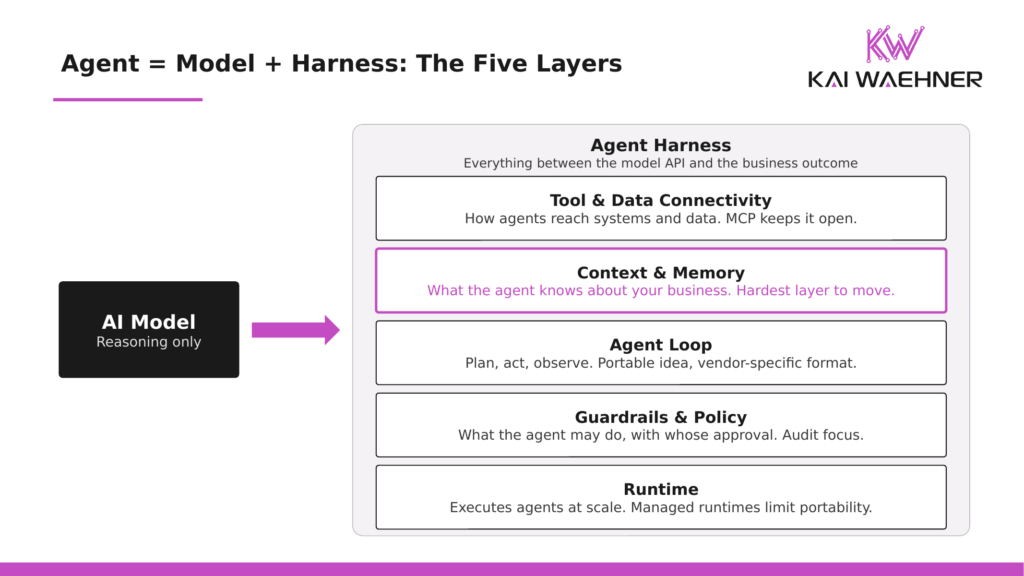
Tool and data connectivity is how the agent reaches systems and data. The Model Context Protocol is the stabilizing force here, and building on it preserves interoperability. One caveat: an open standard with a single dominant implementer is more open than a proprietary protocol and less open than a standard with many.
Context and memory is what the agent knows about your business: entities, permissions, history, relationships. This is the stickiest layer by far. Context compounds in value the longer it accumulates, and it compounds in exit cost at exactly the same rate.
The agent loop is the reasoning cycle: plan, act, observe, repeat. Loop logic tends to be portable in concept and proprietary in format.
Guardrails and policy decide what the agent may do, with whose approval, under which limits. In regulated environments this layer is what your auditors examine.
The runtime executes all of the above: state, retries, isolation, scale. Managed runtimes are convenient, and they are also where your agent architecture becomes non-portable.
Model-Agnostic Is Not Harness-Agnostic
Every harness vendor claims to be model-agnostic, and most are telling the truth. You can swap Claude for Gemini, run an open-weight model, or route by cost. The claim is real and it is also beside the point. Model-agnostic and harness-agnostic are different promises, and nobody makes the second one, because the harness is the product.
The Three Shapes of Harness: Framework, Managed Runtime, Embedded
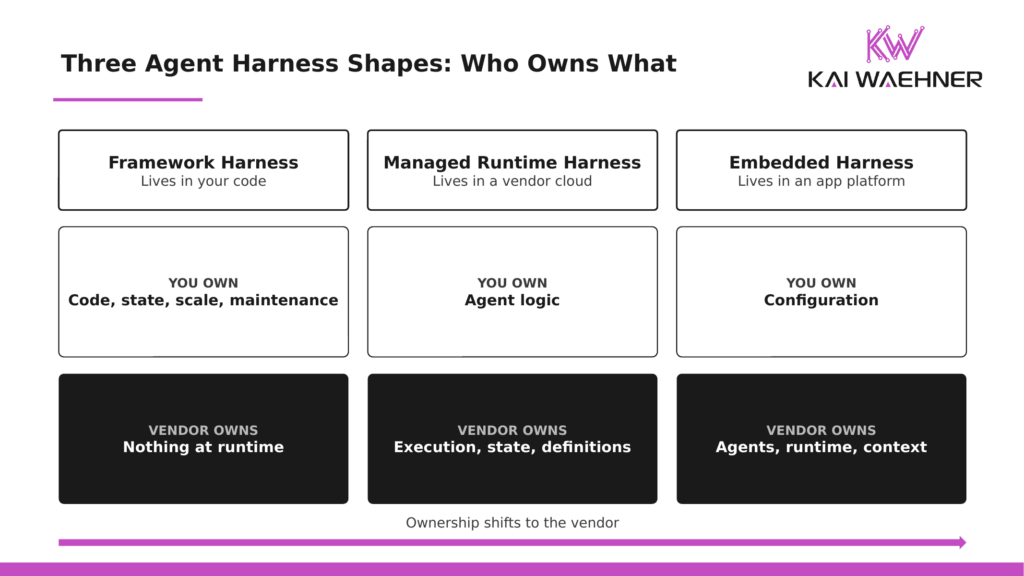
Harnesses come in three shapes, defined by what each one owns of your architecture:
- A framework harness lives in your code: you own everything and maintain everything.
- A managed runtime harness lives in a cloud: the vendor owns execution, state, and scale, and your agent definitions live in their format.
- An embedded harness lives inside an application platform: the platform owns the whole thing, and the agents work only where they were born. None of these is wrong.
They are three different deals, and the mistake is signing one without reading it.
Where Your Context Ends Up: Your Data Layer or the Vendor’s
One question decides more than any feature comparison: does the context your agents accumulate live in your data layer or inside the harness? If it lives in your data layer, governed and current, the harness is replaceable infrastructure. If it lives inside the harness, the harness owns your agents’ usefulness, and leaving means starting over. Ask it first, because the rest is detail.
Five Questions Before You Commit to a Harness
Skip the feature checklist and run the portability test.
- Export: can you export agent definitions in a format another system can read, and has anyone actually done it?
- Context ownership: where does accumulated context live, and can you point at it in your own data layer?
- Runtime: could it be re-hosted on infrastructure you control, or is it inseparable from one cloud?
- Observability: do you get the full audit trail, or only the vendor’s summary of it?
- Exit cost: what is the realistic cost in engineer-months, measured today, before it grows?
Ask all five of the same vendor, in the same meeting, and write the answers down. The gap between what a vendor claims about portability and what it can demonstrate usually shows up somewhere between question one and question five.
When the Harness Choice Matters Less
Not every team needs harness portability, and pretending otherwise would make this post less useful. A team running agents inside one SaaS platform it will never leave gets no value from portable agent definitions. The captured position is rational there, the same trade the landscape describes for platform-embedded AI generally.
The engineering community adds a second caution worth taking seriously: harnesses should stay lightweight, because every model generation changes the optimal agent structure, and over-engineered control flow breaks with the next release.
Both points sharpen rather than weaken the argument. Keep the clever logic thin and disposable. Invest in the durable parts instead: state, policy, audit, and the portability of your definitions, because those survive every model release while the clever logic does not.
Where the Harness Sits: Orchestration, Data Integration, and Process Intelligence
The harness is the inner loop, running one agent with its reasoning cycle, tools, memory, and guardrails. What the harness does not do is coordinate the enterprise.
Workflow orchestration is the outer loop that does: coordinating work across agents, systems, and humans, with approvals, schedules, retries, lineage, and the audit trail that regulated industries require. Process intelligence tells you which processes deserve agents in the first place. And data integration feeds all of it, because an agent working from stale data produces confident wrong answers no matter how well its harness is built.
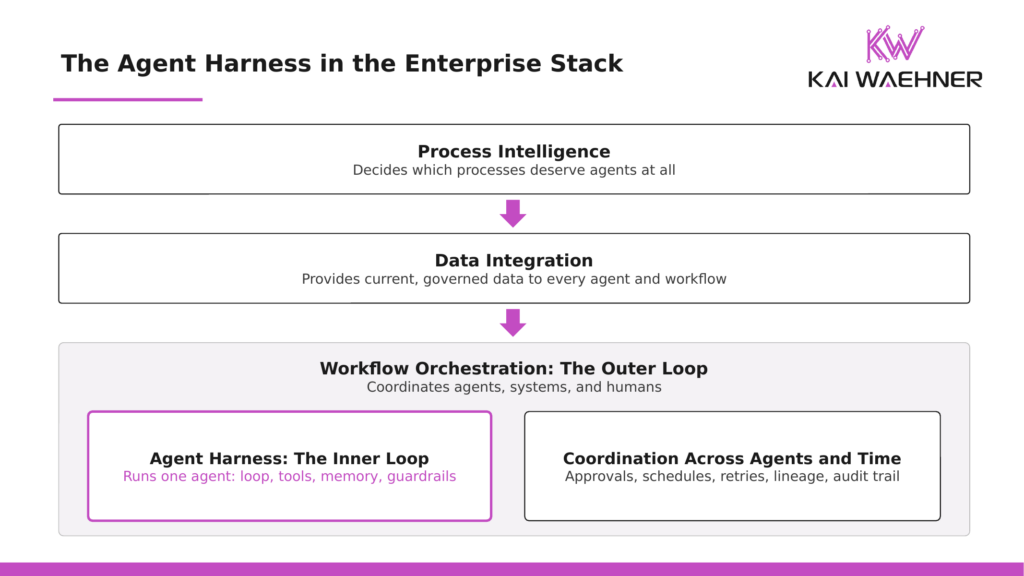
The harness question lives inside the trusted agentic AI layer of that architecture. The Trusted Agentic AI Landscape covers the model layer above it, and the Data Integration Landscape 2026 and Process Intelligence Landscape 2026 cover the other two pillars.
The Harness Outlives the Model
The model is the replaceable part now. The harness is where your context, your architecture, and your switching costs live, and it deserves the scrutiny the model choice used to get. Choose the model for capability. Choose the harness for what it lets you keep.
To follow this work across data integration, workflow orchestration, process intelligence, and trusted agentic AI, subscribe to the newsletter and connect on LinkedIn.