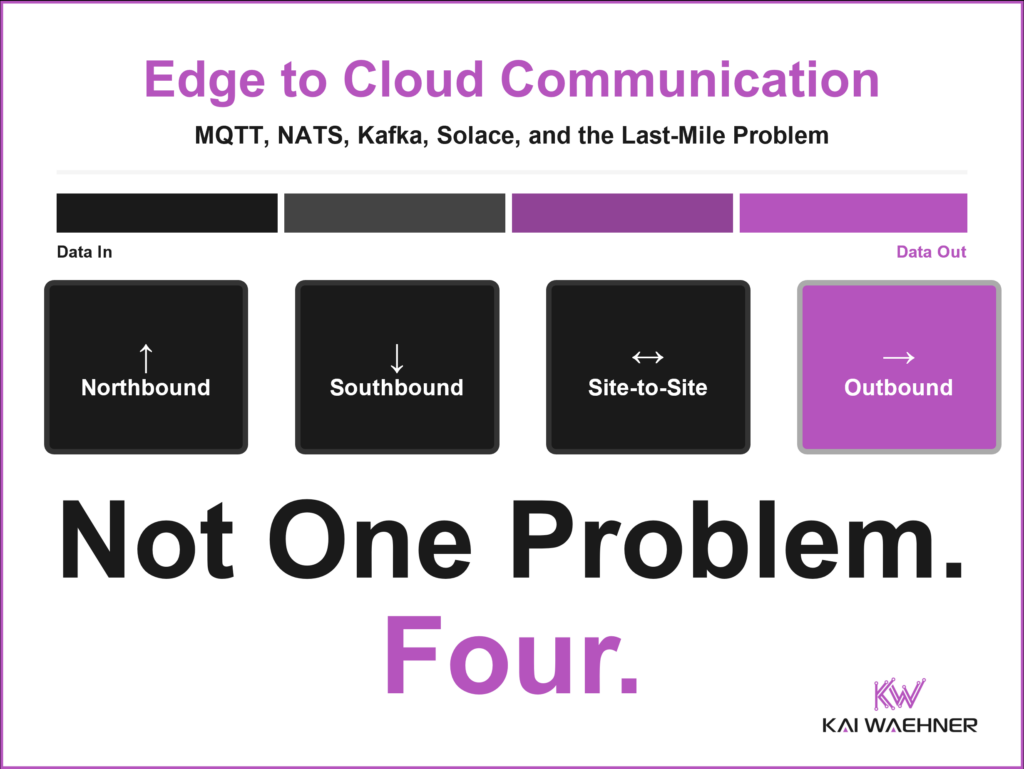
Edge to cloud is not one integration problem. It is four: telemetry going up, control going down, sites syncing sideways, and data reaching people. Each has different physics. Most failed projects picked one technology for all four.
Every enterprise with factories, stores, vehicles, hospitals, or devices faces the same architectural question. How does data move between the edge and the data center or cloud, in both directions, reliably, securely, and at acceptable cost? The vendor landscape answers with dozens of overlapping options: MQTT platforms, hyperscaler services, event streaming, event mesh, messaging fabrics, delivery platforms, and protocol proxies. This article structures the option space by traffic pattern instead of by product category, maps the vendor categories onto those patterns, and closes with a decision framework you can apply to your own architecture.
The categories here sit alongside the wider integration landscape rather than inside it. For that broader map across event streaming, API, and batch, see the Data Integration Landscape 2026.
What Does Edge to Cloud Communication Mean?
Edge to cloud communication is the movement of data between distributed physical locations and centralized computing environments, in both directions, across networks the architect does not control.
The word edge hides four very different tiers:
- The device edge means microcontrollers, sensors, and actuators with kilobytes of memory.
- The gateway edge means industrial PCs, vehicle computers, and protocol converters.
- The site edge means a factory, store, hospital, or ship with local compute and its own network boundary.
- The near edge means regional data centers close to many sites. A technology that fits one tier often fails at another.
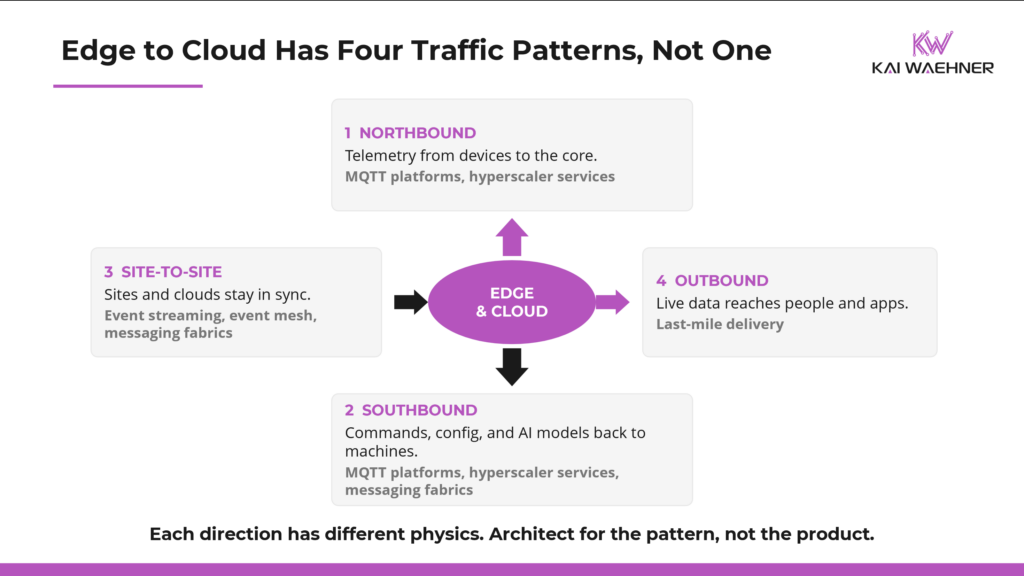
The traffic crossing these tiers falls into four patterns:
- Northbound telemetry moves sensor readings, machine states, transactions, and logs from the edge toward central platforms for analytics, AI, and business systems.
- Southbound control moves commands, configuration, software updates, and increasingly AI models from central platforms down to machines and gateways.
- Site-to-site traffic synchronizes data between sites, between a site and a core data center, or between clouds.
- Outbound delivery pushes live data from central platforms to the applications people use: dashboards, mobile apps, and trading screens.
Direction plus consumer type plus constraint determines the right technology. Vendor preference does not.
Why Do Network Constraints Decide the Edge to Cloud Architecture?
The network between edge and cloud is the one component you cannot refactor. Its properties dictate the architecture before any product evaluation starts.
Connectivity is unreliable. Ships, vehicles, and remote sites go offline for hours or days. Any viable architecture is offline first: local operation continues, data buffers locally, and synchronization resumes when the link returns. This is why store and forward is the single most important capability on any edge evaluation checklist.
Inbound connections are forbidden. Industrial sites, retail networks, and vehicle fleets sit behind NAT, firewalls, and cellular carriers. Security teams do not open inbound ports for messaging. Every serious edge technology therefore uses the same trick: the edge dials out. MQTT clients dial out to brokers. NATS leaf nodes dial out to hub clusters. Azure IoT Operations dials out from the factory to the cloud broker. Different stacks, identical answer, because the constraint is identical.
Hardware is constrained and heterogeneous. An 8-bit microcontroller, a fanless gateway PC, and a site server need different footprints. Some technologies scale down to bare microcontrollers. Others assume a Kubernetes cluster. Matching footprint to tier is half the selection process.
Data residency is now an architecture requirement, not a legal afterthought. European manufacturers increasingly must prove which data leaves the site, the country, or the jurisdiction. Topic design, routing rules, and retention policies become compliance controls.
And one constraint is usually invented rather than measured: latency. Teams assert real time requirements that the business case does not contain. A large share of edge traffic is perfectly fine as periodic batch over a metered link. Keep that thought. It returns in the site-to-site section.
Northbound: How Does Telemetry Get from OT and Devices into the Core?
Northbound telemetry is the pattern the industry knows best, and the one with the most settled consensus.
At the machine level, OPC UA provides the semantic information model. It defines what a temperature, a batch, or a machine state means. MQTT provides the efficient transport, and Sparkplug adds topic structure, birth and death certificates, and state awareness on top of MQTT.
The two standards stopped being rivals. OPC UA Pub/Sub over MQTT is the convergence point: OPC UA semantics carried over MQTT infrastructure. Edge gateways and industrial DataOps products, for example HighByte or Ignition with its MQTT modules, convert brownfield protocols like Modbus and S7 into that stack.
The Unified Namespace (UNS) pattern then organizes all site data as a live, hierarchical topic structure on a central broker. I covered UNS design and its trade-offs in depth in Unified Namespace vs. Data Product in IT/OT for Industrial IoT and the broader MQTT market in MQTT Market Trends: Cloud, Unified Namespace, Sparkplug, Kafka Integration, so this section stays short.
The real decision is the broker and its operating model. Self-managed platforms carry the northbound load for most industrial estates: HiveMQ and EMQX at the enterprise end, Mosquitto and NanoMQ where a lightweight or embedded footprint matters. They give you deployment control, protocol depth, and edge variants that run on gateways. Managed cloud services remove the operations burden and integrate natively with cloud analytics. The dividing line is usually sovereignty and site autonomy: if the broker must run inside the factory, on the ship, or in a specific jurisdiction, self-managed wins. If all sites have reliable connectivity and the data may leave, managed wins on cost of operations.
The hyperscalers themselves tell an asymmetric story. Google retired Cloud IoT Core in 2023 and exited the category. AWS IoT Core remains the steady incumbent for managed device connectivity. Azure went furthest architecturally: Azure IoT Operations runs a distributed MQTT broker on Arc-enabled Kubernetes at the site edge and bridges it to the Event Grid MQTT broker in the cloud, which now supports Sparkplug natively. That is a symmetric edge plus cloud MQTT pair from a single vendor, and it is a new pattern. One hyperscaler retreated, one held, one doubled down. The lesson for architects: managed convenience is real, but so is the risk that a cloud provider deprecates your ingestion layer. The open standards underneath, MQTT and OPC UA, are the insurance policy. Choose products that speak them, and migration remains possible.
Southbound and Outbound: How Do Data and Commands Flow Back to Machines and People?
Almost all edge content covers ingestion. The return direction is harder, and it is where architectures break, because the return direction has two completely different consumers.
Machines need commands and state. Request-response over pub/sub topics handles commands: reboot this gateway, close this valve, change this setpoint. Retained messages and device twins handle state: a device that reconnects must immediately learn its desired configuration without waiting for the next command. Fleet-wide rollout needs staged delivery, and the payloads keep growing. Configuration files became firmware images, and firmware images are becoming AI models. Shipping a quantized model to ten thousand gateways is a southbound data movement problem, not an MLOps footnote. The same fabric increasingly carries traffic for agents at the edge: AI agents that perceive local data, act locally, and coordinate through the messaging layer. NATS and the MQTT platforms are both positioning for exactly this workload.
People need the current picture. A plant manager opening a dashboard, an operator reconnecting after a network drop, and a trader loading a screen mid-session all have the same requirement: current state on connect, then live updates. A log is not a user interface. Machines just consume the stream. People do not. This is the last-mile delivery problem, and it has its own vendor category: Lightstreamer, Ably, and PubNub sit between the central platform and many concurrent browsers and mobile apps, handling fan-out, per-client throttling, and entitlement checks. The category is maturing fast. For instance, Lightstreamer’s Kafka Connector 2.0, released in July 2026, moved snapshot management into the connector itself, so every reconnecting client receives materialized state followed by the live stream. Delivery to humans deserves a dedicated article. Here it earns its place as the fourth traffic pattern that most edge architectures forget until the first user complains.
Site-to-Site: How Do Sites, Data Centers, and Clouds Stay in Sync?
The third direction is sideways: keeping data consistent between many sites and one core, or between multiple clouds.
For durable event streams, Kafka-style replication is the default. Open source MirrorMaker 2 or vendor-specific cluster linking copies topics between an edge cluster and the central cluster, preserving ordering and history. Apache Kafka carries the open-source case, Confluent, Amazon MSK, Aiven, and other solutions the managed one. This suits sites large enough to operate a streaming cluster, such as a factory with local analytics that also feeds the global platform.
For thousands of small sites, the streaming cluster per site model collapses under its own operations weight. This is where NATS is architecturally distinct rather than just another broker. The entire server is a single small binary with no external dependencies. Each store, vehicle, or clinic runs a leaf node that dials out to the central cluster, keeps serving local applications when the WAN drops, and uses JetStream mirroring to synchronize persisted streams when connectivity returns. Retail chains run this pattern across thousands of locations. Its own maintainers warn against one trap: do not stretch a single stream cluster across unstable edge links, because the cluster’s consensus breaks every time the network does. Instead, let each site persist its data locally and keep serving through an outage, then mirror to the center asynchronously when the link returns.
For enterprises whose sites run applications rather than device fleets, an event mesh covers the same ground at the application layer. Solace links its brokers across data centers and clouds so an event published anywhere reaches any interested subscriber, with topic routing and governance built in. It is the natural fit when the endpoints are SAP, mainframes, and microservices rather than sensors.
And a large share of site-to-site traffic does not need streaming, even if streaming is often the stronger long-term architecture. Nightly file synchronization, batch uploads over metered links, and change data capture from edge databases remain perfectly valid when there is no real time requirement. This is especially true when the existing OT and IT systems on both ends are batch-oriented anyway, and no business case justifies the cost and effort of making them real time. Real time is a requirement, not a default. Stream when you need fresh data, or when you build greenfield and carry no legacy batch systems to preserve. An architecture that streams everything pays streaming costs for batch problems.
Which Category Serves Which Edge to Cloud Pattern?
Seven vendor categories map onto the four patterns. No single category covers all of them, and messaging fabrics, event mesh, and protocol proxies deliberately span several.
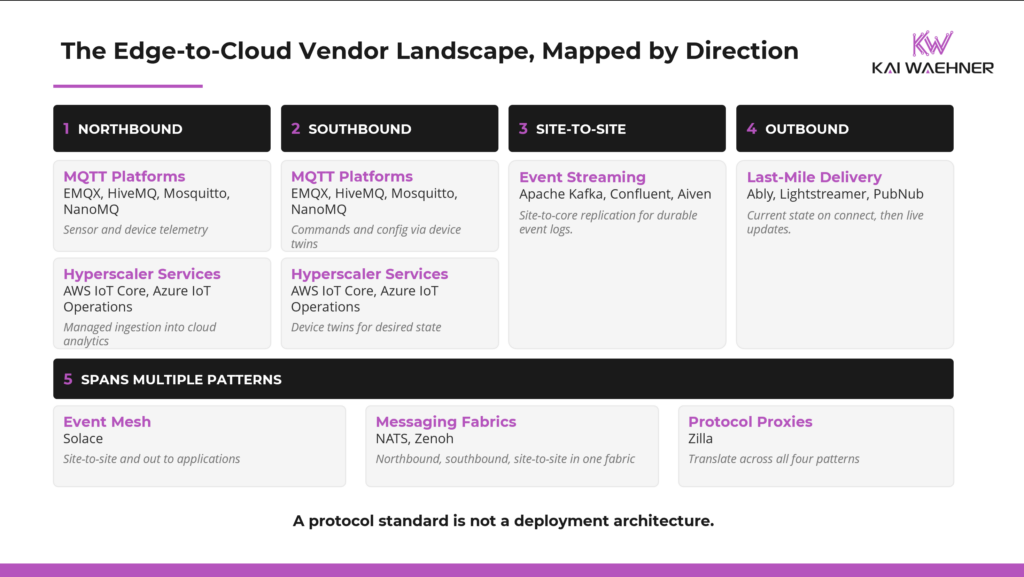
MQTT platforms (EMQX, HiveMQ, Mosquitto, NanoMQ) serve both northbound telemetry and southbound control, because MQTT is bidirectional by design. Hyperscaler services (AWS IoT Core, Azure IoT Operations) do the same for the managed-cloud case, ingesting telemetry and pushing desired state through device twins. Event streaming (Apache Kafka, Confluent, Aiven, and more in the data streaming landscape) owns site-to-site replication. Last-mile delivery (Ably, Lightstreamer, PubNub) owns outbound delivery to people, and it is the only pattern with a category built solely for it.
Three categories span multiple patterns. An event mesh (Solace) routes site-to-site and out to applications. Messaging fabrics (NATS, Zenoh) carry northbound, southbound, and site-to-site in a single fabric. Protocol proxies (Zilla) translate across all four, replacing several specialized components with one layer.
The underlying distinction is worth stating plainly: a protocol standard is not a deployment architecture. MQTT standardizes the wire, which is why so many products speak it and your devices stay portable. NATS and Zenoh standardize the topology, which reduces moving parts and increases commitment. Zenoh, born from DDS research and adopted by automotive initiatives including General Motors’ uProtocol and by the ROS 2 robotics ecosystem, goes furthest: it routes named data along the shortest path between producer and consumer, aiming to make the cloud versus edge placement debate irrelevant.
These spanning options are not equivalent. A fabric like NATS or Zenoh reduces moving parts and unifies security by being one technology end to end, but that reach is also the lock-in: the more it carries, the more expensive it is to leave. A protocol proxy like Zilla does the opposite. It spans the patterns by translating between existing technologies, which keeps your exit options open at the cost of another component in the path. The right choice depends on how many patterns you actually need and how much lock-in you can accept, not on which vendor markets hardest.
How to Choose: Five Questions That Pick Your Edge-to-Cloud Architecture
Product evaluations start too late. Answer five questions first, and the shortlist mostly writes itself.
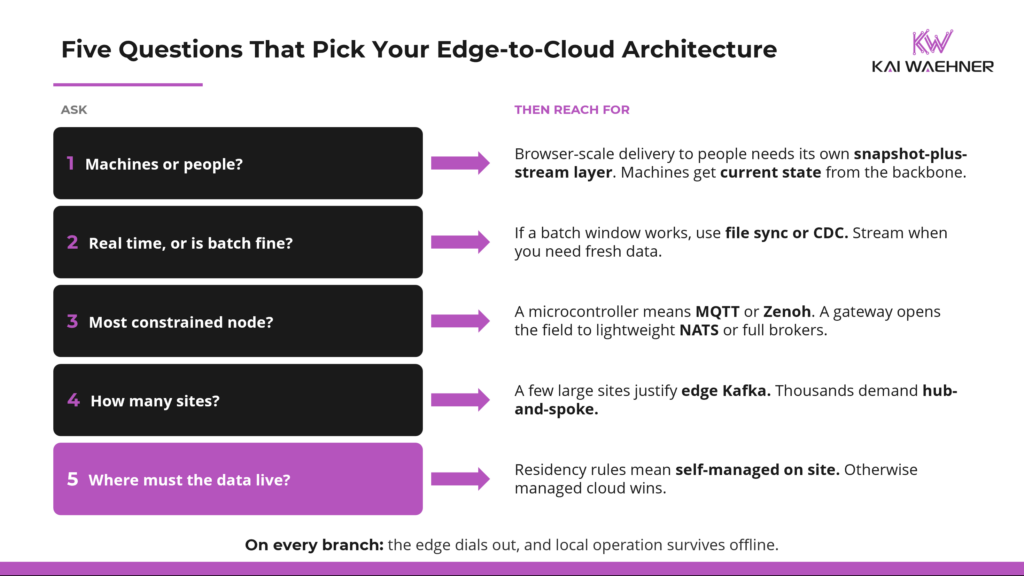
Who consumes the data, machines or people? People need current state on connect, then live updates, which means a last-mile delivery layer over the backbone. Machines just consume the stream.
Does this flow actually need real time? Measure before you architect. If a fifteen minute batch satisfies the business case, use file sync or change data capture. Stream when you need fresh data, because streaming infrastructure you did not need is the most expensive kind.
What is the most constrained node in the path? A microcontroller means MQTT or Zenoh, the two with clients small enough for the device itself, not a JVM. A gateway opens the field to lightweight NATS or full brokers, and a site server adds event meshes or a small streaming cluster.
How many sites, and can each one operate a cluster? A few large sites with local analytics justify edge Kafka clusters with MirrorMaker or cluster linking. Hundreds or thousands of small sites demand hub-and-spoke: NATS leaf nodes or hierarchical MQTT bridges, with store and forward at every spoke. Enterprises whose sites run applications rather than devices fit an event mesh.
Where must the data live? If residency or sovereignty rules apply, the broker runs on site or in jurisdiction, self-managed, and routing policy becomes a compliance control. If data may leave and connectivity is solid, managed cloud services win on operations cost.
Two checks apply on almost every branch, at every step. The edge must dial out and never accept inbound connections to the site. And local operation must survive offline, with a buffer sized deliberately, not discovered in the first outage. Five questions, four patterns, one map. The technologies then sort themselves into it.
Moving Data Is Not Automating the Business
Every pattern and category in this article solves the same problem: moving data between edge, data center, and cloud. That movement is necessary but not sufficient. When telemetry arrives, something must decide what happens next: trigger the maintenance workflow, roll back the failed firmware deployment, replicate the dataset, open the ticket, retrain the model.
Deciding what happens next is workflow orchestration. It spans the same edge to cloud boundary as the data movement beneath it. Data integration moves the events. Orchestration, with the process intelligence to see how those flows actually run, decides what the business does about them. And increasingly, agentic AI acts on those decisions at the edge. These are not three separate topics. They are one stack, and edge to cloud is where they meet the physical world.
Architectures that move data and improvise everything above it end up with the automation logic scattered across broker plugins, cron jobs, and cloud functions. That is the integration spaghetti this whole discipline set out to remove.
Edge to cloud is not one problem. It is four. Architect for the pattern, not the product.