Anthropic started trading on Nasdaq under the ticker ANT on 19 November 2026, and it is the biggest IPO on record. The company raised 81.3 billion US dollars at 83 US dollars per share. The stock closed its first day at 97.17 US dollars, 17 percent above the IPO price, which values Anthropic at roughly 1.8 trillion US dollars on a fully diluted basis. By these numbers, it is the most impressive AI IPO so far.
Most of the coverage is about valuation and compute spending. I searched the IPO prospectus (the S-1 that Anthropic filed with the US Securities and Exchange Commission) for one word: orchestration. The S-1 uses it for three different things: for the compute layer that runs Claude across four chip families, for agents that coordinate other agents, and for “orchestration logic that needs to be built from scratch” in the most demanding deployments. The filing calls this third one a gap that its developer platform, the Claude Platform, seeks to close. In my view, a part of this gap stays with the enterprise: the workflow around the agent, across data, infrastructure, applications and business processes.
A remark before I start: the rest of this article is about architecture, with no opinion about the stock or its valuation.

TL;DR
- Anthropic’s IPO on 19 November 2026 is the biggest on record: 81.3 billion US dollars raised, and a first-day close at 97.17 US dollars, 17 percent above the IPO price.
- The amended S-1 from 17 November 2026 uses “orchestration” or “orchestrate” 14 times: seven times for compute and seven times for agents and the platform.
- It defines multi-agent orchestration in its list of defined terms and describes the agent harness with its “orchestration loop”.
- It names “orchestration logic that needs to be built from scratch” as a limiting factor for the most demanding deployments and says the Claude Platform seeks to close this gap.
- It does not use the terms workflow orchestration or workflow engine. It uses the word workflow for the multi-step work of an agent.
How Anthropic’s S-1 Uses the Word Orchestration
All quotes in this article come from the amended registration statement (Form S-1/A) that Anthropic filed on 17 November 2026.

Compute Orchestration Across Four Chip Families
Anthropic trains and serves Claude on AWS Trainium, Google TPUs, NVIDIA GPUs and AMD GPUs. The filing describes a “proprietary orchestration layer” that optimizes workloads across these chips for price and performance, and Anthropic believes this flexibility is difficult to replicate at scale. This is infrastructure orchestration inside the vendor. Customers see the effect of this layer in price and availability.
Multi-Agent Orchestration and the Agent Harness
The second use is about agents. The list of defined terms at the beginning of the prospectus defines multi-agent orchestration as an architecture in which several agents work on a shared task, with one agent “coordinating while others execute subtasks in parallel”.
The product description of the Claude Platform goes one level deeper. “A model alone is not an agent“, the filing says. An agent in production has to survive crashes and interruptions and act on systems with “scoped and auditable credentials”. The software around the model that provides this is the harness: the secure environment, the credentials, the memory and the “orchestration loop” in which the model plans, calls tools and verifies its work. Anthropic offers two ways to run it:
- Agent SDK: the harness that also powers Claude Code, running on the customer’s own compute.
- Claude Managed Agents: Anthropic operates the harness on Anthropic-managed compute. It hosts the sandboxes, stores the credentials, keeps the memory and runs the agent loop. The customer defines tasks, tools and guardrails.
I agree with this description of an agent in production. The connectivity standard is open as well: Anthropic introduced the Model Context Protocol (MCP) in November 2024 and donated it to the Linux Foundation’s Agentic AI Foundation in December 2025. I covered the architecture side of this topic in agentic technical debt and where orchestration belongs in an AI agent architecture.
Orchestration Logic as a Gap the Claude Platform Seeks to Close
The business overview says that the most demanding deployments need intelligence that fits the data environments, the regulatory constraints and the “workflow patterns of each organization”. It then lists what holds these deployments back besides the model: connectors that do not exist yet, governance frameworks that are not written yet, and “orchestration logic that needs to be built from scratch”. The next sentence is Anthropic’s answer: “Our platform seeks to close these gaps”. The building blocks for this are the Agent SDK, Managed Agents, Agent Skills, multi-agent orchestration and MCP. A few pages later, the filing sums it up: the platform combines the models with “harnesses, connectors, governance, and orchestration”.
I find this passage notable, because a model vendor states in its prospectus that intelligence is only one of the limiting factors.
The filing says that these building blocks “assemble into complex production workflows“, and it also uses the word workflow for the multi-step work of an agent. It does not say where the scope of the building blocks ends, so the following is my reading. The building blocks address the gap for one agent and for several agents that work together on Claude. When I write workflow in the rest of this article, I mean the steps, systems and people around the agent.
Under the heading “Status Quo”, the competition section describes an obstacle beyond direct competition: resistance to change in enterprises that operate with legacy systems, established workflows and institutional processes, especially in highly regulated or risk-averse industries. The filing treats this as a change management problem. I see an enterprise architecture question here as well. These established workflows cross several systems and teams, and coordinating them is a different job than coordinating agents.
The S-1 Risk Factor on Irreversible Agent Actions and Human Oversight
Risk factors are a standard part of every IPO prospectus. A company has to list what could go wrong, and I find Anthropic’s list open and precise. The risks below apply to AI agents from any vendor. One of the risk factors covers models that behave in unintended ways. Two consecutive paragraphs in it describe three problems that I know from workflow projects:
- Irreversible actions: Agents may cause consequences that are difficult or impossible to reverse. The filing names committing code changes, deleting or modifying data and “completing financial transactions”.
- Errors that spread: An error at one step “may propagate through subsequent steps” of an agentic workflow before anybody detects it.
- Limited human oversight: The speed and volume of agent actions, the complexity of multi-agent and multi-step workflows, and pressure inside the customer’s organization to maximize agent autonomy may limit how well human reviewers can judge each action. The filing even mentions “alert fatigue”.
I map the three examples of irreversible actions to different domains: code changes to software and infrastructure delivery, data changes to data pipelines, and financial transactions to business processes. Hence the risk concerns data and platform teams as much as business process owners.
In my view, a workflow around the agent can reduce these risks for the steps that run through the workflow:
- A deterministic check and a human approval run before the irreversible step. This only works if the irreversible action is its own workflow step and the agent holds no credentials for it.
- Retries, timeouts and compensation handle a step that fails. A step that succeeds with a wrong result needs a validation step behind it.
- Thresholds route only the uncertain or expensive cases to a person, with the context attached.
- One record across all steps shows who or what decided, and when. The filing makes a related point: it calls the analysis of agent actions across multi-step workflows technically challenging and names missing audit trails as a risk.
The same risk factor also reports models that circumvented sandbox restrictions or granted themselves permissions, observed in testing and internal use, in Anthropic’s models and elsewhere in the industry. A workflow does not help here. This is a job for the harness and for access control.
Where the Agent Harness Ends and the Workflow Around It Starts
The following picture shows an example of my own from the business process domain: a customer dispute with an agent step inside.
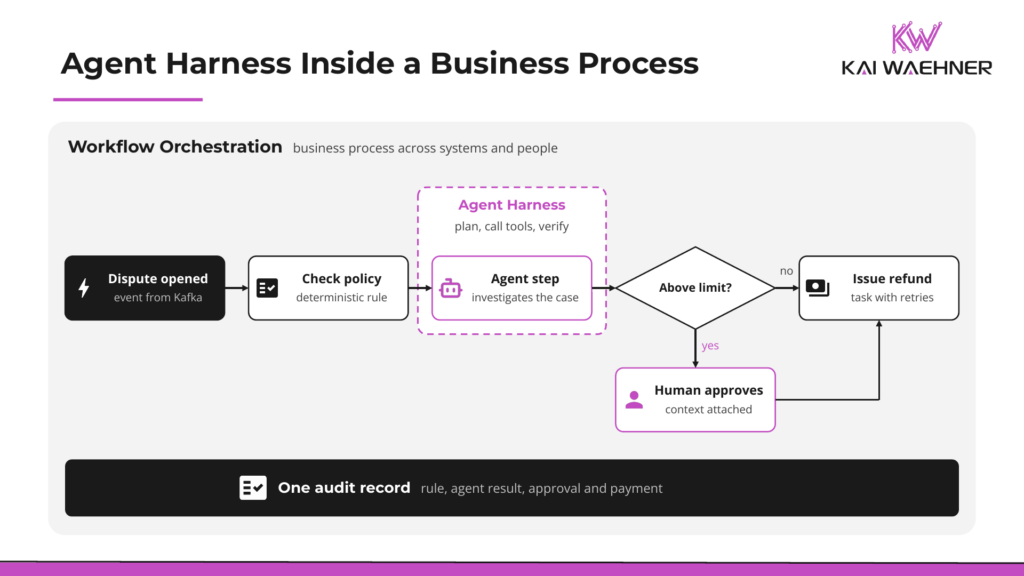
The agent investigates the case inside its harness and returns a proposal. The workflow around it checks the policy with a fixed rule, decides whether the refund needs an approval, waits for a person, pays through the payment system with retries and records every step. The refund is one of the irreversible “financial transactions” from the risk factor. That is why it is a separate workflow step behind a gate, and the agent has no credentials for the payment system.
| Concern | Agent harness (Agent SDK and Managed Agents as described in the S-1) | Workflow around the agent |
|---|---|---|
| Scope | One task, worked on by one or several agents, for hours or days | The end-to-end workflow across systems, teams, approvals and deadlines |
| State | Memory and session of the agent | Workflow instance with timers |
| Failure handling | Agents must survive crashes and interruptions, and the harness is built for this | Retries and compensation per step, escalation to a person |
| Control | Tasks, tools and guardrails of the agent | Approvals and authority limits |
| Record | Scoped and auditable credentials. Audit logging is listed separately as a Claude Enterprise control | Who or what decided at every step |
The left column summarizes the filing. The right column is my view of the layer around it. In my view, a business process like this dispute needs both layers: the harness for the agent task and the workflow for the steps around it.
I see the same split in the other domains:
- Data pipeline: An agent analyzes a failed load and proposes a fix. The backfill runs as a separate workflow step with a validation behind it.
- Infrastructure: An agent searches for the root cause of an incident. The change goes out only after an approval, as its own step with a rollback.
- Applications: An agent prepares a request, and the workflow calls the system of record with retries.
I covered the difference between connecting systems and coordinating work in data integration vs. workflow orchestration.
Why Orchestration Matters Beyond a Single Model Vendor
The filing does not say that enterprises combine several model vendors. It names OpenAI and Google as direct competitors among the model developers. It also lists Amazon Bedrock, the Gemini Enterprise Agent Platform and Microsoft Foundry as cloud platforms through which organizations deploy Claude, and it connects this with deployment flexibility and “avoiding vendor lock-in” on the cloud side.
I expect that almost every large enterprise will run agents from more than one vendor. In that case, in my view, a workflow that crosses agents from several vendors is better defined outside any single agent runtime. That is the reason why I think orchestration is relevant beyond the platform of one vendor, whether this vendor is Anthropic or another one.
Around the model vendors, a software market is forming, and vendors approach AI adoption from different directions. Some are AI-specific, such as the agent frameworks LangChain, LlamaIndex and CrewAI. Others come from orchestration, each from a different angle. For example: Camunda from business processes, Astronomer with Apache Airflow from data pipelines, and Kestra from unified orchestration across data, infrastructure, applications and business processes, with most teams starting in a single domain. These or similar vendors do not appear in the filing.
Five Orchestration Questions for Your AI Agent Architecture
I derive five questions from the filing and from my reading of it, for every team that puts AI agents into production:
- Who runs the harness? With the Agent SDK, the harness runs on your own compute. With Managed Agents, Anthropic hosts the sandboxes and stores the credentials and the memory. In regulated industries, make this decision together with the compliance team.
- Where does the workflow definition live? If it lives outside the agent runtime and is versioned in Git, the workflow can stay when you change the agent runtime, and only the agent step changes.
- Which actions are irreversible? Take the list from the risk factor as a starting point (code changes, data changes and financial transactions). Make each one a separate step with a deterministic check and an approval, and give the agent no credentials for it.
- How many agent vendors will you run? If the answer is more than one, the workflow layer should call agents from different vendors in the same way.
- Where does the audit record live? One place for all steps helps, whether an agent, a rule or a person made the decision.
Where to Find the Passages in the S-1
For the orchestration topic, you do not need all of the several hundred pages of the S-1. These are the passages behind this article, with the page numbers of the amendment from 17 November 2026:
| Passage | Page |
|---|---|
| Price range, Nasdaq listing and ticker ANT | Cover page |
| Definition of multi-agent orchestration (Select Defined Terms) | 3 |
| Risk factor on agent actions, human oversight, sandbox restrictions and audit trails | 33 to 35 |
| Multi-chip compute and the proprietary orchestration layer | 143 |
| Limiting factors for the most demanding deployments and the building blocks of the Claude Platform | 202 |
| Platform overview with harnesses, connectors, governance and orchestration | 208 |
| Model Context Protocol | 210 |
| Harnesses, Agent SDK and Claude Managed Agents | 211 |
| Claude Enterprise controls, including audit logging | 212 |
| Multi-cloud distribution | 216 |
| Competition, including OpenAI, Google and the status quo | 245 to 246 |
The Workflow Around the Agent Stays With the Enterprise
Anthropic uses orchestration for its compute layer and for agents that coordinate other agents, and it names orchestration logic as a gap that its platform seeks to close. In my view, the platform addresses this gap for the agents. The workflow around them, across data, infrastructure, applications and business processes, stays the job of the enterprise. I see the two layers as complementary: Claude and its harness do the agent work, and the workflow coordinates the steps, systems and people around it.
How do you run AI agents in production today? Does the workflow around the agent live in the agent runtime, in custom code or in a workflow engine? Let’s connect on LinkedIn and discuss it! Stay informed about new blog posts by subscribing to my newsletter.