An AI agent that acts for a customer reads the current state, the history and similar products in one request. Where operational and analytical data for AI agents should live is now one of the main database decisions. Two architectures compete for it.
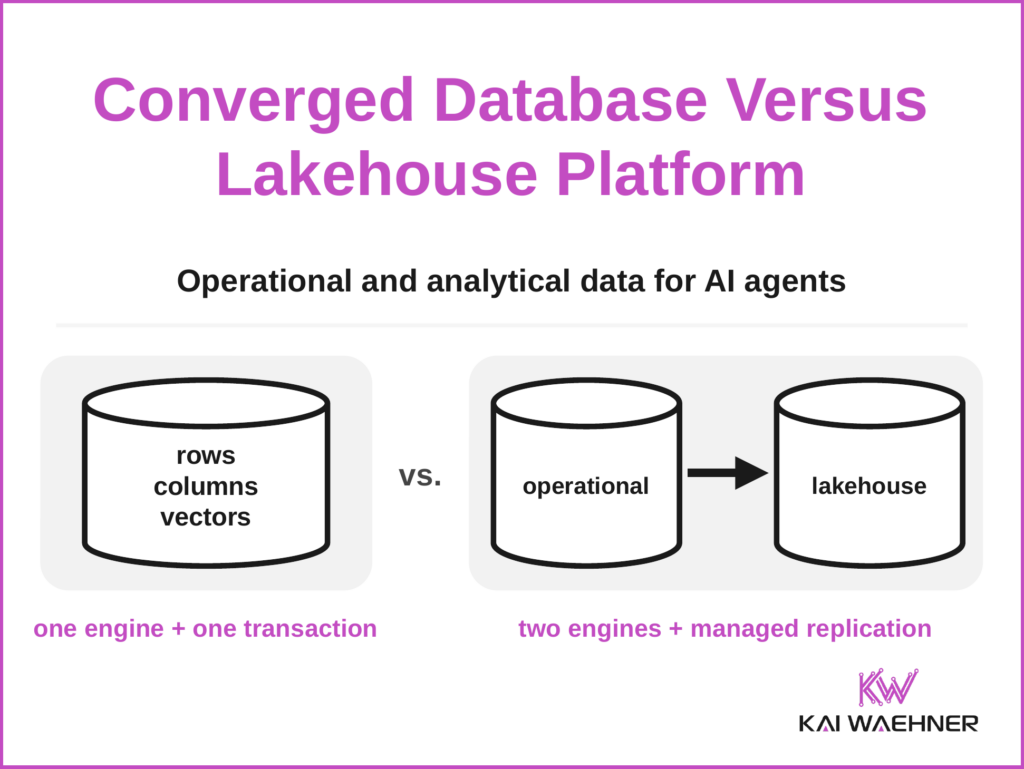
A converged database keeps rows, columns and vectors in one database engine and one transaction. Oracle AI Database 26ai and OceanBase are examples. A lakehouse platform runs a separate operational database next to the lakehouse and copies the data between the two engines through managed replication. Lakebase in Databricks and Snowflake Postgres are examples. The lakehouse vendors bought operational Postgres for this reason, as described in my post on why the lakehouse vendors and the clouds bet on Postgres for AI applications.
Both architectures work. Which one fits depends on how old the data of each read may be. This post covers:
- Why one agent request mixes operational and analytical data
- How a converged database and a lakehouse platform differ
- What managed replication between two engines buys and costs
- A simple test that assigns each read to the right place
Why One AI Agent Request Needs Operational and Analytical Data
A customer asks a retail agent to exchange a jacket for a larger size. The agent needs three kinds of data for this one request:
- Current state. Is the larger size in stock, and is it already reserved for another order?
- History. How often did this customer return items in the past year?
- Retrieval. Which similar products fit if the size is sold out?
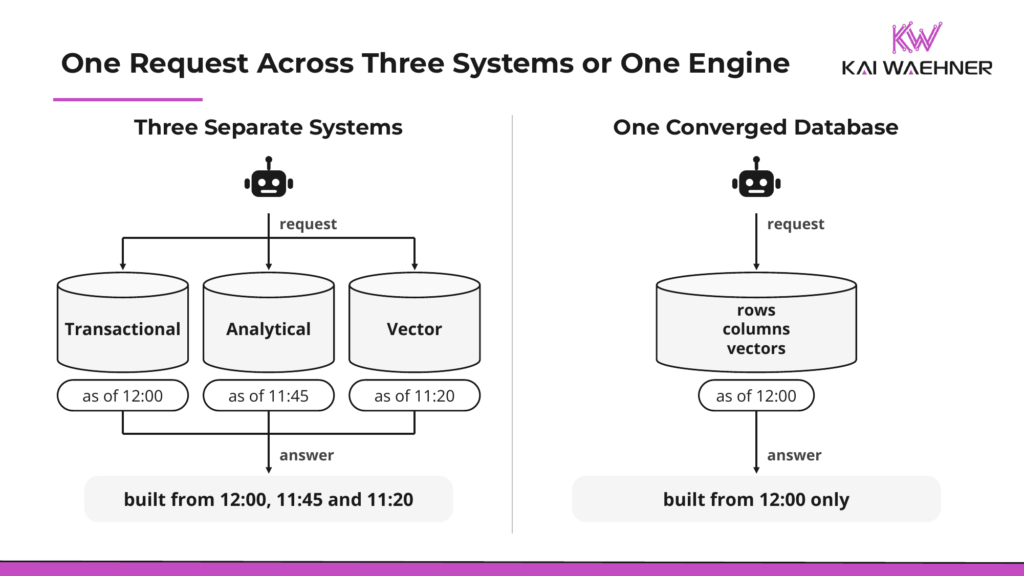
Assume the stock sits in the transactional database, the return history in the lakehouse and the product embeddings in a vector store. Then the agent reads three points in time. Every read succeeds. Only the combination can be wrong, and the agent cannot see it.
The picture below shows the same request against three separate systems and against one converged database.
One Engine in a Converged Database and Two Engines in a Lakehouse Platform
The market answers this problem with two architectures. They give different guarantees, and both are legitimate.
A converged database gives a guarantee at write time. Rows, aggregates and vectors change in the same transaction, so every read sees one point in time. Examples are Oracle AI Database 26ai, OceanBase with its hybrid row and column storage, AlloyDB with its columnar engine, and SQL Server 2025 with its native vector type. SAP HANA Cloud, SingleStore, TiDB and Spanner with its Columnar Engine belong here too. Postgres with the pgvector extension also keeps rows and vectors in one transaction, for a smaller scope without columnar execution.
A lakehouse platform gives a guarantee across a synchronization boundary. The operational database and the lakehouse are two different engines, and each change reaches the second engine later. Every read there therefore spans a lag window. Examples are Lakebase in Databricks, Snowflake Postgres, the SQL database in Microsoft Fabric and Amazon Aurora with zero-ETL into Redshift. Document databases such as MongoDB Atlas and Couchbase Capella follow a similar pattern with separate nodes or services for search, vectors or analytics.
The two architectures come from opposite directions. The lakehouse vendors added an operational database next to their analytics. The established database vendors added columns and vectors inside their transactional engines. Both now promise one platform for state, history and retrieval. My comparison of OceanBase, Databricks and Snowflake shows both directions in more detail, including where each platform fits best and where it does not.
Managed Replication Copies Data Between Two Different Database Engines
Managed replication is a continuous copy of changes from one database engine into a different engine, operated by the vendor as a product feature. A typical path runs from Postgres into the lakehouse. High availability is a separate concept. It copies one database to a standby of the same engine in another zone or region, so that the database survives a failure. Every platform in this post offers high availability as well. However, a standby does not give the agent history or analytics.
The lakehouse vendors and the clouds all offer managed replication between their operational database and their analytics:
- Databricks. Synced tables copy lakehouse tables into Lakebase, in continuous mode with seconds of latency. The opposite direction, the change data feed from Lakebase into Unity Catalog, has been in public preview since May 2026. It writes changes about every 15 seconds.
- Snowflake. Snowflake Postgres mirrors its tables into Snowflake with sub-minute lag. This mirroring has been generally available since October 2026.
- Microsoft. Fabric mirroring replicates operational databases into OneLake and publishes changes as fast as every 15 seconds. At Ignite in November 2026, Microsoft added Fabric HorizonDB, a serverless Postgres inside Fabric, in public preview.
- AWS. Zero-ETL replicates Aurora into Redshift within seconds, without a pipeline that the customer operates.
Databricks goes one step further with its LTAP architecture, where analytical engines query live Lakebase data directly, but this path is still in preview.
The Pipeline Work That Managed Replication Takes Over
Before managed replication, the customer built this path as a pipeline. The vendor now takes over that work:
- The pipeline code is gone. No connector configuration, no transformation job and no schema mapping to maintain.
- The scheduler is gone. Replication runs continuously, and nobody decides between hourly and every five minutes.
- The retries are gone. The vendor handles failures and catch-up.
- Most of the operational risk is gone. Replication is a product feature with a service level.
Many teams already run the lakehouse as the center of their data platform. For them, this is the right way to get an operational database next to it. In addition, an agent on this platform gets state and history under the same governance. Zillow, for example, uses Lakebase as the memory of the agent behind its AI Mode. The data for evaluation lives on the same platform.
What Managed Replication Between Two Engines Buys and Costs
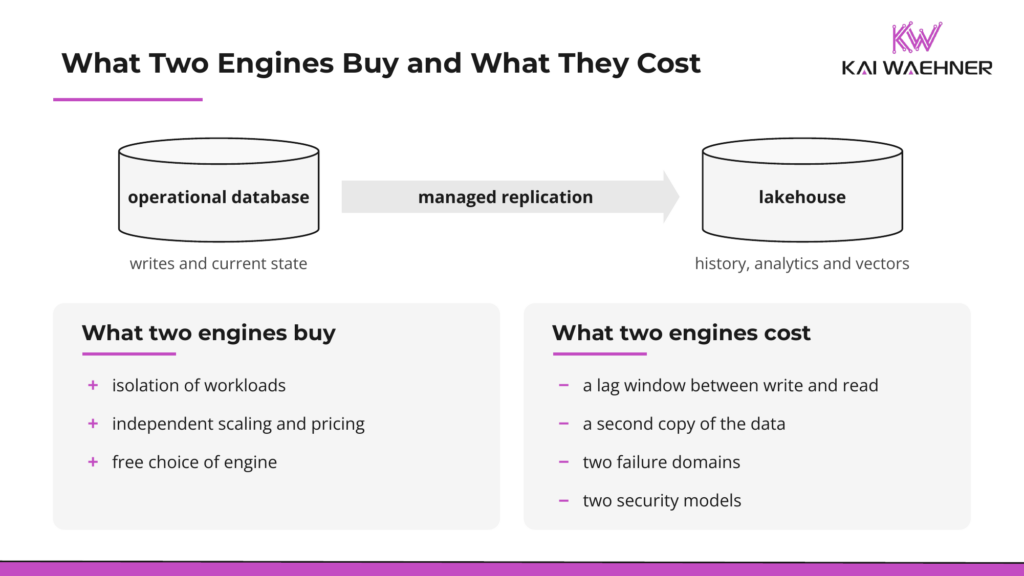
The boundary between the two engines stays, even when the vendor runs the replication. A write lands in one engine, and the read on the other engine happens later. This boundary brings benefits and costs, as the picture below shows.
Isolation, Independent Scaling and Free Choice of Engine
The case for two engines is strong. A converged database offers these three benefits only in part:
- Isolation of workloads. A heavy analytical scan never slows down a transaction, because it runs on a different engine. Inside one engine, isolation needs separate replicas or resource limits.
- Independent scaling and pricing. Each side scales on its own and is paid on its own meter.
- Free choice of engine. The best engine for history is rarely the best engine for the current state. Two engines let a team choose both and keep the exit cost lower.
A converged database trades part of this flexibility for one transaction. This is the right choice for reads that must describe the same moment. For reads that tolerate a lag, the flexibility of two engines often weighs more.
The Lag Window Is the Central Cost for AI Agents
The published numbers range from seconds for zero-ETL and synced tables to under a minute for Snowflake Postgres mirroring. This is current enough for a dashboard and for most history. It is too late for reads that must match a write.
The jacket example shows the problem. The product team marks a product as discontinued in the operational database. The vector index in the lakehouse still contains the product until the change arrives. Hence, the agent can recommend a product that the shop no longer sells. Both reads succeed, and no error message appears.
A Second Copy, Two Failure Domains and Two Security Models
The boundary has three further costs:
- A second copy. The data exists twice, with its own storage, index and backup. Open table formats such as Apache Iceberg reduce this cost because several engines share the files. However, the index, the cache and the security model still exist twice.
- Two failure domains. When replication falls behind, the analytical side goes stale without any application noticing. Most teams find out during an incident.
- Two security models. Each engine has its own access rules, and both must agree on who may see which row. In practice, they drift apart, and the drift shows up in an audit.
How Old the Data of Each Read May Be Decides Where It Lives
Neither architecture is right for every read. Therefore, the decision is made per read. For every read in one agent decision, ask how old the data may be when the agent uses it. The answers fall into three groups. The picture below shows them for the jacket example.
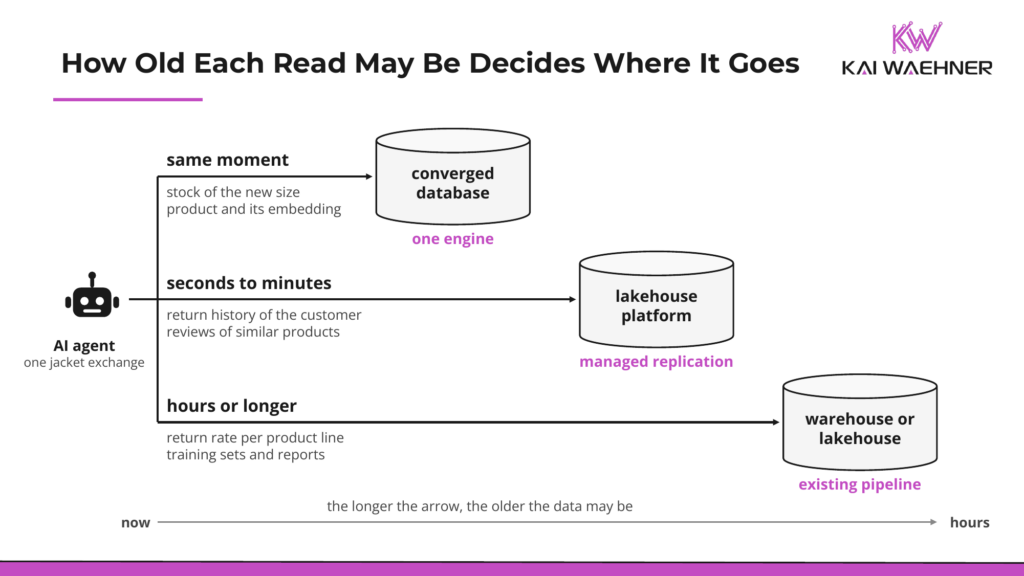
- Reads that must describe the same moment belong in one engine. Examples are the stock of the new size and its reservation, the task state of the agent and a product with its embedding. A converged database fits, and so does Postgres with pgvector for a smaller scope.
- Reads that tolerate seconds to minutes belong on a managed replication path. Examples are the return history of the customer and reviews of similar products. A lakehouse platform fits.
- Reads that tolerate hours belong in the pipeline the team already runs. Examples are return rates per product line, training sets and reports. The existing warehouse or lakehouse fits.
Most enterprises have all three groups. As a result, the architecture combines several products. A vendor of a converged database will offer one transaction for all three groups. A vendor with managed replication will say that the lag window does not matter. Both are right for some reads and wrong for others, and the age of each read shows which.
Apache Kafka and the Shift Left Architecture Connect Data Across Vendors
Managed replication connects the operational database and the lakehouse of one vendor. Many agents need more. They also need events from other databases, SaaS applications or a mainframe. A data streaming platform such as Apache Kafka carries these events across vendors to every system that needs them. My post on Apache Kafka and the database as source of truth for AI agents shows how the database, the Kafka event log and the lakehouse each hold one part of the truth. It also shows where managed replication ends at the vendor boundary.
The Shift Left Architecture moves data validation and processing from the lakehouse to the data streaming layer, close to the source. Operational systems, analytics and AI agents then consume the same validated data products. My post on the Shift Left Architecture 2.0 describes the operational, analytical and AI interfaces of these data products. For the agent, this reduces the drift between the operational copy and the analytical copy, and between their two security models.
Converged Database Versus Lakehouse Platform Is a Decision per Read
Operational and analytical data for AI agents needs a decision per read. A converged database fits the reads that must match a write in the same moment, because rows, columns and vectors share one transaction. A lakehouse platform fits the reads that tolerate seconds to minutes. Its managed replication copies data between two different engines and removes a pipeline the team used to own. This is a different feature from the high availability standby of one database. The existing warehouse or lakehouse keeps the rest. How old the data of each read may be decides.
The market reflects the same split. Managed replication between the operational database and the lakehouse has become a standard feature of the lakehouse vendors and the clouds. Converged databases come from the established database vendors and from distributed SQL databases.
This post is part of a series about databases for AI applications. Earlier posts covered why the lakehouse vendors and the clouds bet on Postgres. They also covered how Apache Kafka and the database share the truth for AI agents.
Which reads of your AI agents must match a write, and which tolerate a lag? Do you use a converged database, a lakehouse platform with managed replication or both? Let’s connect on LinkedIn and discuss it! Stay informed about new blog posts by subscribing to my newsletter. And if you want to go deeper, have a look at my book The Trinity of Modern Data Architecture.