Lessons Learned: Best Practices for a Successful Introduction of Business Process Management (BPM)

The article illustrates some rules how to do BPM correctly. These rules are very important for success of a BPM project. If you do not consider them, your next BPM project may fail too… Please leave feedback, if you have any other opinions or experiences.

I have written an article for “Service Technology Magazine” regarding the following topic: Lessons Learned: Best Practices for a Successful Introduction of Business Process Management (BPM). Here is the link: http://www.servicetechmag.com/I64/0712-3. The article illustrates some rules how to do BPM correctly. These rules are very important for success of a BPM project. If you do not consider them, your next BPM project may fail too…

Here is a short summary for introducing BPM succesfully (for people who are short of time and not reading the whole article):

  • Rule 1: If you want to do BPM correctly, then be aware that your primary goal is to improve Business-IT-Alignment!
  • Rule 2: If you want to do BPM correctly, then do not try to realize it without a service-oriented Architecture!
  • Rule 3: If you want to do BPM correctly, then be aware that BPM is not just tooling, but an engineering process with a huge, iterative lifecycle!
  • Rule 4: If you want to do BPM correctly, then use it only when you really gain benefits!
  • Rule 5: If you want to do BPM correctly, then do NOT believe in BPM myths!
  • Rule 6: If you want to do BPM correctly, then use BPMN 2.0!
  • Rule 7: If you want to do BPM correctly, then choose the right BPM tool for the job!
  • Rule 8: If you want to do BPM correctly, then do NOT use it for systems integration!

Please leave feedback, if you have any other opinions or experiences.


Best regards,

Kai Wähner (Twitter: @KaiWaehner)



Dont‘ miss my next post. Subscribe!

We don’t spam! Read our privacy policy for more info.
If you have issues with the registration, please try a private browser tab / incognito mode. If it doesn't help, write me: kontakt@kai-waehner.de

You May Also Like
Read More

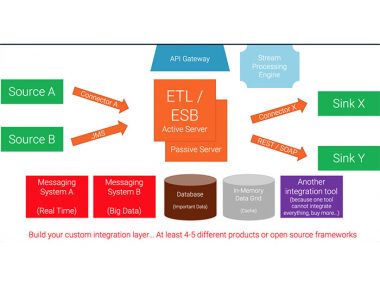
Apache Kafka vs. Middleware (MQ, ETL, ESB) – Slides + Video

This post shares a slide deck and video recording of the differences between an event-driven streaming platform like Apache Kafka and middleware like Message Queues (MQ), Extract-Transform-Load (ETL) and Enterprise Service Bus (ESB).
Read More
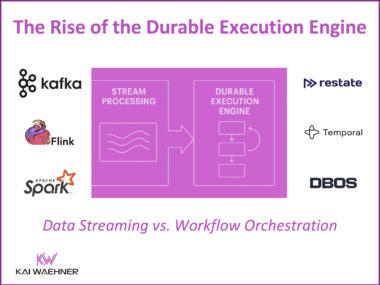
Durable Execution Engine with Restate Temporal DBOS vs Stream Processing with Kafka Streams Apache Flink Spark Structured Streaming
Read More

­­The Rise of the Durable Execution Engine (Temporal, Restate) in an Event-driven Architecture (Apache Kafka)

Durable execution engines like Temporal and Restate are redefining how developers orchestrate long-running, stateful workflows in distributed systems. Unlike traditional BPM tools focused on human-centric tasks, these engines automate machine-to-machine processes with built-in durability, retries, and fault-tolerant coordination. When integrated with event-driven platforms like Apache Kafka, they enable scalable, resilient architectures—handling complex business logic such as order processing, fraud detection, and multi-step transactions. This blog explores their capabilities, differences from stream processing tools like Apache Flink, Kafka Streams or Spark Structured Streaming, and the emerging role they play in modern enterprise infrastructure.
Read More