
Skip to content
kaiWaehner
  • Home
  • Blog
    • Latest Insights
    • Data Integration
    • Process Intelligence
    • Trusted Agentic AI
    • Enterprise Architecture
  • Activities
    • Talks at International Conferences
    • Video Recordings
    • Publications
  • About ME
  • Work with ME
  • Home
  • Blog
    • Latest Insights
    • Data Integration
    • Process Intelligence
    • Trusted Agentic AI
    • Enterprise Architecture
  • Activities
    • Talks at International Conferences
    • Video Recordings
    • Publications
  • About ME
  • Work with ME
Linkedin X-twitter
kaiWaehner
Linkedin X-twitter
  • Home
  • Blog
    • Latest Insights
    • Data Integration
    • Process Intelligence
    • Trusted Agentic AI
    • Enterprise Architecture
  • Activities
    • Talks at International Conferences
    • Video Recordings
    • Publications
  • About ME
  • Work with ME
  • Home
  • Blog
    • Latest Insights
    • Data Integration
    • Process Intelligence
    • Trusted Agentic AI
    • Enterprise Architecture
  • Activities
    • Talks at International Conferences
    • Video Recordings
    • Publications
  • About ME
  • Work with ME
API Management, Cloud, Cloud-Native, Docker, EAI, ESB, Microservices, Middleware, SOA

Hybrid Integration Architecture is the New Default

  • August 5, 2016

The IT world is moving forward fast. The digital transformation changes complete industries and peels away existing business models. Cloud services, mobile devices and the Internet of Things establish wild spaghetti architectures though different departments and lines of business. Several different concepts, technologies and deployment options are used. A single integration backbone is not sufficient anymore in this era of integration. Therefore, a Hybrid Integration Architecture is getting the new default in most enterprises.

Different user roles need to leverage different tools to integrate applications, services and APIs for their specific need. A key for success is that all integration and business services work together across different platforms in a hybrid world with on premise and cloud deployments.

Hybrid Integration Platform

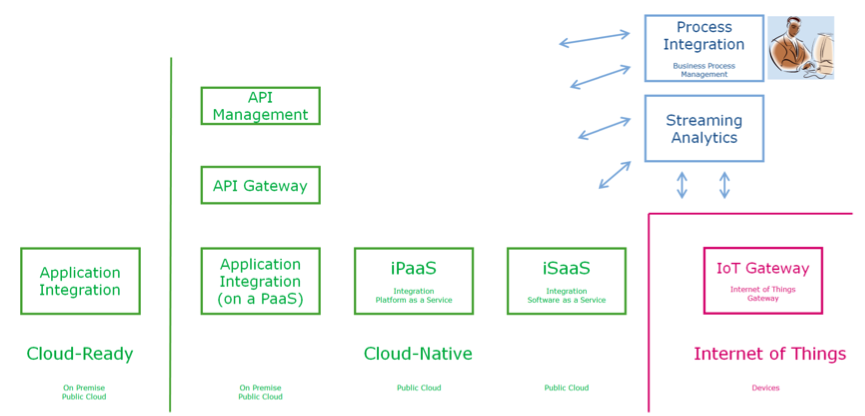
“Hybrid Integration Platform (HIP)” is a term coined by Gartner and other analysts. It describes different components of a modern integration architecture.

One of the keys for success in today’s more and more complex world is that different platforms work together seamlessly. Different components share interfaces and metadata and allow consolidated operations management. API Management is often used as a mediator between interfaces to encourage an agile and innovative enterprise culture – internally; as well as between partners; and for public external communication.

Leveraging a well-conceived hybrid integration architecture allows different stakeholders of an enterprise to react quickly to new requirements. Mission critical core business processes (also called “core services”) are still operated by the central IT department and change rather infrequently. On the other side, the line of business needs to try out new business processes quickly, or adapt existing ones, in an agile way without being delayed by frustrating rules and processes governed by the central IT. Innovation by a “fail-fast” strategy and creating so called “edge services” is getting more and more important to enhance or disrupt existing business models.

The following picture shows possible components of a Hybrid Integration Platform:
2016_Hybrid_Integration_Architecture

If you want to learn more about all these components and how they relate to cloud-native concepts like microservices and containers, please take a look at the Voxxed article “The Need for a Hybrid Integration Architecture“.

 

Don't miss my next post. Subscribe!

We don’t spam! Read more in our privacy policy

Check your inbox or spam folder to confirm your subscription.

Share this post :
Picture of Kai Waehner
Kai Waehner
bridging the gap between technical innovation and business value for data integration, workflow orchestration, and agentic AI.
Tag Cloud
AI Analytics Apache Apache Camel apache kafka AWS Azure Big Data Cloud Cloud-Native Confluent Data Streaming Deep Learning EAI Edge Enterprise Application Integration ESB ETL event streaming flink Hadoop Hybrid IBM IIoT Integration IoT J2EE Java JEE kafka Kafka Connect kafka streams KSQL machine learning microservices middleware MQTT open source Oracle Real Time SaaS Spark Streaming Analytics Stream Processing TIBCO
kaiWaehner
Data Integration
Process Intelligence
Trusted Agentic AI
Enterprise Architecture
Linkedin-in X-twitter
Latest Posts

Data Integration vs Workflow Orchestration: Connecting Systems Is Not Coordinating the Work

27. July 2026
Read More »

Process Intelligence Landscape 2026: Mining, Orchestration, and the Agentic AI Shift

22. July 2026
Read More »

When to Use AMQP, JMS, Kafka, or MQTT: Trade-offs, Not a Winner

17. July 2026
Read More »

Kafka vs Flink vs Spark: Do You Really Need Real-Time?

14. July 2026
Read More »

Don’t miss my next post. Subscribe!

We don’t spam! Read more in our privacy policy

Check your inbox or spam folder to confirm your subscription.

© 2026 - KAI WAEHNER
  • Imprint
  • Privacy Policy